

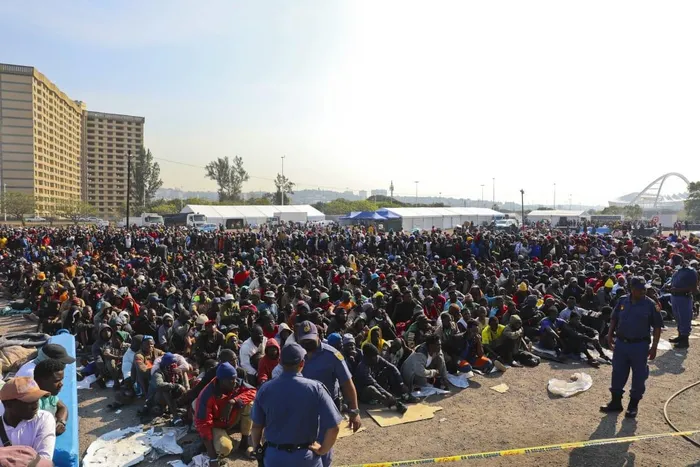
Cops screened foreign nationals gathered in Durban, as many prepare to leave South Africa amid growing fear and uncertainty ahead of the June 30 anti-immigration protests.
Image: Doctor Ngcobo / ANA Studio
More than 8,200 foreign nationals have been processed for repatriation through the Beitbridge Port of Entry in less than two weeks, as South Africa faces heightened tensions and growing fears of xenophobic violence ahead of the June 30 anti-immigration protests.
The Border Management Authority (BMA) said between June 12 and June 24, it processed 6,709 Malawian nationals for repatriation, transported in 112 buses, and 1,521 Zimbabwean nationals transported in 26 buses.
This brought the total number of repatriated foreign nationals processed at Beitbridge during the period to 8,230.
BMA Commissioner Dr Michael Masiapato said the authority was continuing to facilitate the "lawful and orderly repatriation" of foreign nationals through the port of entry.
"All foreign nationals arriving for repatriation are processed in the presence of officials from their respective embassies to verify identity, travel documentation, and compliance with applicable immigration requirements," the BMA said.
The BMA reported that pressure at the port increased on Thursday, June 25, when 17 buses transporting foreign nationals arrived without the required Emergency Travel Certificates.
The buses could not be processed and were redirected to the Musina truck stop area "to decongest the Beitbridge Port of Entry" until the necessary documentation was obtained and verified.
The authority also raised concerns that a significant number of buses transporting repatriated foreign nationals were registered in South Africa but did not have the required cross-border permits.
"In line with the law, buses without valid cross-border permits are not allowed to cross the border. Furthermore, some drivers attempting to transport foreign nationals across the border were found not to be in possession of any passports, which is mandatory for cross-border travel," the BMA said.
The authority urged transport operators involved in repatriation activities to ensure that buses are roadworthy, drivers possess valid passports, and all cross-border permits are secured before arriving at the port.
Masiapato said the BMA remained committed to working with the Department of Home Affairs, the Department of International Relations and Cooperation, foreign embassies, law enforcement agencies, border entities, and transport operators to ensure that repatriations were conducted in a lawful, safe, dignified, and orderly manner.
The movement of thousands of foreign nationals out of the country comes amid rising anti-migrant sentiment and a wave of protests linked to the March and March movement and other anti-illegal immigration groups.
The groups have been mobilising around June 30, a date they have described as a deadline for undocumented foreign nationals to leave South Africa. The government has not issued such a deadline, and authorities have repeatedly warned that immigration enforcement remains the responsibility of the state, not private citizens or vigilante groups.
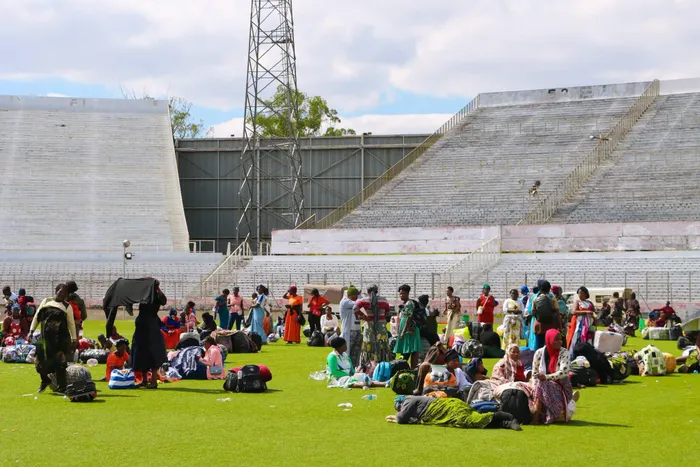
Repatriated Malawian nationals wait in Durban before their journey home, amid heightened tensions over planned June 30 anti-immigration protests in South Africa.
Image: Facebook
In recent weeks, thousands of foreign nationals, particularly Malawians, have gathered at temporary shelters and transit sites in KwaZulu-Natal while seeking assistance to return home. Migrant communities and civil society organisations have raised concerns that the climate of fear has affected both documented and undocumented foreign nationals.
March and March has maintained that its campaign is aimed at undocumented migration, but its planned actions have heightened security concerns across the country.
The movement and its supporters have circulated plans for various protests ahead of June 30, including further action this weekend in areas such as Parklands in Cape Town.
This follows recent anti-immigration protests in parts of Cape Town, including Sea Point and the Wynberg to Claremont area.
In Gauteng, anti-immigration mobilisation has also taken place in Ekurhuleni, including Benoni, Actonville, Wattville, Springs, and KwaThema, where residents and organisers have marched under calls for undocumented foreign nationals to leave the country.
The planned June 30 demonstrations have also caused tension in KwaZulu-Natal. According to media reports, March and March founder Jacinta Ngobese-Zuma said the eThekwini Municipality had refused permission for the movement to protest on June 30, citing security concerns.
According to media reports, eThekwini Metro Police head Colonel Boysie Zungu said the city was not banning the organisation from protesting entirely, but was saying it could not march on June 30 because of a national security threat.
"There is a clear national security threat on June 30, so we are saying to them they can march, just not on that day. We are not denying them the right to protest," Zungu reportedly said.
The refusal has been criticised by the movement, which has argued that the right to protest is constitutionally protected and that it had complied with the processes required under the Regulation of Gatherings Act.
Police have said they are preparing for the planned demonstrations across the country. Acting National Police Commissioner Lieutenant-General Puleng Dimpane said extensive planning had taken place at national, provincial, and local levels, while law enforcement agencies have warned that violence, intimidation, and unlawful conduct would not be tolerated.