

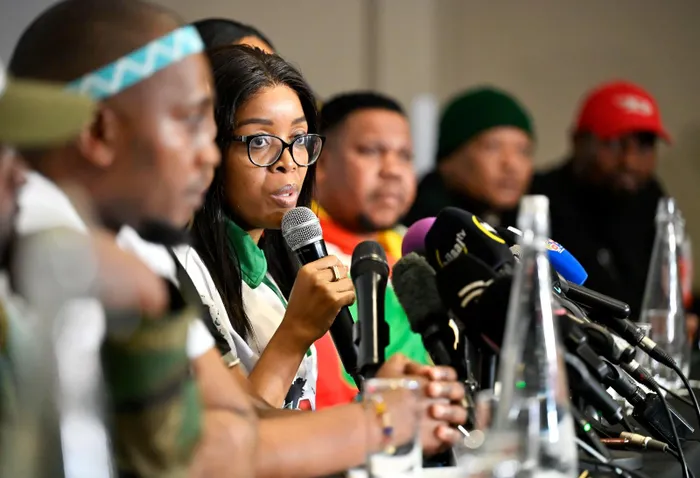
Jacinta Ngobese-Zuma, leader of the March and March movement, reiterated the need for illegal immigrants to leave South Africa by June 30.
Image: Itumeleng English/Independent Media
Jacinta Ngobese-Zuma, leader of the March and March movement, reiterated the need for illegal immigrants to leave South Africa by June 30.
Speaking at a media briefing on Wednesday, Ngobese-Zuma said they had the support of many South Africans.
"South Africans said they wanted to see the country taking shape and for illegal immigrants to self-deport."
Tensions over immigration have escalated in parts of the Western Cape, KwaZulu-Natal, and Gauteng, with protests in some areas directed at undocumented migrants. Some foreign nationals have begun leaving the country amid the unrest.
The anti-migrant group has called for undocumented migrants to leave South Africa by June 30.
It is also demanding stricter visa controls, a review of asylum policies, tougher action against employers of undocumented workers, accountability for corrupt police officials, and restrictions on access to public services for undocumented migrants.
On Monday, acting police minister Professor Firoz Cachalia announced that R600 million, typically allocated to police stations and community policing, would be redirected to security operations for the planned shutdown.
He made the announcement during a press briefing, a week before the deadline set by March and March.
Cachalia said police were prepared to respond to any disorder.
“Peacefully and within the confines of the law, however, criminality, intimidation, incitement to violence, the destruction of property, and any attempt to undermine public safety will not be tolerated,” he said.
“The rule of law will prevail. Police remain the lead law enforcement agency responsible for maintaining public order.”
He added that the mobilisation would come at significant cost.
“I can tell you it is going to cost the police over R600m. That is what it costs when there are efforts to destabilise the country,” he said. “Money that would otherwise have been deployed to improve safety in communities and police stations now has to be spent on ensuring we have the resources to deal with this protest action.”
Cachalia said the South African Police Service (SAPS) had strengthened operational readiness nationwide and would act against any attempts to incite violence or damage property. He said the South African National Defence Force (SANDF) could be deployed if required.
“We do scenario planning and then deploy optimally, not on the basis of existing threats,” he said. “The responsibility of police is to secure the country’s infrastructure and the safety and security of its people.”
Meanwhile, a political dispute has intensified between government officials and organisers of the planned demonstrations, with protest leaders accusing authorities of ignoring concerns about illegal immigration.
March and March leader Jacinta Ngobese-Zuma criticised government responses, saying officials were failing to address what she described as weaknesses in immigration enforcement and corruption.
“I think our government has a serious communication problem,” she said.
“The one thing I am not understanding is why the government of South Africa is not addressing the real issue, which is illegal immigration and foreign nationals who are buying documents and corruptly getting onto the system.”
She said frustrations among South Africans stemmed from a failure to enforce existing laws.
Ngobese-Zuma also said concerns about immigration should not be dismissed as xenophobia or ethnic mobilisation, arguing that authorities were ignoring legitimate grievances.
President Cyril Ramaphosa has repeatedly rejected the June 30 shutdown.
He urged South Africans not to take action against foreign nationals and warned that police would act against anyone inciting violence or disorder.