

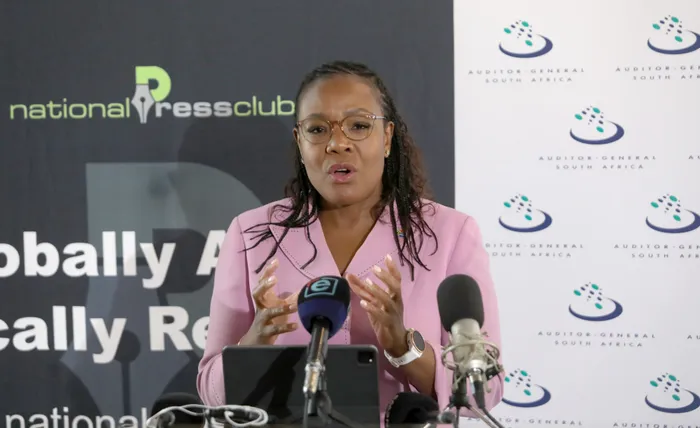
Auditor-General Tsakani Maluleke raised alarm over the state of finances of the country's eight metropolitan municipalities, when she presented her 2024/25 consolidated report on local government audit outcomes before the National Assembly’s Portfolio on Cooperative Governance and Traditional Affairs.
Image: Oupa Mokoena / Independent Newspapers
Auditor-General Tsakani Maluleke has raised serious concerns about the state and financial health of the country’s eight biggest municipalities, as she released the 2024/25 consolidated general report on local government audit outcomes.
On Wednesday, Maluleke painted a bleak picture of the financial health of the eight metropolitan municipalities before the National Assembly’s Portfolio on Cooperative Governance and Traditional Affairs.
She said the metros warranted particular attention because together they look after almost 54% of the expenditure budget in local government, 40% of the population and households, and are responsible for significant service delivery.
“On the whole, metros are regressing not just on audit outcomes, but importantly, on financial health, but also on service delivery,” Maluleke disclosed.
According to the Auditor-General, metros are also expected to deliver on the country’s aspirations of driving inclusive and sustainable economic growth and are an “essential part of how we hope to stimulate the economy (and) expand the infrastructure that is available to us”.
“Unfortunately, of all the categories of municipalities, metros are going backwards,” she said.
Maluleke explained that local municipalities have improved on a net basis, intermediate cities have also improved, district municipalities have improved on a net basis, but metros are going backwards.
She said the City of Cape Town has regressed when it used to have a clean audit.
The City of Cape Town, Maluleke added, regressed on supply chain management or procurement issues that led to non-compliance, which then landed the municipality in the unqualified audit space with findings.
She said the municipality did submit quality financial statements and a quality performance report, but what it needs to do now is to sort out the control matters that let it down on procurement.
The Auditor-General said the eThekwini Metro was also in the unqualified audit with findings category for over a decade now, as it did not struggle with compiling financial statements.
However, she said the basic functions across different directorates in terms of how they collaborate with each other is still a problem.
“There is fragmentation as they seek to deliver services, ongoing non-compliance with the law around procurement in particular leading to leakages. Ill-attention to ensuring that when funds are available to drive infrastructure projects that they are spent properly. Unfortunately, too often they are not being spent properly, leading to delays in infrastructure and also poor quality work that’s delivered by contractors,” Maluleke stated.
She said little attention was paid to performance planning, monitoring, reporting, and accountability for performance.
“What this unqualified audit opinion for a decade has done, it has unfortunately delayed progress in fixing the basics that should make for how a metro functions in delivering on its objectives.”
In the City of Johannesburg, she said the municipality operated on a number of big entities – City Power, Pikitup, Joburg Water, and Metrobus – which hold significant parts of the budget and service delivery mandate, and most of them have unqualified audit opinions with findings.
“They have had that level of outcome for many years, some of them for more than a decade, meaning that they can put the financial statements together for the audit process, but their financial governance is weak, procurement issues continue to be plagued by non-compliance and leakages, performance management remains quite weak,” Maluleke said.
She further stated that the city, outside the entities, received a qualified audit opinion this year after it had been unqualified for many years, and this time around, it was unable to correct the errors the Auditor-General SA identified through the audit and jump to an unqualified audit opinion.
“They have been relying on the audit process for many years, and this time, they couldn’t do it. What you have is a city at its core that is unable to present credible financial statements, and then they do benefit somewhat from the credible financial statement from the entities, and when you look at it together, you have an unqualified audit opinion,” explained Maluleke.
She warned: “The City of Joburg needs ongoing attention on oversight, as well as on the executive. The institutional arrangements within Joburg must be attended to; if we don’t do that, we are going to continue on this slide where financial health deteriorates, which is what we are seeing, where service delivery continues to be compromised, which is what we are living with.
“We are going to continue on the path where investors that look at the City of Joburg don’t look at it in the way they might have years ago, in that the interest of putting capital within the balance sheet of the City of Joburg or even capital within the City of Joburg as individual investors, that interest will continue to diminish.”
She said Gauteng’s three metros – Johannesburg, Ekurhuleni, and Tshwane – have regressed on audit outcomes over the course of the 2021-2026 local government term.
Maluleke added that the notable regression was Ekurhuleni, which regressed to a qualified audit opinion over the course of the current term.
Ekurhuleni regressed this year on financial statements credibility, according to the Auditor-General.
The City of Tshwane has been in the category of qualified audit opinions for a number of years alongside Mangaung, the Buffalo City Metro, and the Nelson Mandela Bay.
Maluleke also expressed the importance of closing what has been an undesirable accountability and oversight gap among municipalities, especially metros, and in particular, metros such as Mangaung.