

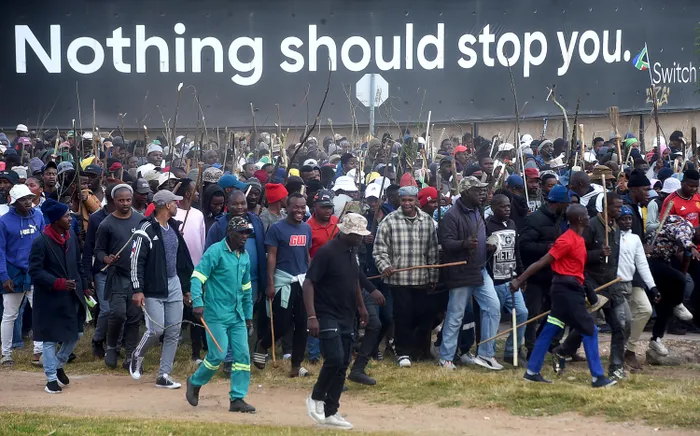
Scores of Tembisa residents joined the protest led by local activist Xolani Khumalo, in collaboration with the Tembisa Community Forum.
Image: Itumeleng English / Independent Newspapers
As calls for illegal immigrants to leave South Africa remain defiant ahead of the June 30 deadline on Wednesday, residents from Tembisa gathered to voice their concerns over what they believe are the rising levels of crime and the negative impact of illegal immigration on their community.
The march, spearheaded by activist Xolani Khumalo and the Tembisa Community Forum, began at Birch Acres Mall and concluded at the Tembisa police station.
The crowd was joined by local and visiting civic organisation leaders such as Nkosikhona "Phakelumthakathi" Ndabandaba, Ngizwe Mchunu, and Zandile Dabula, who rallied around a single message: that the country's challenges with crime and other social issues are linked to the alleged presence of undocumented immigrants.
"I think the issue of illegal immigration has gone on for a long time. It is time that we, as South Africans, gather together and ensure that those who are illegally here leave us to resolve our own issues. Once they leave, they can come back as visitors," said Sibongile Njilo, a resident who joined the marchers towards the Tembisa police station.
Musa Mbewe, a leader of the United South Africans, expressed concerns about the repercussions of illegal migration on the township’s youth and the working-age population.
"We are one-dimensional, we are speaking in one word - they must go home. This is not even personal. I don’t understand why we are supposed to be explaining ourselves so much, but this is also a sign and a gesture that we are doing this peacefully. This is merely a request to say these are the challenges that South Africans are dealing with daily."

Tembisa residents have joined the call for illegal immigrants to leave South Africa ahead of the June 30 deadline imposed by March and March and other civic organisations.
Image: Itumeleng English / Independent Newspapers
Mbewe emphasised the dire consequences of unchecked illegal immigration, stating: "We are not prepared to witness more graves of our children being dug because of the number of people illegally residing in our country."
Amid the sea of voices, Boitumelo Legodi, representing the Community Defence Unit (CDU), which leads crime-fighting and anti-drug initiatives in Ekurhuleni, echoed concerns regarding unemployment and crime.
She said: "Foreigners have become too many and are now dominating spaza shops and other opportunities that should be reserved for our children, who are unemployed and are now susceptible to drug abuse."
Outside the police station, Khumalo and his team delivered a memorandum outlining the community's grievances, demanding that police efforts be intensified to combat crime, with allegations surfacing that authorities may have been complicit in the crime wave linked to undocumented immigrants.
"We are here because of the problems we have as members of this community. We are saying that all undocumented migrants who are here illegally should vacate the country so that we can begin to resolve our problems," Khumalo firmly stated.
Brigadier Cyril Nkuna acknowledged the community's concerns, asserting the need for collaboration between police and residents to effectively tackle crime. "As the police, we call on the community to help, as we cannot end crime on our own," Nkuna said.
He pledged to increase and double efforts in the fight against crime, while appealing for public partnership in the pursuit of safety and security.
Meanwhile, at a media briefing aimed at addressing urgent national concerns, Gerald Twala, the labour convenor at the National Economic Development and Labour Council (Nedlac), articulated a counter-narrative to the prevalent belief that the nation’s high unemployment rates and crime issues can be attributed primarily to the influx of illegal immigrants.
"These are real and legitimate grievances. However, South Africa’s economic crisis was not created by migrants. It is rooted in economic stagnation, deindustrialisation, mass unemployment, corruption, austerity, weak governance, and the failure to build an economy that serves the majority."
Echoing Twala's sentiments, the SAFTU General Secretary, Zwelinzima Vavi, condemned the wave of vigilantism and xenophobic attacks directed towards non-South Africans, stating: "Removing foreign nationals from workplaces, communities, or public spaces will not reopen factories, repair municipalities, strengthen public healthcare, or create sustainable jobs."