

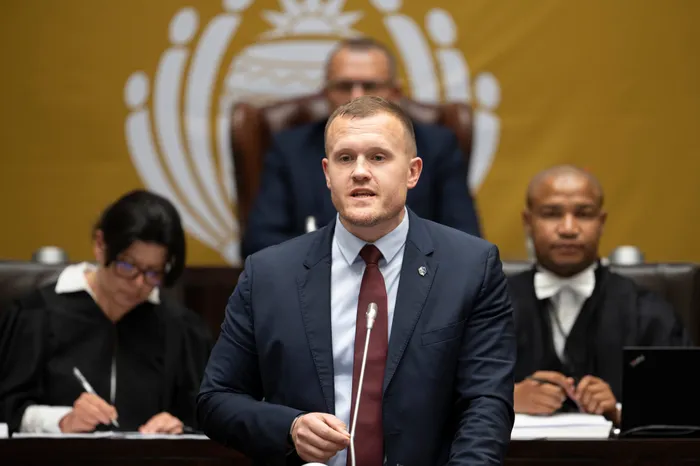
Portfolio Committee on Police Chairperson Ian Cameron says the Hawks have become extremely ineffective and that at times he doubts they should even continue to exist.
Image: Armand Hough / Independent Newspapers
The Directorate for Priority Crime Investigation (DPCI), according to Portfolio Committee on Police Chairperson Ian Cameron, has become extremely ineffective and its capacity to fight crime is below its call of duty.
Cameron believed that the elite unit, better known as the Hawks, was operating at about 45% capacity and had been “hollowed out completely” over the years.
“Honestly, in some cases, I am starting to doubt whether they should even exist because I don’t think they are fulfilling their mandate at all,” said Cameron.
However, he said some Hawks members were trying hard to do their work.
Hawks National spokesperson Colonel Katlego Mogale has not yet responded to questions sent to her.
Three of KwaZulu-Natal-based Hawks members, including their boss Major-General Lesetja Senona, were recently suspended after they were linked in the Madlanga Commission of Inquiry into the theft of 541kg of cocaine worth around R200 million from their storage in Port Shepstone in November 2021.
During the Madlanga inquiry, Senona was also linked to suspected crime kingpin Vusimuzi “Cat” Matlala, including allegedly using professional powers to assist Matlala’s Medicare24 in securing a R360 million SAPS healthcare contract.
Former Hawks national boss Major-General Richard Shibiri was fired this week after the entity found him internally guilty of bringing law enforcement into disrepute by associating himself with “a known criminal”.
The retired Constitutional Court Judge Mbuyiseli Madlanga-led commission, which is investigating allegations of criminality, political interference, and corruption within South Africa's criminal justice system, also heard from another Hawks officer, Colonel Gavin Jacob, who admitted to mishandling information on the drugs stolen from Port Shepstone.
Cameron, whose committee is responsible for holding police accountable, said the Hawks, in terms of leadership, “is extremely broken if not completely so”.
“It is the same across the board, as here and there you might have single successes, but if you ask them how many major cartel leaders, syndicates, and organisations they have identified and brought to book over the past five years, the number will be extremely low if at all.
“In most cases, they cannot even answer that,” said Cameron.
He said to bring the elite back into action, an integrity audit needs to be conducted on its members.
He said it is a problem that the Hawks still have Major General Patrick Mbotho in its senior management structure.
“He was sacked from the SAPS for sending porn to members of the Family Violent Child Protection and Sexual Offences Unit around 2019 and later moved to DPCI.
“Previous Hawks head, General Godfrey Lebeya, defended the appointment and promotion, saying that they are not a punitive organisation while someone like that is not beyond reproach and there is no chance that they can justify making those types of promotions.
“But unfortunately, that has become the norm in the DPCI,” he said.
Cameron is now pinning hopes on the Madlanga Commission to help turn around the Hawks.
“It is already good that we are now seeing consequences from the Madlanga Commission and even from the portfolio committee’s point of view, we are seeing things starting to happen,” he said.
Political analyst Justice Malala recently described Senona as a person who should be in jail.
“Senona took the whole folder with the names of his colleagues, along with their phone numbers, ID numbers, and their addresses and gave it to Cat Matlala, saying, 'These are the people who are investigating you.'
“A lot of bad stuff is coming out of the Madlanga Commission,” said Malala.
Professor Johan Burger, an independent crime and policing consultant, said the rot in the Hawks could be linked to the “state capture” period.
He said the unit was created to be independent and free from political interference like its predecessor, the Directorate of Special Operations (Scorpions), which reported directly to the Department of Justice.
“When the Hawks were placed within the SAPS, there were already doubts at that stage whether they would be as independent as the Scorpions.
“There were some court cases, including a Constitutional Court judgment, which forced the government to create some changes to the legislation that created the Hawks to make them more independent, for an example, the head of the Hawks does not report to the national commissioner like all the other police units, the Hawks head reports directly to the police minister,” he said.
Burger said the Concourt judgment in March 2021 and legislation amendment brought hope that the Hawks would be relatively independent.
“Now we know General Berning Ntlemeza was removed as the Hawks head because of corruption and political subservience accusations during the state capture era, and, in fact, he was associated with the state capture period.
“He was replaced by General Lebeya, whom we all accepted as much more competent in the first phase, as he is well qualified in terms of the law, with a doctorate and being an admitted advocate.
“But still, Lebeya expressed concerns during his term that there were several people appointed by Ntlemeza still left behind, and he found it extremely difficult to work with,” said Burger.
He said in 2012, it was recommended that the Hawks should have its own competent national commissioner and deputy national commissioner, but he said the recommendations were never implemented.
“The rot that was set in motion during the state capture period has taken a while, root, escalated and grown, and changing this will take time, and it is not something that you can clinically switch on and off.
“The process has started in Minister Firoz Cachalia’s office, as he has appointed the advisory panel and pulled in Mr Edward Kieswetter from SARS (South African Revenue Service) to lead that process, and he (Kieswetter) has a good reputation for turning organisations around,” said Burger.