

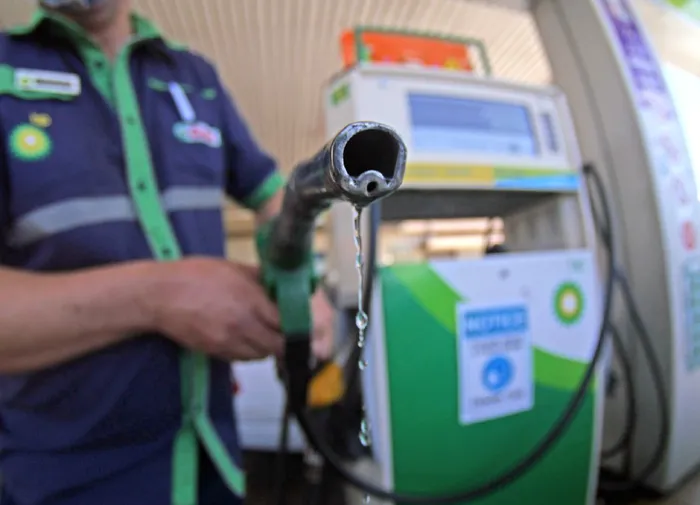
Stakeholders express mixed reactions to the government’s announcement of a R3-per-litre fuel levy reduction.
Image: File
To cushion consumers from a crippling fuel price increase, Finance Minister Enoch Godongwana and Mineral Resources and Energy Minister Gwede Mantashe on Tuesday announced a temporary R3-per-litre reduction in the General Fuel Levy (GFL).
The intervention (from Wednesday, April 1 to May 5, 2026) will see the GFL for petrol drop from R4.10 to R1.10 per litre and for diesel from R3.93 to R0.93 per litre.
This temporary relief has been met with a mix of welcome and caution from key stakeholders across the political spectrum, civil society, and the transport sector, with many questioning the sustainability of the measure and urging for longer-term solutions.
DA spokesperson on Finance, Dr Mark Burke, said the party had proposed a R3.17 reduction with a funded plan, and Minister Godongwana came close.
“The DA looks forward to more details as to how this fuel levy relief will be funded. We cannot afford to take on more national debt. Nor can taxpayers be expected to fund this relief through some other form of taxation. The only viable route to funding this relief is to make spending more efficient,” Burke said.
EFF national spokesperson Sinawo Thambo said that the intervention resulted from sustained public pressure and the fact that rising fuel prices are exacerbating poverty for the working class.
Thambo described the temporary relief as merely a postponement of the burden that will once again be imposed on the people. “There should be a permanent removal of the fuel levy.”
Freedom Front Plus chief spokesperson on mineral and petroleum resources, Dr Wynand Boshoff, said the intervention offers motorists some relief, but the lost tax revenue will eventually have to be recovered.
“The current crisis underscores South Africa’s dependence on imported fuels. Such volatile times serve to crystallise the strategic importance of Sasol, as well as ensuring a sustainable electricity supply to facilitate electric transport,” Boshoff said.
AfriForum public relations head Ernst van Zyl said: “The next thing we would like to see is that the government provides the necessary transparency about the status of the country’s strategic fuel reserves.”
He said AfriForum found that about one-third of the price at the pump goes to taxes and levies, and the organisation believes there should be a conversation regarding permanently lowering this excessive tax burden.
The Organisation Undoing Tax Abuse (OUTA) Chief Executive Officer, Wayne Duvenage, said: “Government cannot keep reacting at the last minute while households and businesses carry the uncertainty.”
He said South Africa needs more transparency on its strategic oil reserves, adding that “South Africans deserve to know what safeguards are in place and when they will be used to protect the economy.”
South African National Taxi Council (Santaco) national spokesperson Mmatshikhidi Rebecca Phala said the overall increase in fuel prices continues to place significant pressure on the taxi industry and its daily operations.
“Taxi associations across the country are currently assessing the impact of these increases on their operational costs and profit margins. Based on these assessments, associations will communicate directly with their commuters regarding any potential fare adjustments,” Phala said.
Solidarity Research Institute (SRI) Economic Researcher Theuns du Buisson warned that the National Treasury must be careful not to further pressure households and businesses when recovering lost tax revenue.
“There is great secrecy about the amount of funds that the central energy fund holds in accounts such as the Equalisation Fund. Now is the right time to use these funds and other emergency funds to ensure that taxpayers are not disadvantaged in the long term in paying for the current relief,” Du Buisson said.
Motor Industry Staff Association (MISA) Operations Chief Executive Officer, Martlé Keyter, said: “Workers are being crushed between the rising cost of fuel and electricity. Families are forced to choose between commuting to work, putting food on the table, and keeping the lights on. This is not sustainable.”
United Association of South Africa (UASA) spokesperson Abigail Moyo said: “UASA reminds the government that many households, particularly those with low incomes, depend on paraffin for cooking, heating, and other needs. These households also require relief measures to address the rising cost of living.”