

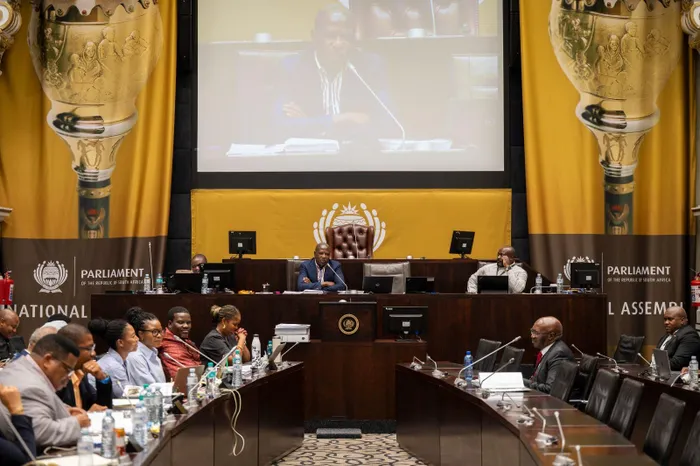
The Ad Hoc Committee met on Tuesday to consider the second draft preliminary report.
Image: Armand Hough / Independent Newspapers
Members of the Ad Hoc Committee probing allegations made by KwaZulu-Natal Police Commissioner Nhlanhla Mkhwanazi on Tuesday expressed their unhappiness with the second draft preliminary report, saying it diluted and watered-down the political party inputs.
The committee met to deliberate the draft preliminary report that was meant to have highlighted the areas of convergence and differences on the inputs made at the last meeting before it is sent to affected parties.
Content advisor Christine Silkstone told the members that their approach to the findings was that the committee was an oversight body, not a court or prosecutorial authority.
“The findings distinguish between established governance weaknesses, unresolved allegations, institutional risk, and matters requiring referral,” Silkstone said.
She also said that where evidence was incomplete, indirect, classified, contested, or not tested with an affected person, the report used cautious language.
The draft report found that suspended Police Minister Senzo Mchunu’s December 31, 2024, directive was issued and implemented through a materially deficient governance process.
The Medicare24 procurement process was affected by serious irregularities and control failures.
Regarding Mchunu, the report found executive accountability and unresolved integrity concerns but did not find a proven corrupt agreement or cartel instruction.
Serious unresolved issues and referrals were recorded regarding suspended Deputy National Commissioner Shadrack Sibiya, but it was not found that he acted for attempted murder-accused tenderpreneur Vusimuzi “Cat” Matlala, political fixer Brown Mogotsi, or an organised crime network.
No findings of corruption, perjury, or extortion were made in the allegation by Matlala in the Rolex-false affidavit against former minister Bheki Cele.
It also did not make any personal criminal or disciplinary findings against Investigative Directorate Against Corruption head, Advocate Andrea Johnson.
There was no finding or unlawful disclosure by MP Fadiel Adams and Dianne Kohler-Barnard on the classified intelligence information.
The draft report listed the persons who did not give evidence before the committee or evidence against them was not tested.
Crime Intelligence’s Feroz Khan’s absence limited the committee’s ability to resolve allegations concerning him, and no adverse finding was made.
The report recorded concerns about private investigative conduct and access to information by forensic investigator Paul O’SUllivan and Sarah-Jane Trent.
ANC MP Khusela Sangoni-Diko said a lot of inputs by her party were not captured.
“Some recommendations are moderated. We would say they are diluted,” Diko-Sangoni said.
She also said the ANC had raised an issue on classified information in the possession of Adams and Kohler-Barnard.
“The draft report seems to create doubt whether the information was classified or not, whereas in the evidence it was clear it is indeed classified,” she said, adding that they had recommended that the two MPs be referred to the Ethics Committee and assessed by the Joint Standing Committee on Intelligence.
MK Party MP David Skosana also said that their submissions were not captured to their expectation.
“I am disappointed to say the least with what I am seeing here,” Skosana said.
“On the issues of the relationship between Mogotsi and Mchunu, I don't know if we say there is no evidence,” he added.
DA MP Ian Cameron said the report was quite comprehensive and advised they hold physical meetings when they deliberate the final report.
Cameron said Kohler-Barnard had referred the classified intelligence report to the Inspector-General of Intelligence (IGI), as there was no Joint Committee of Intelligence at the time.
“The question is what else would she have done. The logical conclusion was to send the information to the IGI,” he said.
EFF MP Leigh-Ann Mathys noted the report referred to vulnerability in the criminal justice system when there was evidence of the erosion of the system that was exploited by the politically connected criminals.
Mathys said the report watered down the evidence and that Mchunu’s directive was irrational.
“It was not a sound decision at all. It must come out more clearly.”
Mathys said the relationship between Mchunu, Mogotsi, and Matlala did not create a reasonable risk as suggested by the draft report.
“It was an improper influence because of what was involved. It must be clearly stated,” she said, adding that Matlala’s relationship with senior SAPS officials was irregular.
Mathys, who gave a comprehensive list of omissions along with Sangoni-Diko and Xola Nqola, said the draft report was watered down on O’Sullivan, Trent, and former IPID head Robert McBride.
“The relationship was improper, irregular, and warrants a criminal investigation. That must be one of our recommendations.”
ActionSA MP Dereleen James said the draft report did not reflect the evidence that was led before the committee.
“ActionSA’s position right now is that this report is materially watered down. It definitely omits evidence. It reads like a summary of proceedings rather than the determination of fact placed before the committee,” she said.
Committee Chairperson Soviet Lekganyane said the language of the third draft report should be unambiguous and that it should not be shy about the findings, recommendations, and referrals.
“They must come out vigorously. They must be glaring for everybody to see that the committee has made the recommendations and specific findings.”
The content team was given until Friday to come up with the third draft preliminary report to be considered before it is sent to the affected parties.