

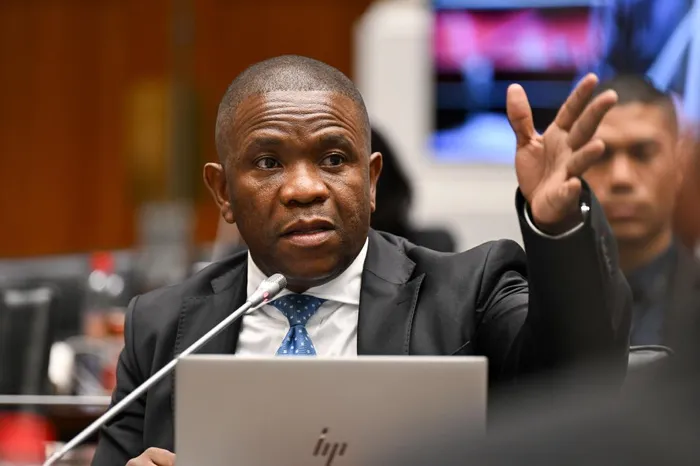
The Ad Hoc Committee investigating allegations made by KwaZulu-Natal Police Commissioner Nhlanhla Mkhwanazi received a draft report from evidence leaders on Thursday.
Image: Henk Kruger / Independent Newspapers
The draft report of the Ad Hoc Committee that investigated allegations made by KwaZulu-Natal Police Commissioner Nhlanhla Mkhwanazi has found evidence from witnesses that showed a serious and multi-layered institutional crisis in law enforcement.
Briefing the committee on the draft report on Thursday night, evidence leader, Advocate Norman Arendse, said the central finding from the 28 witnesses was that suspended Police Minister Senzo Mchunu issued his December 2024 directive to disband the Political Killings task team (PKTT) without consulting President Cyril Ramaphosa, National Commissioner Fannie Masemola, National Prosecuting Authority, and the Civilian Secretariat of the Police.
Arendse said the directive was transmitted on the eve of a public holiday while Masemola was on leave.
He further stated that Mchunu’s reasons contradicted his own concessions during his testimony.
“Whether the directives were ultra vires (beyond powers) is a matter reserved for determination by the committee.”
The committee, which held its public hearings from last October until early this year, was formed following a media briefing by Mkhwanazi months after Mchunu issued the directive to disband the PKTT and placed a moratorium to fill vacancies in Criminal Intelligence.
Arendse said credible evidence was that the disbandment of the PKTT was influenced by its success in assisting the Gauteng Counter-Intelligence Operations that unmasked criminal syndicates, involving law enforcement officials, not by operational and budget reasons.
Mchunu’s justification was based on complaints by academic Mary de Haas and whistle-blower Patricia Mashale, among others.
“He advanced reasons in his evidence not recorded in the directive… He admitted to instructing the recording of Lieutenant-General Mkhwanazi without consent and misrepresented to Parliament the president’s consultation on the directive.”
Masemola had presented credible evidence that was consistent with the directive.
“Whether the minister had lawful authority to issue the directive is a question up to the committee,” he said.
According to Arendse, Ramaphosa did not sanction the disbandment of the PKTT.
While he established the Madlanga Commission, suspended Mchunu, and appointed Acting Minister Firoz Cachalia, Arendse said the committee may wish to make recommendations on passive oversight in the SAPS.
Regarding the alleged corrupt relationship between Mchunu, alleged political fixer Brown Mogotsi, and attempted murder-accused tenderpreneur Vusimuzi “Cat” Matlala, Arendse said the committee had made it clear that Mogotsi was not truthful with his relationship with the suspended minister.
Matlala, who has an extensive criminal history spanning 25 years, conceded to making cash payments to former minister Bheki Cele for facilitation fees for the return of his confiscated firearms and the cessation of police operations against him.
“He conceded under questioning that his actions were illegal and amounted to bribery.”
Arendse said Cele has not been given an opportunity to address the bribery allegations.
Matlala’s evidence was not credible and contrary to him characterising himself as a victim, when he was a participant in an alleged corruption network, he said.
Arendse added that Matlala’s admission of making payments to Cele, being involved in fronting, and being associated with kidnapped narcotics manufacturer Jerry Boshoga justified continued investigation and prosecution.
The draft report also touched on the allegations of the Big 5 criminal syndicate involving tenderpreneurs conducting business with the state and working with law enforcement officials to protect the cartel.
It also looked at the referral of alleged criminality within Crime Intelligence by National Coloured Congress leader Fadiel Adams to the Investigative Directorate Against Corruption (IDAC), which had raised concerns about its conduct and exceeding its mandate.
The inquiry had heard evidence about the misuse of the Secret Service Account to enable corruption and political interference in the SAPS.
The report noted the systemic gaps in executive oversight, as there was no performance assessment of Mchunu, and a 14-month delay in instituting an inquiry into the fitness of Director of Public Prosecutions Andrew Chauke to hold office.
It also found systematic governance failures across the SAPS, Crime Intelligence, and the NPA, as well as the absence of vetting of senior SAPS officials and inadequate external oversight of IDAC before October 2025.
Arendse said as part of the recommendations, vetting came across most of the evidence, along with independent lifestyle audits, continuation and capacitation of PKTT, and institutionalisation of the multi-disciplinary prosecution-guided investigations.
There were also recommendations on the need for a massive overhaul of procurement, among others.
The members of the committee have until next Friday to study the report before it is discussed in the week starting June 8 before their mandate expires on June 12.
A report on the governance matter has already been shared with the members.
Committee Chairperson Soviet Lekganyane said the draft report was voluminous, but the executive summary made it easy for them to comprehend it.
“We want to thank you for the tremendous work done. It has not been easy, but we achieved, and we are here today. We want to thank you so much for your efforts,” said Lekganyane to the evidence leaders.
He indicated that the committee still has to share the report to the parties that appeared before it to note the recommendations that will be made.