

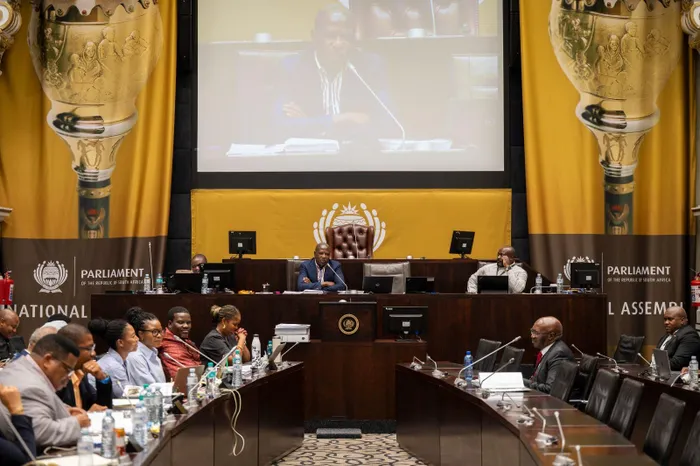
The Ad Hoc Committee on Tuesday evening resolved to seek another extension until the end of May or the first two weeks of June.
Image: Armand Hough / Independent Newspapers
The Ad Hoc Committee will request another extension to finalise the report on the investigation into allegations made by KwaZulu-Natal Police Commissioner Nhlanhla Mkhwanazi.
The committee, which was last given till the end of April to wrap its work, will now ask to be given an extension until the end of May or the first two weeks of June.
At Tuesday evening's meeting, it was noted that the evidence leaders' report was incomplete and that transcripts for forensic fraud examiner Paul O’Sullivan and former head of Independent Police Investigating Directorate Robert McBride had not yet been received.
Other transcripts were speeded up with the appointment of another service provider.
Evidence leader Advocate Norman Arendse said they have most of the transcripts of key witnesses, except O’Sullivan and McBride.
“We will provide a draft report within a week from today,” he said.
The Secretariat has drafted the outline of the report and indicated that the draft report will be ready by May 8, and parties will make submissions on May 15.
The team of evidence leaders will be beefed up to finalise the writing of the report with the re-appointment of former evidence leader Advocate Lerato Zikalala, who left the inquiry late last year.
Committee Chairperson, Soviet Lekganyane, said they will propose to National Assembly Speaker Thoko Didiza to grant another extension until the end of May or the second week of June.
The committee will coordinate with Didiza’s office to view the classified intelligence report of the Inspector-General of Intelligence.
Acting Minister of Police Firoz Cachalia had sent the report to Didiza’s office, but she returned it because there was no arrangement made by the committee with her office to receive the classified report.
The committee also resolved to reject the request by Sarah-Jane Trent to receive a confidential report into her mental state when she testified before the committee in March.
Trent wrote in April to the committee asking that her testimony be expunged from the record of evidence, and had also indicated that she was waiting for a forensic psychological report.
While parliamentary legal services advised that the confidential report be viewed by the MPs in person under strict conditions, Lekganyane said there was no way a citizen could send a report and inform Parliament what to do with it.
“They could have written to request to come to a meeting to present the confidential report. Why do they want to impose obligations on the report they claim to be confidential?” he said.
The committee also rejected a request by the Busisiwe Mkhwebane Foundation to hold an in-camera session for former intelligence analyst Philasande Dotyeni to give more evidence on the death of former Crime Intelligence boss Sindile Mfazi.
Dotyeni had claimed that Mfazi did not die because of Covid-19-related illness but was poisoned while investigating Personal Protective Equipment contracts within the SAPS.
The foundation claimed that the committee had committed to grant Dotyeni such an in-camera session, but this was denied by the committee.
“There has never been any commitment that there would be an arrangement for him. The committee has never made such a decision,” Lekganyane said.
He noted that some documents related to protected disclosures by Dotyeni had made their way onto social media.
“Any information that comes to the committee comes by way of a statement or affidavit. The person alerts or informs the committee about the documents they want to bring,” said Lekganyane.