

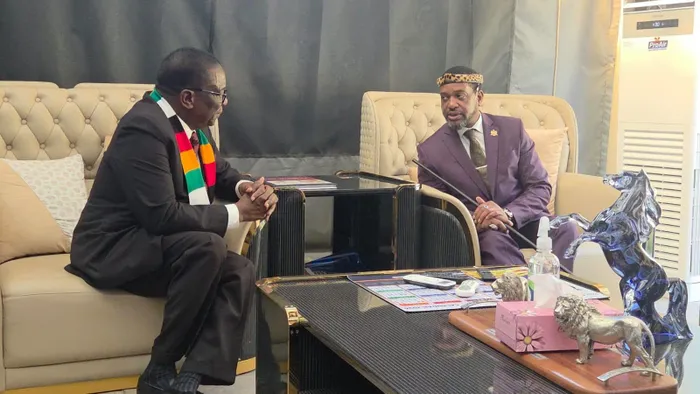
During his Zimbabwe visit, King Misuzulu kaZwelithini said lawful migration must be distinguished from illegal immigration, while warning that governance failures contribute to migration tensions across Africa.
Image: King Misuzulu/ Facebook
King Misuzulu kaZwelithini says Africa’s shared history and cultural ties should not be used as a reason to ignore the immigration laws of sovereign nations, arguing that enforcing border controls and immigration laws should not be mistaken for xenophobia.
The AmaZulu King made the remarks during an official visit to Zimbabwe, where he met President Emmerson Mnangagwa and discussed the challenge of balancing African unity with respect for the sovereignty and laws of individual states.
The comments come amid ongoing debate in South Africa over illegal immigration, with calls for stronger enforcement of immigration laws and concerns over rising tensions, including accusations of xenophobia and the targeting of foreign nationals.
"I come to Zimbabwe not merely as the King of the Zulu Nation but as a son of Africa who believes that our continent's greatest strength lies in our shared history, our shared humanity and our shared responsibility to one another," King Misuzulu said.
The King said South Africa and Zimbabwe were not only neighbours but family, with histories that had been intertwined for centuries before the establishment of modern borders.
However, he said shared heritage did not remove the obligation to respect the laws of sovereign states.
King Misuzulu used his own arrival in Zimbabwe as an example, saying he had followed the country's immigration procedures despite his position as a traditional leader.
"As I arrived here in Zimbabwe today, I presented my passport to the immigration authorities. My passport was stamped. I declared my nationality. I declared the purpose of my visit. I informed the authorities where I would be residing during my stay."
He said complying with Zimbabwe’s immigration requirements did not diminish his dignity but instead respected the country's sovereignty.
"That process did not diminish my dignity. It honoured the sovereignty of Zimbabwe."
The King said every country had the right to regulate who entered its territory, for what purpose and for how long.
"Likewise, every sovereign nation has the right to know who enters its territory, for what purpose they enter, how long they intend to remain, and whether they comply with that nation's laws."
He said enforcing immigration laws was not unique to Africa but was a recognised international practice.
"This is not an African principle. It is a universal principle of international law."
"Every member state of the United Nations maintains borders. Every member state issues visas. Every member state enforces immigration laws. Africa should never be expected to apologise for exercising rights that every sovereign nation in the world already exercises."
King Misuzulu warned against a polarised migration debate, saying some people wrongly viewed every concern about illegal immigration as xenophobia, while others unfairly blamed foreign nationals for every challenge facing their communities.
"Neither position serves Africa," he said.
He said violence against innocent people, regardless of nationality, could never be justified, but countries should also not be expected to abandon immigration enforcement because of fears of being labelled xenophobic.
"The distinction between illegal immigration and lawful migration must remain absolutely clear."
The King said people who entered countries legally, complied with laws and contributed positively to society should be treated with dignity.
"However, unlawful entry, document fraud, organised human trafficking and deliberate violations of immigration legislation are matters of criminal justice and public administration, not questions of race or nationality."
Referring to the historical links between communities across Southern Africa, King Misuzulu said African identity extended beyond colonial borders but should strengthen respect between nations.
He referred to the movement of Nguni-speaking communities during the 19th century, including Chief Mzilikazi kaMashobane, who established the Ndebele nation in present-day Zimbabwe, and Soshangane kaZikode, who established the Gaza State across parts of present-day Mozambique, Zimbabwe and Eswatini.
"These histories remind us that African identity has never been confined to colonial borders. Our shared ancestry should inspire mutual respect. It should never be used to justify disregarding the immigration laws of sovereign nations."
"Being family does not exempt us from respecting one another's homes. On the contrary, family respects family."
King Misuzulu rejected suggestions that South Africans were hostile towards other Africans, saying the country had historically welcomed students, entrepreneurs, professionals, investors, refugees and visitors from across the continent.
"This shared history of solidarity must never be forgotten."
At the same time, he said South Africans were entitled to expect immigration into the country to be managed lawfully, transparently and effectively.
"Expecting government institutions to administer immigration laws is not an act of hatred. It is an expectation of good governance."
The King said the central challenge facing African countries was not xenophobia but governance.
"The true challenge before us is therefore not xenophobia. The true challenge is governance."
He said poorly managed borders, failures in documentation systems, corruption, human trafficking, exploitation of undocumented workers and weak cooperation between governments contributed to tensions within communities.
King Misuzulu called for African governments to work towards what he termed the "Harare Principles on Responsible African Mobility", aimed at promoting lawful, secure and managed migration while strengthening cooperation between states.
"Africa does not need open borders without accountability. Africa needs lawful mobility. Africa needs secure mobility. Africa needs managed mobility."
He said Africa should protect both the dignity of lawful migrants and the sovereignty of nations.
"Africa must never choose between compassion and order. We must uphold both."
IOL Politics