

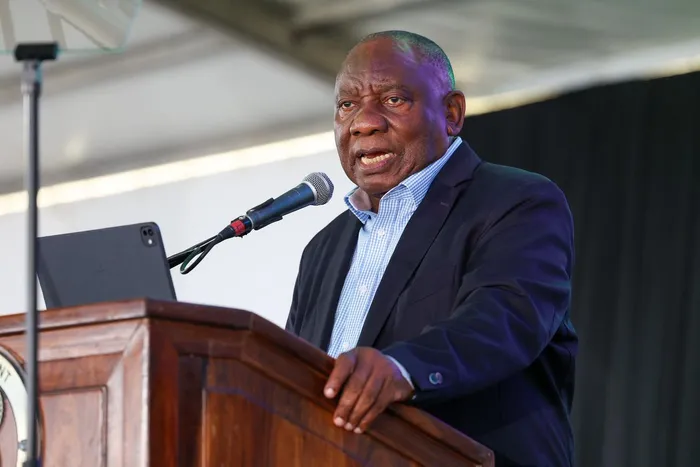
President Cyril Ramaphosa said the Madlanga Commission is already driving action against criminal infiltration in state institutions, as government implements task teams, audits and enforcement measures across the security cluster.
Image: GCIS
President Cyril Ramaphosa says the Madlanga Commission of Inquiry into criminality, political interference and corruption within the criminal justice system is already having a significant impact, even before it submits its final report, as government intensifies efforts to root out corruption and criminal infiltration in law enforcement.
He made the remarks during an oral reply session in the National Council of Provinces (NCOP) on Thursday, where MPs questioned him on progress in addressing corruption within the police service, accountability for implicated officials, and measures to stabilise the criminal justice system.
Ramaphosa was responding to DA MP Dennis Ryder, who asked what steps government had taken to identify and remove criminal infiltration and corruption within law enforcement, following findings from the Madlanga Commission.
In a follow-up, Ryder said South Africans expected three outcomes from government: that criminals be caught, convicted and that institutions enabling them be cleaned up.
He said the commission had pointed to organised criminal networks penetrating parts of the state and questioned what senior officials had already been removed or prosecuted, asking whether government was still pursuing investigations while “accomplices remain within the system”.
Ramaphosa said the commission, chaired by Justice Mbuyiseni Madlanga, is expected to submit its final report at the end of August 2026, adding that its findings and recommendations would assist in strengthening law enforcement capabilities.
“The findings and recommendations of the Commission are expected to shed light on the alleged corruption and infiltration of the South African Police Service and other organs of the state.”
He added that the commission’s work was already producing results, including the establishment of a special task team by the South African Police Service and the National Prosecuting Authority following its interim report in December last year.
He said the task team had already brought a number of cases to court, while disciplinary processes were also underway in relevant departments.
Ramaphosa said Cabinet had adopted a National Organised Crime Combating Strategy, with multidisciplinary task teams involving the SAPS, NPA, State Security Agency and the South African National Defence Force actively working to investigate and dismantle organised crime syndicates.
He said the syndicates were involved in violent crime, economic and infrastructure-related crimes, drug trafficking, illicit mining, illegal weapons and corruption-linked offences.
He said the State Security Agency had been tasked with conducting vetting and lifestyle audits of senior police officials, including those in detective services, priority crime investigations, criminal intelligence, forensic services and supply chain management.
Ramaphosa said there was clear evidence of criminal infiltration and corruption within law enforcement and other state institutions, but stressed that government was acting through lawful processes to address it.
He said: “However, through the measures that we are undertaking, we are putting out these elements and restoring the credibility as well as the integrity of our law enforcement and security apparatus.”
He added that the majority of police officers and security personnel served with dedication and integrity, often under difficult and dangerous conditions, and should be commended for their work in uncovering criminal activity.
Ramaphosa said those who betrayed public trust must be identified and removed, adding: “Our responsibility is to ensure that those who betray the trust that our people should have in our criminal justice system should be identified, they should be removed, they should be held accountable.”
Democratic Alliance MP Nicolaas Pienaar asked what concrete action had been taken against senior officials implicated in wrongdoing, arguing that South Africans wanted arrests and removals rather than ongoing investigations, and questioned why those named in the commission had not been expelled or prosecuted.
Ramaphosa responded that government must allow the Madlanga Commission to complete its work, but said commissions of inquiry had historically played an important role in exposing corruption and driving reform.
He referred to the Zondo Commission, saying critics had argued that little had been done, but insisted that government had implemented its recommendations, including recovering stolen funds, enacting legislative reforms, and making arrests.
He also cited previous commissions into the South African Revenue Service and the Public Investment Corporation, saying they had led to removals and institutional reforms.
“People are being arrested, people are being prosecuted, people are being put in jail, and people are also being disciplined in the places where they work,'' he said.
ANC MP Sylvia Sithole raised concerns about tensions between the South African Police Service and the National Prosecuting Authority’s Investigating Directorate against Corruption, warning that internal conflict within the security cluster was undermining public trust and asking for timelines on integrity testing, lifestyle audits and vetting processes.
Ramaphosa said government was working to ensure cooperation within the security cluster and to stabilise relations between agencies so that focus remained on fighting crime rather than internal disputes.
He said lifestyle audits and vetting processes for senior officials were under way through the State Security Agency, although he cautioned that such processes take time.
“That is a rigorous process that is currently underway, and whilst I would like to give clear timelines, vetting processes, lifestyle audits do tend to take time.”
Patriotic Alliance MP Bino Farmer raised concerns about whistleblowers who expose corruption and face intimidation or assassination attempts, asking what protection measures were in place for them and their families.
Ramaphosa said whistleblowers were crucial in exposing wrongdoing and must be protected, adding that government was working on measures to ensure their safety and that of their families, and encouraging more people to report corruption.
“Whistleblowers are those South Africans who are brave, who are honest, who are able to reveal the wrong things that are being done, even by their colleagues,'' he said.
Pienaar also questioned why senior political figures named in the commission had not been expelled or arrested.
Ramaphosa said the commission must be allowed to continue its work and that government would act where evidence of wrongdoing was established, with task teams already empowered to act on findings emerging from the inquiry.
“We should allow the Madlanga Commission to continue doing its work,'' said Ramaphosa.
IOL Politics