

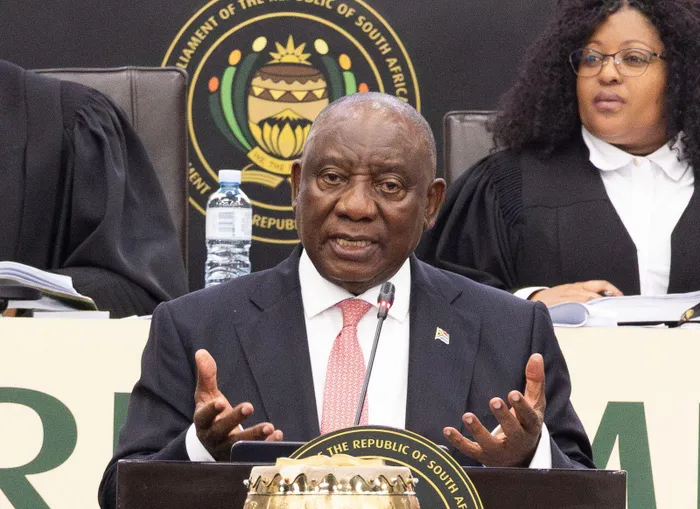
President Cyril Ramaphosa told the NCOP that government will intensify enforcement against illegal immigration, strengthen border controls, and address asylum backlogs while warning against any attempts to destabilise South Africa through marches or unlawful actions.
Image: GCIS
President Cyril Ramaphosa says there is no place for racism, sexism, xenophobia, or Afrophobia in South Africa, adding that the government will not tolerate attempts to destabilise the country, whether through marches or any other means.
He was speaking during an oral reply session in the National Council of Provinces (NCOP) on Thursday, where MPs questioned him on illegal immigration, border management, and the asylum system backlog.
Ramaphosa was responding to ANC MP Kenny Mmoiemang, who asked whether the government was introducing immediate measures to deal with illegal immigration, strengthen border control and enforcement, and address severe capacity constraints and backlogs in the asylum system.
He also asked about enforcement mechanisms to limit the employment of undocumented migrants and alignment with a Constitutional Court ruling barring rejected asylum seekers from submitting repeat applications while remaining in the country unlawfully.
Ramaphosa said Cabinet had adopted a comprehensive migration management approach on 3 June 2026, which he said had already been outlined in a national address on 7 June.
“The government has identified illegal immigration as a significant challenge in our country, which has implications for social cohesion, national security, and the provision of services to our people.”
He added that the approach had been endorsed by the Presidential Coordinating Council and discussed with stakeholders, including faith-based organisations, business, labour, and traditional leaders.
Ramaphosa said the government’s response was structured in five key areas.
The first was enforcement, including intensified action against violations of immigration and labour laws.
He said law enforcement agencies were increasing deportations of undocumented foreign nationals, while workplace inspections were being stepped up.
He also confirmed the establishment of dedicated immigration courts.
He said the Department of Employment and Labour would recruit 10,000 inspectors, adding that the rollout would be phased due to budget constraints.
“We are doing it in phases largely because of the budgetary concerns and restrictions that we have.
However, we are finding pockets of finance that will enable us to bring as many as possible,” he said, adding that inspectors would undergo training before deployment.
The second pillar focused on border security, including infrastructure upgrades, technology deployment and increased personnel. Ramaphosa said government would redevelop the six busiest ports of entry and relocate refugee reception centres to border posts.
The third pillar focused on strengthening the immigration system through digital transformation and anti-corruption measures.
“We are establishing an intelligent population register with biometric data, underpinned by a digital ID, and phasing out the green ID books that enable identity theft,” Ramaphosa said.
He added that an electronic travel authorisation system would be extended to airports and major land ports of entry.
The fourth pillar involved legal and policy reform. Ramaphosa said Cabinet had approved a revised White Paper on Citizenship, Immigration and Refugee Protection, alongside new labour migration and employment legislation that would introduce quotas for foreign nationals in certain sectors.
The fifth pillar focused on asylum management. He said the Refugee Appeals Authority had recruited additional adjudicators, with support from the United Nations High Commissioner for Refugees, to clear backlogs and finalise outstanding appeals.
Ramaphosa also stressed regional cooperation, saying South Africa could not deal with migration alone and was working through SADC, the African Union and bilateral relations to address instability and economic pressures driving migration.
MPs also raised concerns about planned marches on 30 June, questioning government’s preparedness to deal with possible violence, instability and disruptions to public order.
“We have put in place security and other measures to deal with any attempts to destabilise our country, whether by citizens or foreign nationals, and we will not tolerate any attempts to destabilise the country by anyone, whether marching or otherwise,'' Ramaphosa said.
He added that security forces were ready and that government was working to ensure 30 June remained a normal working day.
“The 30th of June will be a normal day where people will be able to work, to go about their business. Our security forces are ready,” he said.
He further stressed collective responsibility, saying leaders must actively promote peace.
“We are all leaders, each one of us has a role to play to ensure we call for peace, we call for calm,” he said, adding that authorities must act lawfully against those attempting to destabilise the country.
Democratic Alliance MP Fredrik Badenhorst asked what contingency measures were in place to prevent violence, loss of life and instability ahead of the 30 June marches, and who would be held accountable should government fail to maintain order.
Ramaphosa responded that security structures were fully prepared, with intelligence and policing units in place to prevent instability and ensure public safety.
Freedom Front Plus MP Hendrik van den Berg argued that foreign workers were preferred in sectors such as agriculture and construction due to lower costs and flexibility, and called for labour market reforms.
Ramaphosa rejected the argument, saying the reality was that many undocumented migrants were being exploited.
“They are being paid slavery wages. They are also being made to work in the most unacceptable conditions, conditions that working people in our country would not accept,” he said.
He added that South Africa’s labour framework was determined by legislation passed in Parliament and that any reforms would require formal legislative processes.
ANC MP Edwin Noe asked about regional efforts to address migration pressures and reduce the number of people leaving their home countries in search of opportunities in South Africa.
Ramaphosa said South Africa was committed to promoting economic development across the continent and region, including through the African Continental Free Trade Area, which he said would strengthen trade, industrialisation and job creation in African countries.
He said stronger economic growth in neighbouring countries would reduce migration pressures by enabling people to find work closer to home.
He added that South Africa also works through regional platforms, including the Southern African Customs Union (SACU), which he described as one of the oldest trading blocs, where further discussions on regional economic integration were continuing.
IOL Politics