

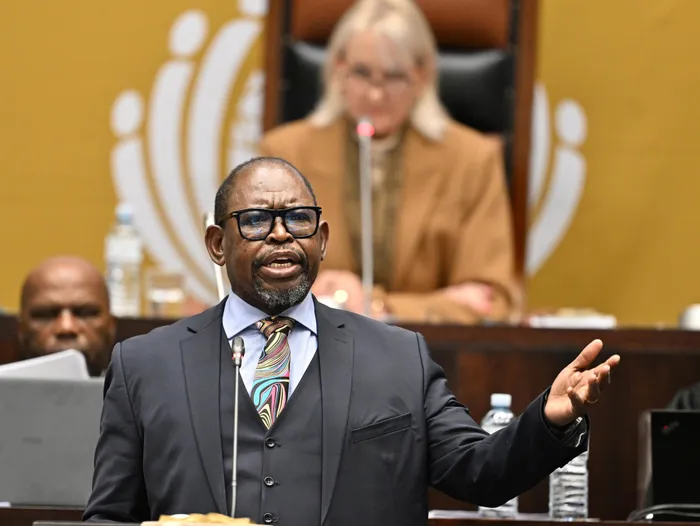
Finance Minister Enoch Godongwana appeared in the National Assembly on Tuesday, where the Appropriations Bill was tabled.
Image: Phando Jikelo / RSA Parliament
Finance Minister Enoch Godongwana said that while there is acknowledgement that departments are underfunded, there is not enough scrutiny of how national departments spend their budgets.
Godongwana said this as he appeared in Parliament on Tuesday, where the Appropriation Bill was passed, and will be sent to the National Council of Provinces (NCOP) for concurrence. Parliament’s processing of the budget will conclude when the NCOP approves the Bill, expected on Friday.
Godongwana started by thanking the chairpersons of the committees on Appropriations and Finance, saying that “to produce a report of this nature reflects some patience of a different kind”.
He said that the Budget tabled in February was R2.3 trillion, and that what the debate on the Appropriation Bill focuses on is a portion of that.
“That budget is divided as Section 214 of the Constitution requires us, between the spheres of government. Through the Division of Revenue Bill, we dealt with R1.1 trillion in this budget.
“Now we're dealing with the remaining one trillion, which affects national departments.”
Godongwana expressed his frustration with Members of Parliament, noting that they failed to differentiate between the two separate Bills during their discussions.
“People say this Budget does not talk to anyone in Khayelitsha. The biggest portion of this Budget, R302.4 billion, goes into the Department of Social Development, supporting 26.5 million beneficiaries.”
Godongwana said that even if it is an election year, “we must not twist facts” as “26.5 million are covered by this Budget, and they're scattered across the length and breadth of this country”.
He added that one of the issues that needs greater scrutiny is how the money is spent.
“…The problem is not money. The problem is the effective use of that money. That's what we should be talking about.
“We introduced what is called targeted responsible spending, because we realised that one of the key things we can improve services is not higher taxes; it is to begin, to shift, and prioritise those government programmes which are inefficient to derive service savings, and for those savings to be re-channelled, towards the priorities the government wants to achieve.”
Godongwana remarked that Members of Parliament share the duty of oversight; they should critically evaluate departmental expenditure patterns rather than merely accepting claims of insufficient funding.
“When you do oversight in departments, you should be asking the relevant ministers, to what extent are they using the money allocated to them?”
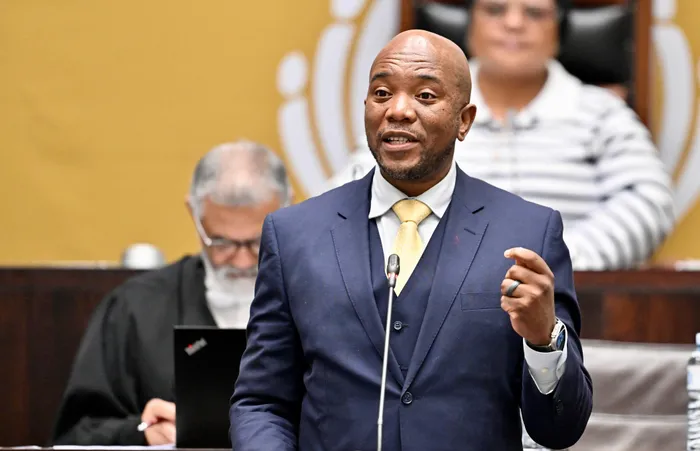
Chairperson of the Standing Committee on Appropriations and BOSA leader, Mmusi Maimane.
Image: Phando Jikelo / Parliament RSA
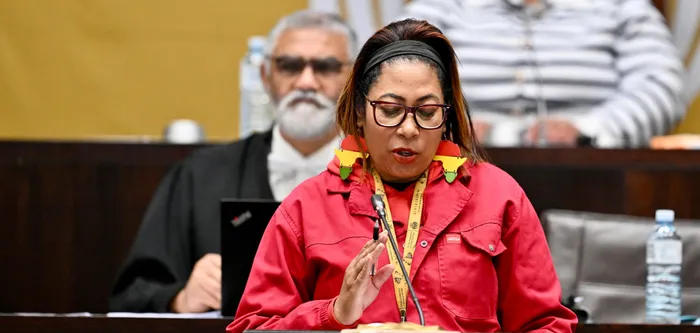
The EFF’s Hlengiwe Octavia Mkhaliphi said they reject the Bill.
Image: Phando Jikelo / Parliament RSA
Chairperson of the Standing Committee on Appropriations, Mmusi Maimane, said the Appropriation Bill is more than a financial instrument.
“It is a statement of our values and our priorities. Our Constitution did not create Parliament to be a spectator in the budgeting process. It created Parliament to be an active participant, a check on executive power, and the custodian of the people’s money.
“For many years, under a dominant-party system, Parliament largely accepted budgets as presented by the Executive. The culture and capability required to actively amend budgets were never fully developed. Now, in a more competitive and accountable political environment, Parliament is expected to exercise powers that many committees have never been adequately trained or resourced to perform. This must change,” Maimane said.
uMkhonto weSizwe Party’s Thulani Gamede said they rejected the Bill as “people did not fight for a stabilised debt-to-GDP ratio”.
“They fought for land, for jobs, and for justice. This Bill provides none of those.”
The EFF’s Hlengiwe Octavia Mkhaliphi added that they also reject the Bill “not because we oppose budgeting, but because we oppose the continued use of the Budget as an instrument to perpetrate inequality in South Africa”.
“We oppose it because it protects elites and reproduces the same economic structure that kept millions of South Africans in poverty. This House must ask itself a simple question. Who is this Budget for?”
RISE Mzansi National Leader Songezo Zibi said that budgets are never enough.
“Out of this Budget, we have public hospitals that will still fail to provide the level of care South Africans need to live long, healthy lives... There is enough money – if not wasted on poorly conceived plans, poor project management, poor contract management, and corruption – to make a big difference in people’s lives.
“The challenge for the Cabinet must be to create a shorter list of priorities – allocating more to critical public services while rapidly expanding transparent, well-regulated private investment in others. This requires a fundamental change in attitude: moving from thinking the state can do everything to considering the totality of the capital available in the country under different rules and conditions,” Zibi said.