

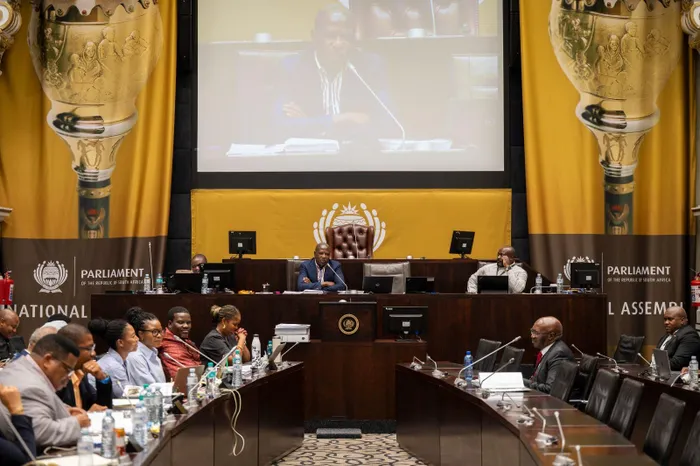
The Ad Hoc Committee is set to embark on a process that will culminate in the adoption on the draft report on its investigation into allegations made by KwaZulu-Natal Police Commissioner Nhlanhla Mkhwanazi.
Image: Armand Hough / Independent Newspapers
The Ad Hoc Committee has adopted a roadmap towards the finalisation and the adoption of the report in its investigation of the allegations that were made by KwaZulu-Natal Police Commissioner Nhlanhla Mkhwanazi.
This after the committee’s secretariat tabled on Tuesday night a process and a schedule for the committee to conclude its business in a month’s time as it will not be in a position to meet this Friday’s deadline, June 12.
At its meeting last week parliamentary legal advisor Andile Tetyana highlighted the challenges faced by evidence leaders in completing their evidentiary overview report which had a cascading impact on the progress of the milestones in the parliamentary inquiry.
“We would like the committee to consider another request for extension of the deadline within which the committee must submit its report to the House,” Tetyana said.
Although the matter was not discussed, apart from Tetyana saying that they were ready to be directed and guided by the committee to make the request for extension, content advisor to the committee Nicolette van Zyl-Gous presented a roadmap for the committee to conclude its business on Tuesday night.
“The purpose of the proposed process is to ensure the committee's final report is firmly grounded in the evidentiary record, informed by collective deliberations and capable of producing findings and recommendations that strengthen accountability, governance, and public confidence in police and the broader justice system,” Van Zyl-Gous said.
The committee received an evidentiary evidence report from the evidence leaders last Thursday and parties had asked to be given a week to study it before the discussions.
The presentation indicated that the content team of the committee’s secretariat will record issues raised by MPs, identify areas requiring further consideration, and assist in the development of findings and recommendations arising from the evidence before the committee.
Van Zyl said there was a document prepared by the content team on structural governance concerns and reform imperatives in the police and criminal justice system.
She said the deliberations on the report were scheduled over five phases spanning from June 9 until July 16.
“This proposed process and timetable are indicative and may be adjusted by the committee depending on the progress made during the deliberations,” she said.
Van Zyl-Gous also said the finalisation was anticipated by July 16 with about eight meetings being planned.
“Should additional deliberations or procedural requirements arise, the finalisation may extend to July 31, 2026. The proposed timetable does include drafting time and the right to reply by affected persons.”
The phase one phase will focus on establishing the record of evidence and methodology.
It started with adopting the reporting schedule on Tuesday night and will be followed by a workshop on oversight and mandate of the committee on Wednesday night as well as discussion on evidentiary overview and introducing the structure of the preliminary report.
This will be followed by evidentiary assessment when the committee starts working on the draft committee report, organising witness evidence and deliberations on seven themes from June 11 until June 18.
As part of the phase three, the content team will write up findings and recommendations and draft reports sent to MPs between June 19 and June 24.
The draft report is expected to be sent to implicated persons over a two weeks spanning from June 25 until July 8.
Once the representation by affected persons is considered on July 10, the final report will be finalised and adopted on July 16.
No discussion was held on the proposed schedule, as parties raised no questions.
Concluding the meeting, committee chairperson Soviet Lekganyane said the schedule has been accepted and adopted by the committee.
“There will be a workshop (on Wednesday) on the principles that we should apply when we will be considering the reports,” said Lekganyane.