

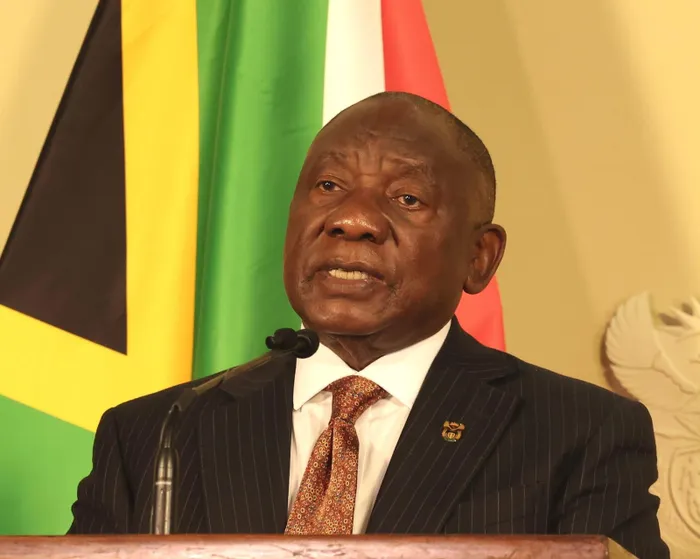
President Cyril Ramaphosa on Sunday night announced tougher penalties for employers hiring undocumented migrants
Image: GCIS
President Cyril Ramaphosa says employers who hire undocumented migrants will face harsher penalties, including imprisonment, as part of government's intensified efforts to tackle illegal immigration.
Addressing the nation on Sunday night, Ramaphosa outlined a five-point plan aimed at strengthening immigration enforcement amid rising tensions over undocumented migration and calls for undocumented foreign nationals to leave South Africa.
His address comes ahead of a planned nationwide shutdown on 30 June and follows a recent increase in protests targeting foreign nationals in parts of the Western Cape, KwaZulu-Natal and Gauteng.
Ramaphosa said Cabinet had adopted a comprehensive Migration Management approach, endorsed by the President's Coordinating Council, which includes provincial and local government representatives.
The first phase of the response will focus on enforcing existing immigration, labour and related laws.
He said the Department of Home Affairs, Border Management Authority, South African Police Service (SAPS) and other law enforcement agencies would intensify efforts to identify and deport undocumented foreign nationals living illegally in the country.
According to Ramaphosa, the Border Management Authority prevented more than 450,000 illegal border crossings over the past year.
Government will also establish dedicated immigration courts to accelerate deportation processes.
Inspections of businesses suspected of employing undocumented foreign nationals will be increased, while the Department of Employment and Labour has begun the phased recruitment of 10,000 labour inspectors during the current financial year.
Ramaphosa said penalties for employers who contravene the Immigration Act would be strengthened.
"We cannot have a situation where employers who, after being charged and found guilty of violating our laws, merely pay a fine and continue employing undocumented foreign nationals whom they exploit," he said.
The second pillar of government's response focuses on securing South Africa's borders through increased investment in technology, infrastructure and personnel.
Government will also begin relocating refugee reception centres closer to border posts, starting with the Tshwane centre this year, to improve the processing of asylum applications.
The third aspect of the plan centres on strengthening the immigration system through anti-corruption measures and technological reforms.
Ramaphosa said corruption within the Department of Home Affairs often enables illegal immigration and warned that officials involved in document fraud or unlawful entry schemes would face dismissal and criminal prosecution.
Government is also establishing an Intelligent Population Register containing biometric data for every person in the country as the foundation for a digital identity system.
The Department of Home Affairs will set a date for the discontinuation of green barcoded ID books, while the Department of Transport is expected to introduce new regulations within three months to prevent abuse of Traffic Registration Numbers as identification documents.
The fourth pillar involves legislative and policy reforms aimed at closing loopholes in the immigration system.
Ramaphosa said government had finalised the National Labour Migration Policy, which proposes employment quotas for documented foreign nationals and stronger action against employers hiring undocumented workers.
Cabinet has also approved the Employment Services Amendment Bill for introduction to Parliament. The legislation would empower the Employment and Labour Minister to set sector-specific quotas for the employment of foreign nationals.
Government is also working to formalise the registration of small and informal businesses while supporting South African-owned informal enterprises through the Spaza Shop Fund.
The final component of the strategy focuses on regional and continental cooperation to address the underlying causes of migration.
Ramaphosa said South Africa would work through the Southern African Development Community (SADC), the African Union and bilateral partnerships to find long-term solutions to migration pressures.
He announced plans to send envoys to several African countries to communicate the measures announced by government.
The Inter-Ministerial Committee on Migration will coordinate implementation across departments and all spheres of government, while national and provincial security structures have been directed to strengthen coordination among law enforcement, intelligence and security agencies.
Ramaphosa said government would not allow migration-related tensions to be exploited to destabilise the country and warned that security agencies were prepared to act to maintain law and order and protect critical infrastructure.
IOL Politics