

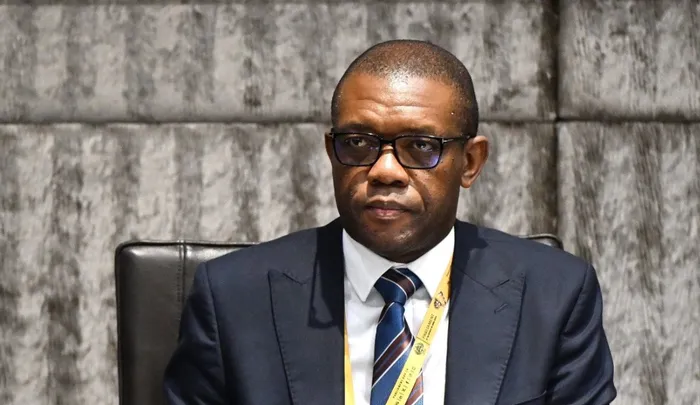
Rise Mzansi leader Songezo Zibi has defended the party's declaration of a R30 million loan write-off as a donation, arguing that the arrangement is fully compliant with South Africa's Political Party Funding Act.
Image: Supplied
Rise Mzansi leader Songezo Zibi has defended the party's decision to declare a R30 million loan write-off as a donation, arguing that the arrangement fully complies with South Africa's Political Party Funding Act.
Speaking at a media briefing on Monday in Johannesburg, Zibi said the loan was originally obtained from the organisation “We Are The People” to fund the party's 2024 election campaign.
The debt was later written off after the party struggled to repay it.
He said the party had paid more than R1 million towards servicing the loan but was unable to settle the outstanding balance.
Under the Political Party Funding Act, Zibi said, a written-off loan must be declared as a donation because it constitutes a financial benefit.
“We took legal advice before the election on the kind of fundraising methods and support that would be acceptable in terms of the Political Party Funding Act," he said.
Zibi rejected suggestions that the donation was improper, noting that the legislation allows juristic persons to donate to political parties within prescribed limits.
"In the United States, there are things called political action committees. Check the Electoral Act and the Political Party Funding Act. It does not disallow them at all," he said.
He pointed to the Democratic Alliance (DA) donor Michel le Roux as an example, saying Le Roux and entities under his control had collectively donated R58 million to the DA through separate legal entities, each remaining within the legal donation threshold.
"The law allows it," Zibi said. "We have never complained about Michel Leroux because the donations were made within the law."
He said “We Are The People” is a juristic person and is therefore permitted to make donations within the limits set by the legislation.
Zibi also said the party had taken out several loans before the 2024 election and had been servicing them in accordance with the law, which requires such loans to be granted on commercial terms.
"We've struggled to repay all of that money," he said.
"When a party is not in a position to repay, there are two options. You can liquidate it, or you can write off the loan."
He compared the process to the way banks and companies account for impaired debt.
"The Political Party Funding Act requires that if you owe somebody money and they say you don't have to pay it anymore, you must declare that as a donation because it's a financial benefit," he said.
Zibi said that the declaration did not involve new funds being transferred to the party.
"This is not R30 million given to Rise Mzansi now. It's election-time debt from before," he said. "There's no money that has changed hands. The benefit is that the loan has been written off."
He added that the donation threshold had increased from R15 million to R30 million, requiring the declaration to reflect the updated limit.
Addressing questions about “We Are The People”, Zibi said the organisation had previously supported voter education initiatives and had made donations to several political parties, including the GOOD Party and the United Democratic Movement (UDM).
He said both the donor and recipient are required to complete disclosure forms and attest to the source of funds.
Zibi also criticised what he described as inconsistent scrutiny of political party funding disclosures.
He said that some declared donors appear only as company registration numbers, yet attract little public attention.
"There's a website and a YouTube channel. People ask who We Are The People is, but there are other donors that attract no scrutiny at all," he said.
His comments come after the IEC raised questions about a R30 million donation declared by RISE Mzansi while releasing its latest political funding disclosure report.
The report, covering January to March 2026, showed political parties received a combined R97.2 million in donations ahead of the local government elections scheduled for November 4.
The IEC said it is seeking additional information about RISE Mzansi's declaration after the party reported that the amount resulted from the conversion of an existing loan into a donation from “We Are The People.”
According to the commission, the transaction did not originate as a direct donation and the terms of the loan conversion are being examined to determine whether they fully comply with the Political Party Funding Act.
The commission has not alleged any wrongdoing but said further assessment is required.
The DA received the largest share of disclosed donations during the reporting period, declaring R57.3 million - nearly 60% of all donations reported.
The party's funding included R54.9 million in monetary donations and R2.4 million in in-kind contributions.
Major contributors included Main Street 1564 (Pty) Ltd, Fynbos Ekwiteit (Pty) Ltd, M. Slack and Fynbos Kapitaal (Pty) Ltd, each contributing between R10 million and R13 million.
Other significant donations included R4 million from G. Ryan, R3 million from D. Barnes and R1.27 million from the Danish Liberal Democracy Programme.
The DA also received substantial non-financial support from the Voices of South Africa Foundation and the Friedrich Naumann Foundation.
IOL Politics