

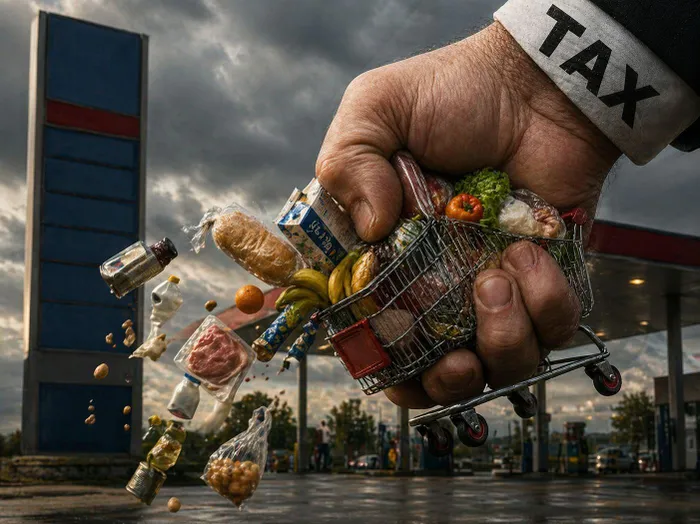
Could general living costs be in for an even bigger squeeze once the fuel tax relief dries up in July?
Image: AI / ChatGPT
Hate to say I told you so, but we raised this very issue back in February, when fuel prices were at four-year lows and South Africans – while mindful of tensions in the Middle East – had no idea that US attacks on Iran were about to send oil prices surging.
The gist of it was that South Africans are paying too much tax on fuel, and while less noticeable during the good times of low fuel prices, that fiscal state of affairs leaves us vulnerable to oil price shocks. Of course, this became painfully obvious to all South Africans after that first refuel in April.
Let's just say that if you got away with an unmortgaged house and both kidneys still attached, you did well.
High fuel prices have a devastating impact on everyone, with transport costs filtering through to almost every aspect of our daily lives. And it’s the least fortunate South Africans, who spend an alarming proportion of their wages on transport, that stand to suffer the most.
It was with great relief that National Treasury, together with the Department of Mineral and Petroleum Resources, announced temporary relief measures at the beginning of April, effectively cutting R3 per litre off the General Fuel Levy.
This certainly helped to cushion the blow of fuel price hikes that would have been in the region of R6 per litre for petrol and R10.50 for diesel, had the interventions not been implemented.
It came as a further relief when the two departments announced on Tuesday that the relief measures would extend into May, while the diesel tax reduction would be increased by a further 93 cents, effectively reducing the General Fuel Levy to zero for the month.
Thanks to this development, next month’s fuel price increases will likely be limited to around R2 for petrol and R4.20 for diesel.
ALSO READ: Where petrol and diesel are heading in May following the tax relief extension
Yet it is worrying that government has already announced an end date for the fuel relief measures.
During the month of June, it announced, the relief amount will be halved to R1.50 for petrol and R1.96 for diesel, with the intervention falling away completely at the beginning of July. This means South Africans will now be exposed to the full General Fuel Levy amounts of R4.10 on petrol and R3.93 on diesel.
This is regardless of what the oil price is doing – and as I wrote this, it was not doing very well, with Brent crude at $114 per barrel as Middle East talks appeared to have stalled.
Although it has spiked beyond this level in recent months, current fuel prices and May projections are based on oil being below $100 per barrel. In fact, to get back to the levels we last saw in March, our friend Brent will need to start hanging out below the $70 level once again.
So I’ll ask again – why is there an end date to the fuel relief when oil prices are hovering at multi-year highs?
Do they know something we don’t about an imminent oil price crash? We can only hope that is the case.
Because to expose South Africans to those oil prices, along with the full tax of around R4 and the controversial R2.25 per litre levy for the embattled Road Accident Fund, could be immensely damaging to South Africa’s general inflation rate, and citizens from the poorest households will suffer the most. The fact that government has not provided any relief for spiralling paraffin costs is quite telling.
I had an interesting conversation yesterday with Bobby Ramagwede, Chief Executive Officer of the Automobile Association, who said the biggest challenges of fuel pricing go far beyond what consumers are currently experiencing.
“The reality is that we need more than just a R3 reprieve, and we need it for more than just a month,” Ramagwede said ahead of Treasury’s announcement of a brief extension of the fuel relief measures.
When fuel prices start to rebase general prices, there will be serious consequences for the economy, he added.
“These are not normal times, and the measures that we’re meant to put on the table should reflect the times that we’re in.
“Yes, a lot of people would argue that we’re not going to collect as much revenue, but I often say to people, well, look at the back of the bus where you’re spilling copious amounts of money in the form of maladministration. It’s not that we can’t afford it, it’s that we’re refusing to accept what’s going on on the other end of the funnel, as a means of appreciating that we actually have the power to shelter both consumer and economy from this turbulent period.”
He said the R6 billion per month that the temporary fuel tax break is currently costing is a drop in the ocean as far as the broader fiscus is concerned.
“What the Finance Minister is not taking into account is that if he allows for this inflationary pressure to kick in by virtue of the fuel price, he is going to systematically exclude a large chunk of his economically active taxpayers. When they cease to participate [through retrenchments and business closures], where is he going to get the revenue then?
“So whilst he’s complaining about R6 billion, I reckon he’s going to lose out on north of R50 billion a month, because people can’t participate anymore because he’s allowed prices to run wild.
“And prices will and can run wild if you increase the fuel price, or allow it to remain inflated.”
Furthermore, Ramagwede feels the RAF does not require as much funding as it is currently receiving; it simply needs better administration. Even tightening the belt on administration, even at municipal level, will solve the problem.
“We still have a lever to pull, and we should view taxes as a uniform lever, and if the state really wants to do well by the broader economy, they should yank that lever in its entirety, and from there we’re on a hope and a prayer because we don’t have reserves,” Ramagwede concluded.
The bottom line is this: South Africans are already paying well over R6 per litre in fuel taxes and levies, without the temporary tax breaks. Surely this is a burden that should not have existed in the first place?
And when the chickens come home to roost, and the economy is in tatters as a result of fuel-related economic shocks, would the government not have lost a great deal more than it would have through extended fuel tax breaks?
Time is not on our side here.
IOL News
* Jason Woosey is a digital journalist at IOL.
** The views expressed do not necessarily reflect the views of IOL or Independent Media.