

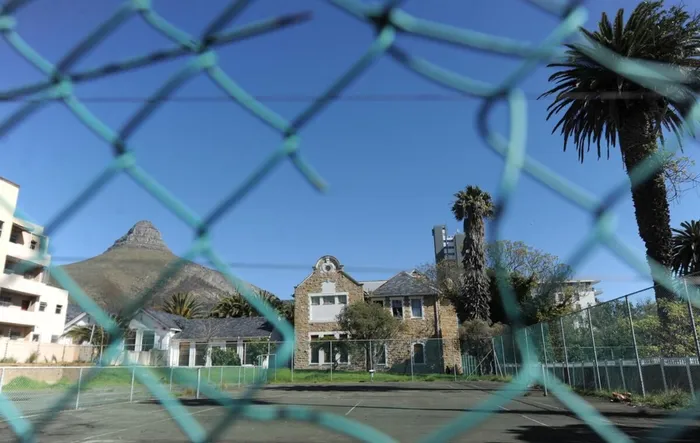
In 2016, this property in Sea Point was sold by the Western Cape Government to the Phyllis Jowell Jewish Day School for R135 million. This sale has now been overturned by the Constitutional Court.
Image: Armand Hough / Independent Media
In a landmark judgment, which delivers a damning indictment of the Western Cape Provincial Government and the City of Cape Town for failing to dismantle the legacy of apartheid spatial planning, the Constitutional Court on Thursday declared the sale of the Tafelberg site in Sea Point unlawful.
The court declared that both the city and the Provincial Government have failed to comply with their obligations to provide access to adequate housing and have failed to comply with their constitutional obligations in the implementation and completion of their respective social housing programmes, policies, and projects in the Cape Town CBD and Sea Point.
Both the city and the province were put on terms to submit a report to the Western Cape High Court within three months, setting out current policies and programmes for the provision of affordable housing in the CBD, including the steps taken to give effect to its constitutional obligations.
The province must also report on the steps taken to co-ordinate with the city and the national sphere of government in respect of the planning and implementation of affordable housing in the CBD.
The report must also include information regarding any policies, programmes, and projects that involve social housing in areas sufficiently close to the CBD that should, in the province’s opinion, be taken into account in assessing compliance with its obligations.
In August 2020, the Western Cape High Court handed down judgment in which it set aside the province’s sale of the Tafelberg site and declared that the Western Cape Government (WCG) and the city failed to redress spatial apartheid in the city.
It ordered the WCG and the city to provide a plan for how they will fulfil their obligations. This order was later overturned by the Supreme Court of Appeal.
In the opening to the unanimous judgment, penned by Judge Nonkosi Mhlantla, she commented that at its core, this case raises a fundamental constitutional question on how we address the enduring legacy of spatial apartheid.
Judge Mhlantla said a city’s architecture tells the story of its soul.
“In Cape Town, as in most, if not all, South African cities, that story remains one of division – where the echoes of apartheid’s spatial planning continue to reverberate through its streets and suburbs.”
She reflected on how every morning, thousands of Cape Town’s workers board buses, taxis, and trains in the pre-dawn darkness, travelling for hours from the city’s periphery to its centre.
“Their daily journey is not just a commute – it is a living testament to the enduring legacy of spatial injustice that this case glaringly exposes before this court.”
Activists want Tafelberg Properties, in Sea Point in central Cape Town, transformed into social housing units; however, the WCG argued that the site is not suitable for social housing and will again be used for a school.
The activists sought to have the court set aside the province’s sale of Tafelberg Properties to the Phyllis Jowell Jewish Day School for R135 million. They argued that the provincial government and city failed to redress spatial apartheid by not making available the well-located provincially owned land for social housing, which previously housed the Tafelberg Remedial School.
Judge Mhlantla, meanwhile, commented that housing policies must actively work to dismantle, rather than perpetuate, apartheid’s spatial legacy. These obligations become particularly acute when dealing with well-located State land in urban centres where historical dispossession occurred.
She further pointed out that the national government has a duty to:
However, the court cannot make an order against the government, as it was not a party to the proceedings.