

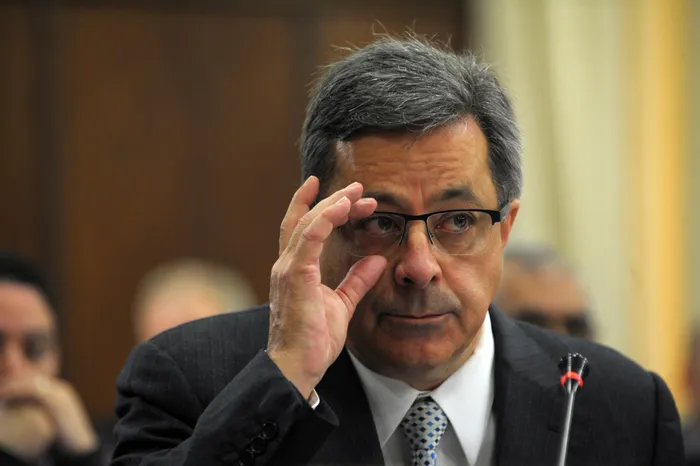
Former Steinhoff CEO Markus Jooste.
Image: Armand Hough | Independent Newspapers
The man accused of masterminding South Africa’s biggest corporate fraud allegedly shot himself on a cliff path in Hermanus hours before he was due to hand himself over to authorities.
Yet more than two years later, the state still has not provided the kind of public transparency that would settle one of the country’s most persistent and explosive conspiracy theories.
No public funeral. No confirmed burial site. No publicly released post-mortem. No inquest date. No public viewing of the body. And no definitive public accounting from the institutions responsible for investigating the death of former Steinhoff boss, Markus Jooste.
Instead, there has been silence, fragmented disclosures, and a trail of unanswered questions that has allowed speculation to thrive.
Now, as social media claims continue circulating that Jooste has allegedly been seen in Europe and South America under a different identity, public distrust surrounding the official version of events has only deepened.
And despite repeated attempts by IOL to obtain clarity, several key institutions either declined to answer material questions or failed to respond altogether.
The result is that, two years after Jooste’s reported death, South Africans are still being asked to accept one of the most consequential deaths in the country’s corporate history largely on trust.
On March 21, 2024, at approximately 3.20pm, emergency services were called to Kwaaiwater Beach in Hermanus after reports that a man had suffered a gunshot wound to the head.
That man was later identified as Jooste, the disgraced former Steinhoff chief executive accused of orchestrating accounting fraud that wiped out billions in shareholder value and devastated pension funds linked to the Public Investment Corporation.
According to police accounts, Jooste had apparently told his wife he was going for a walk while she left to play golf. He allegedly walked toward the cliff path area near the beach before shooting himself.
Emergency personnel reportedly found him alive and transported him to a private hospital, where he later died. The timing was extraordinary. Jooste had been instructed to surrender to the authorities the following day.
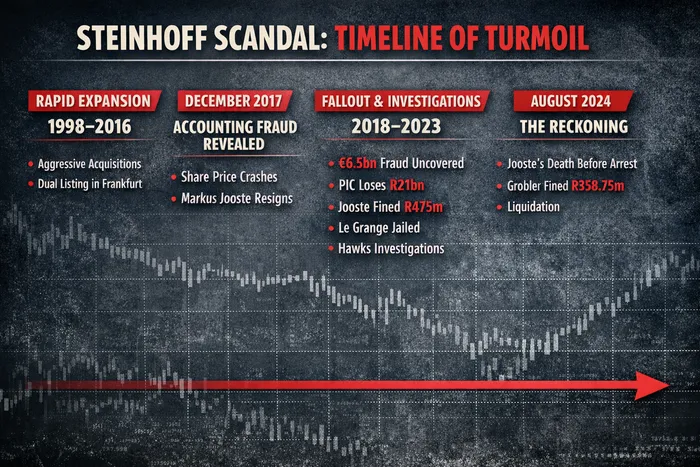
A brief timeline of Steinhoff's implosion.
Image: ChatGPT
The Directorate for Priority Crime Investigation, better known as the Hawks, together with prosecutors, were preparing to move against individuals implicated in the Steinhoff collapse.
His death came just one day after the Financial Sector Conduct Authority imposed a R475 million administrative penalty against him.
The regulator had concluded that Jooste and Steinhoff executives published deceptive financial statements between 2014 and 2017 that fundamentally misrepresented the company’s profitability and financial health.
The collapse of Steinhoff International became one of the biggest corporate scandals in modern South African history. Yet the man widely viewed as the central architect of the fraud never stood trial.
From the beginning, the circumstances surrounding Jooste’s death triggered scepticism. Unlike other prominent public figures, there was no funeral announcement, no memorial service, and no public confirmation of where he was buried or cremated.
Questions multiplied online. Then came reports that deepened the unease. According to earlier reporting by the Cape Argus, a police source claimed that more than a year after Jooste’s death, there was allegedly still no post-mortem report or morgue number attached to the inquest docket.
The source also reportedly questioned whether proof existed linking the firearm to the alleged suicide. That disclosure ignited a fresh wave of conspiracy theories.
Some South Africans compared the case to the death of Gavin Watson, whose fatal crash also became the subject of intense speculation. Others drew parallels with Thabo Bester, who was once officially declared dead before later being discovered alive after escaping prison.
The theories escalated further across social media platforms, where users began alleging that Jooste had been spotted in countries including Spain, Portugal, Greece, Malta, Brazil and Panama.
One widely circulated Facebook post claimed a man resembling Jooste was seen at a coastal property in Glentana on the Garden Route.
None of these claims has been verified, and there is no evidence placing Jooste outside South Africa after his reported death. But the persistence of the speculation speaks to something larger: a profound public distrust in official institutions and the absence of transparent public disclosure in one of the country’s most sensitive cases.
After months of limited public engagement on the matter, the South African Police Service this week provided a detailed response to questions posed by IOL.
In a statement, Western Cape police spokesperson Colonel André Traut confirmed that “all investigative processes applicable to the matter were followed”.
SAPS said a post-mortem examination was conducted on March 22, 2024 and that the relevant forensic reports form part of the official police docket.
The police also confirmed that ballistic testing had been conducted on the firearm involved.
“Emergency medical personnel and SAPS members responded to the incident after authorities were alerted on 21 March 2024. At the time emergency services arrived on the scene, the individual was still alive and was subsequently transported to a medical facility where he later passed away,” Traut said.
He added: “The deceased was formally identified during the investigation process and statements from relevant persons were obtained and included in the docket.”
Police further confirmed that the firearm underwent forensic examination and that the docket had since been submitted to the NPA before being referred to court for an inquest hearing.
“The docket was submitted to the National Prosecuting Authority for legal consideration and has since been referred to the court for an inquest hearing. This process is yet to be concluded and media enquiries in this regard are best addressed by the Department of Justice,” Traut stated.
But critically, SAPS did not provide the post-mortem report itself, did not indicate whether the findings would be made public before the inquest, and did not disclose when the inquest would take place.
The South African Reserve Bank also responded to questions regarding Jooste’s financial investigations and the status of assets attached through exchange control proceedings.
The central bank confirmed that investigations connected to alleged exchange control violations remain active beyond Jooste himself.
Former Steinhoff director Hein Odendaal was fined R2 million for his part in the fraud.
Image: ChatGPT
“The SARB’s investigation into possible contraventions of the Exchange Control Regulations is broader than the late Mr Markus Jooste,” the bank stated.
It added that confidentiality provisions under the SARB Act prevented it from disclosing further details about ongoing investigations.
The SARB also confirmed that a financial shortfall remains and that recovery processes against “numerous persons and/or entities remain ongoing”.
Questions surrounding the attached assets remain unresolved.
Those assets reportedly included Lanzerac Wine Estate, Stellenbosch properties, luxury vehicles and holdings connected to Mayfair Speculators and the Silver Oak Trust.
When asked whether any assets had been released following Jooste’s death, the SARB declined to provide specifics.
“Save for what has been published in the Government Gazette in relation to the assets of the late Mr Markus Jooste, the SARB is not at liberty to divulge further information,” it said.
The bank also refused to comment on whether investigators had identified offshore accounts, shell companies or foreign asset structures linked to Jooste.
The unresolved status of the inquest has become central to the controversy.
An inquest is the legal mechanism through which a magistrate examines the circumstances surrounding a death and makes formal findings.
Until that process is completed, critical questions remain unresolved in the public domain.
Political analyst Kenneth Kgwadi said public scepticism reflects collapsing trust in state institutions.
“Markus Jooste’s death remains a mystery, details are very sketchy, and to be honest, I am not absolutely convinced that he died,” Kgwadi said.
“The public’s engagement with these theories signals a deep loss of confidence in the agencies meant to bring closure to such high-profile cases. The police’s silence is concerning.”
The consequences extend far beyond public curiosity. Jooste’s death effectively halted what would likely have been one of the most significant white-collar criminal prosecutions in democratic South Africa.
Executives implicated alongside him now face legal scrutiny without the central figure in the alleged fraud scheme ever answering questions in court.
Nearly ten executives were named in the forensic investigation conducted by PricewaterhouseCoopers into the Steinhoff scandal.
Yet the man accused of leading the scheme died before criminal proceedings could begin. For pensioners, shareholders and ordinary South Africans who suffered catastrophic losses, the lack of judicial accountability continues to sting.
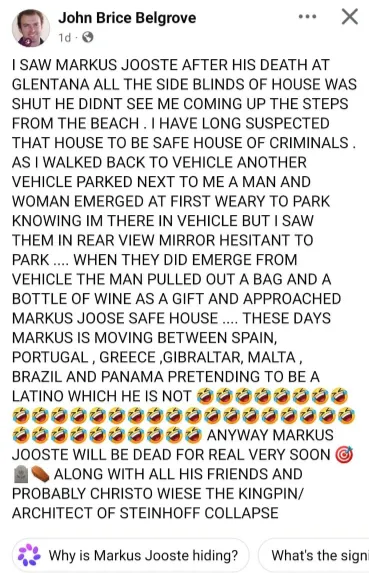
One of the posts that has been circulating online claiming that Markus Jooste is still alive
Image: Facebook
Two years later, the most basic questions remain unanswered publicly:
Until those questions are answered in open court, the rumours surrounding Markus Jooste are unlikely to disappear. Because in the absence of transparency, suspicion has filled the vacuum left behind.