

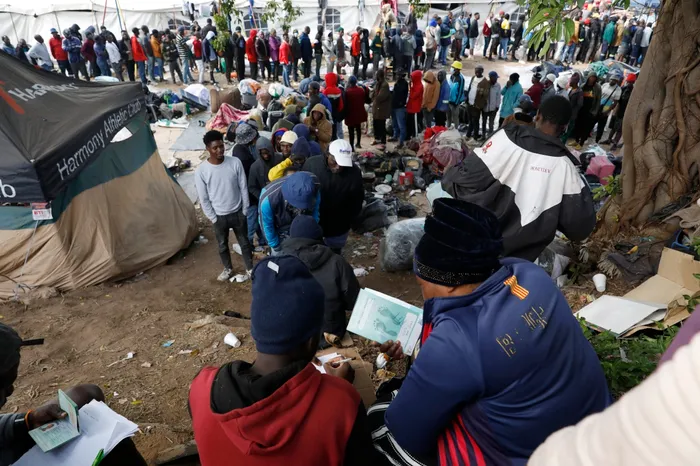
Durban under strain as authorities accelerate removals and NGOs warn of humanitarian risk at Sherwood.
Image: DOCTOR NGCOBO
"I haven't bathed in seven days."
These are the words of a 25-year-old Malawian man sheltering at the overcrowded Sherwood site in Durban, where thousands of migrants are awaiting processing and repatriation.
Having lived in South Africa for the past two years, he described a life now reduced to long queues, uncertainty and deteriorating sanitary conditions, while insisting that his frustration is directed not at his host country but at delays in returning home.
"I've been in South Africa for two years. Normally, I can say it's good, but it depends because some South Africans are good, and some are not. To me, I can say it’s 50-50 for South Africa," he said.
Although he arrived at the site on June 10, he added that "some people here have been here for maybe one and a half weeks. We have water and food, but there are too many people here, so when it comes to sanitation, it's very poor."
He said air in parts of the camp was heavy with the smell of urine and sweat, reflecting the overcrowded conditions and limited access to sanitation facilities, despite efforts to provide water, waste removal and cleaning services.
The scent of mass-prepared food lingered in the background, offering brief relief but doing little to mask the strain of prolonged congestion at the site.
He described dirty toilets and repetitive meals, saying conditions have become increasingly difficult as the site grows more congested.
Despite the hardship, the young man praised law enforcement for protecting those gathered at Sherwood during recent tensions.
“We're angry with our government. We can’t say we're angry with South Africa. We need our government to help us, while these South Africans are helping to keep us safe," he said.
He added that police intervened when a group allegedly attempted to attack the site. His hope remains simple and immediate: “We need to leave this place, even now.”
However, the group of more than 10,000 people clashed with police on Wednesday morning, allegedly throwing stones at the authorities. Police responded with stun grenades and teargas.
"Police had to use minimum legal force to disperse the crowd which had become unruly. Stability and order have been restored, with police continuing to monitor the situation," said KZN police spokesperson, Colonel Robert Netshiunda.
Immigration expert Craig Smith described the crisis as symptomatic of deeper policy and societal failures.
"The Sherwood crisis is a manifestation of the failures of our disgraceful and apathetic attitude to foreigners in South Africa," he said.
"It is evident from the top down to high-net-worth individuals to those who are extremely vulnerable like the present xenophobic violence especially in Durban."
He said that Malawian workers had made a significant but under-recognised contribution to the country's economy and labour market.
"The resource pool of Malawian workers is an extremely productive workforce. They are committed to work and remain loyal and conscientious members of society."
He continued: "They have integrated extremely well in South Africa, whether in the informal or more formal sectors, and it is high time that their value and contribution to our economy is properly recognised by Home Affairs our government."
Smith also levelled criticism at current immigration enforcement practices, alleging procedural irregularities.
"Home Affairs is flouting the immigration laws by attempting to literally 'ship out' thousands of Malawians whether through so-called rogue 'virtual priority courts' or 'herding' them up in large groups and arbitrarily coercing them to be detained and deported against their will despite their rights to contest any such conduct."
He also questioned the consistency of South Africa's immigration policy, claiming that other nationalities had previously benefited from regularisation pathways.
"The fundamental question is why have Malawians not been given similar treatment by Home Affairs by being offered, as in the case of other nationalities, been offered any form of amnesty to remain and work in South Africa just like the Zimbabweans, Angolans, Lesotho nationals have received over the last fifteen years," he said.
Smith also claimed that current approaches amounted to unequal treatment,
"It is my view that it is xenophobic on the part of Home Affairs and government not to give an amnesty. The Mtalawians in South Africa have the same rights to lawful, reasonable and procedurally fair conduct on the part of our government as well as their rights to dignity as ensconced in our Constitution as South African citizens."
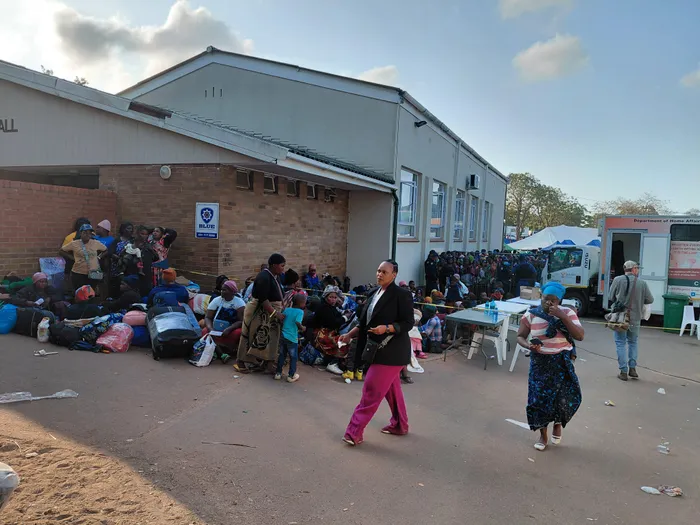
Sherwood tensions deepen as overcrowding and deportations intensify in Durban operation.
Image: XOLILE MTEMBU
Sithembiso Ngema, DA provincial leader, visited the area and said the visit followed sustained concerns from residents and stakeholders.
"We are here to conduct oversight after complaints and a number of service delivery issues in terms of assisting the people that are here,” he said.
He claimed that authorities had been slow to respond despite earlier warnings. "City officials and the executive took this matter lightly and now we are where we are."
Ngema also raised concerns about public safety and coordination during the early stages of the crisis.
"At the time, there were attempts to stop police from intervening, and metro police were nowhere to be seen," he said, arguing that gaps in enforcement had contributed to the current pressures at the site.
"These situations are also avoidable if we can understand the humanitarian, but also there were marches that were taking place, and nobody paid attention to ensure engagement with those people."
This comes as eThekwini Municipality Mayor Councillor Cyril Xaba announced a series of urgent interventions aimed at easing pressure at the site and accelerating the processing of Malawian nationals.
Working with the Departments of Justice and Constitutional Development, Home Affairs, the South African Police Service and other stakeholders, he said the city has committed to implementing measures within 72 hours to improve conditions and speed up deportations.
He added that the Drive-In Site has been activated as an overflow staging area, deployed buses to transport migrants for processing, and increased security, healthcare services, ablution facilities and water supply.
"The interventions are intended to stabilise the situation at this site (Sherwood), reduce humanitarian and public health risks, support the ongoing processing of migrants, and expedite deportation processes."
The mayor stressed that each undocumented foreign national must be processed individually under South African law before deportation can take place, with identity verification, legal documentation and court appearances forming part of the process.
A virtual court has already been established at Sherwood, while six additional courts are expected to increase capacity.
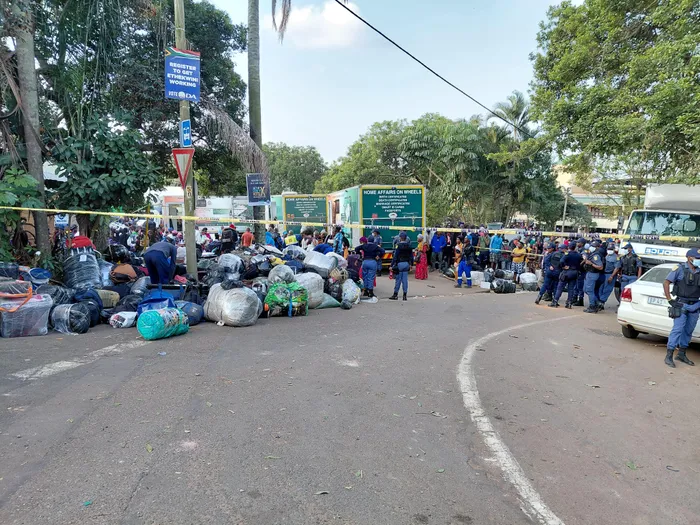
Inside Sherwood camp: migrants describe long waits, poor sanitation and uncertainty over repatriation.
Image: XOLILE MTEMBU
More than 1,400 people have already been deported, with further buses travelling to Malawi as authorities seek to resolve a humanitarian situation that continues to test both the migrants waiting to return home and the agencies tasked with assisting them.
Dr Raymond Perrier, director of the Denis Hurley Centre in Durban, stressed that authorities carried a binding obligation under South Africa's constitutional framework.
"The mayor and all government officials had a legal duty to respect, protect, promote and fulfil the rights promised by the Constitution," he said.
He added that this applied to all individuals without exception. "Political expediency, a quick fix, or responding to a loud mob was not what the South African Constitution promised 30 years ago."
He warned against approaches that could undermine due process and human dignity.
The Gift of the Givers Foundation said it had mobilised support for individuals returning home on buses provided by the Malawian government, working in coordination with Home Affairs and Border Control.
It added that relief supplies were distributed to ease the difficult journey. "With support from Home Affairs and Border Control, our teams distributed Female Care Packs and five-litre bottles of water to help passengers endure the demanding two-day journey."
For those still awaiting processing at the site, the organisation said basic relief items had been provided to mitigate harsh conditions.
"Special attention given to mothers with babies and vulnerable women who were sleeping on cardboard and using plastic sheets for warmth," the statement read.
The organisation also noted that diplomatic engagement had taken place. "The Malawian Director General expressed sincere appreciation for the compassion and support extended to Malawian citizens during this difficult period."
The foundation emphasised that its work was grounded in a non-discriminatory humanitarian ethos.
"At Gift of the Givers, we believe that humanity knows no boundaries. In times of hardship, our responsibility is to assist those in need, regardless of nationality, race, religion, or circumstance."
IOL