

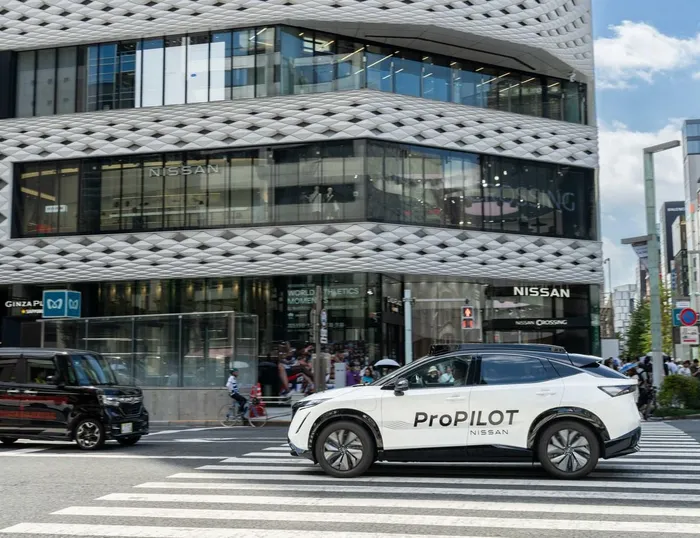
Nissan is advancing its autonomous mobility efforts with real-world tests of its next-generation ProPILOT system in Tokyo.
Image: Supplied
Nissan has taken its next step towards autonomous mobility, beginning real-world demonstrations of its next-generation ProPILOT system on the streets of Tokyo.
Using a fleet of all-electric Nissan Ariya prototypes, the company is testing how its latest driver-assist technology performs in dense, unpredictable urban traffic, which has traditionally exposed the limits of automation.
The system is scheduled for production rollout in Japan from 2027, but these early demonstrations show how far the technology has progressed beyond highway assistance.
At the core of the system is the “Wayve AI Driver”, developed by UK-based Wayve. Unlike traditional rule-based systems, Nissan says this software learns to drive more like a human, interpreting entire scenes rather than reacting to isolated objects.
It uses camera data to understand how traffic situations evolve, allowing it to anticipate movements and adapt in real time. The result, according to Nissan, is smoother and more natural driving behaviour, particularly in complex environments such as intersections, pedestrian-heavy zones and multi-lane traffic.
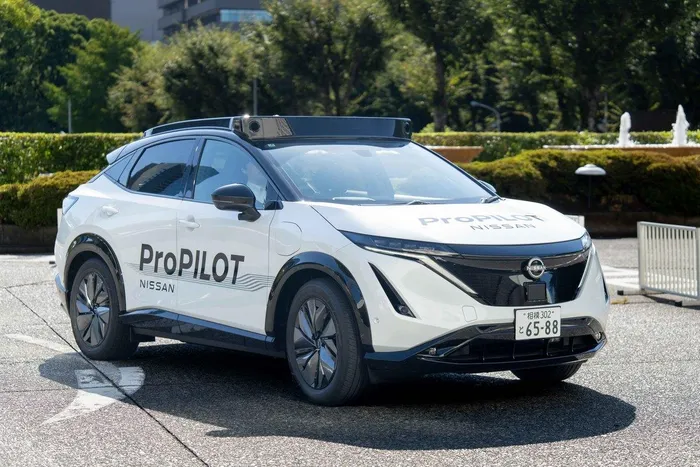
This is paired with Nissan’s “Ground Truth Perception” system, which integrates next-generation LiDAR mounted on the roof. The sensor improves long-range object detection, especially in low-light or high-speed scenarios
Each prototype vehicle is equipped with 11 cameras, five radar units and advanced LiDAR. The layered approach ensures redundancy and accuracy, key factors in building trust in semi- and fully autonomous systems.
Nissan Chief Technology Officer Eiichi Akashi said the next system aims to feel like “a skilled human driver is behind the wheel.”
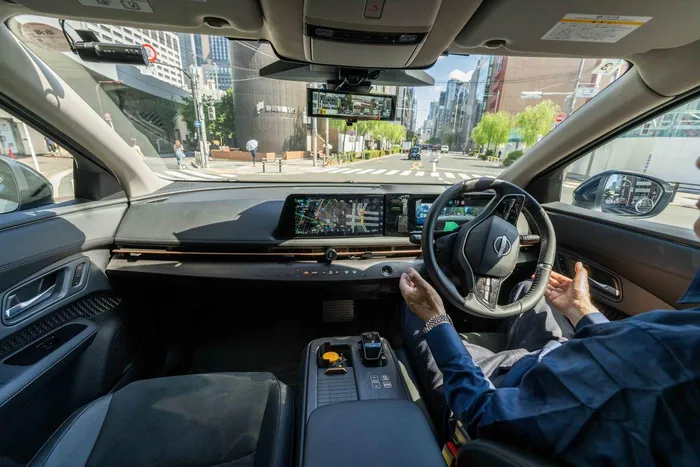
The system uses camera data to understand how traffic situations evolve, allowing it to anticipate movements and adapt in real time.
Image: Supplied
We accompanied one of the engineers on a route through the streets of Tokyo, and it worked virtually flawlessly.
It did indeed feel like a skilled human driver as it negotiated the busy streets and intersections.
In Tokyo, pedestrians always have the right of way, but unlike in South Africa, they always use pedestrian crossings. Sensing people waiting to cross, the car stops accordingly, waits and then continues.
At one intersection, there was a person standing at the crossing on his phone. The car waited for a while, saw he wasn’t going to move, and drove forward. When a traffic light turned red between two pedestrian crossings, the car inched forward so as not to obstruct the crossing in any way.
There was some construction going on, obstructing a lane, and it slowed down, put the indicator on, waited for a gap and moved into the next lane.
In one instance, though, it activated the indicator at an intersection before the one we were scheduled to turn, a minor hiccup if you take the overall ability of the system into consideration.
It remains to be seen whether this type of system and changing of legislation would be possible in South Africa.
Image: Supplied
Around the world, several cities are already deploying or trialling autonomous e-hailing services.
In the US, Phoenix and San Francisco have become a focal point for robotaxi services, with fully driverless ride-hailing already available to the public.
China has accelerated even faster, with large-scale pilot projects in Beijing, Shanghai and Shenzhen, where autonomous taxis operate in designated zones.
Singapore continues controlled testing, while Dubai has outlined plans for a significant portion of trips to be autonomous by the next decade. European trials are also underway in London, and South Korea is also doing tests in Seoul.
It remains to be seen whether this type of system and the changing of legislation would be possible in South Africa.
With our crumbling road infrastructure, broken traffic lights, erratic and dangerous driving, homeless people directing traffic at intersections and our general lack of respect for the rule of law and road rules, we are still a long way off from implementing this type of technology.