

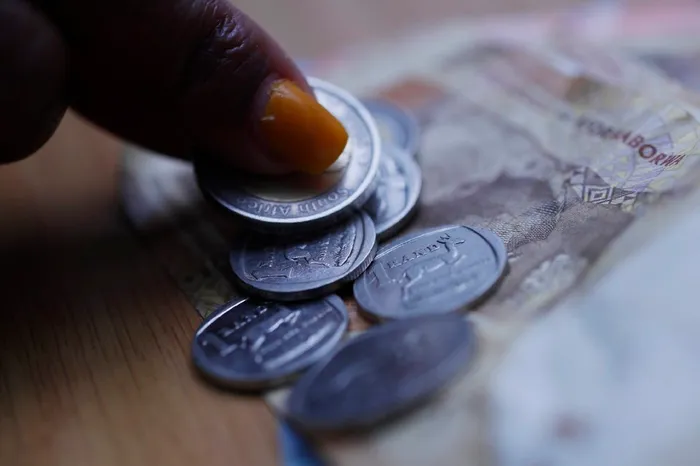
BR Diamonds The rand remained resilient after the US Federal Reserve left interest rates unchanged, although economists warned that escalating Middle East tensions continued to cloud the global economic outlook.
Image: Simphiwe Mbokazi/Independent Newspapers.
The South African rand remained broadly stable on Thursday after the United States Federal Reserve kept interest rates unchanged, while investors continued to assess the impact of renewed conflict in the Middle East on global inflation, oil prices and financial markets.
The Federal Open Market Committee (FOMC) left its benchmark interest rate unchanged at between 3.5% and 3.75%, marking its fifth consecutive decision to pause monetary policy.
Investec chief economist Annabel Bishop said the decision had little immediate effect on the rand.
"The rand has seen little impact. At R16.71 to the US dollar, it is similar to the day before, with flat US interest rates expected, and unlikely to cause rand weakness as a US interest rate hiking cycle typically does," Bishop said.
She noted that the Federal Reserve continued to acknowledge the resilience of the US economy while maintaining its commitment to lowering inflation.
According to Bishop, Federal Reserve Chair Kevin Warsh stressed that policymakers were deliberately avoiding forward guidance because uncertainty remained elevated.
"He added that the policy statement conveys just the facts. It is steering clear of forecasting," she said.
Bishop said investor sentiment had also been supported by the Federal Reserve's balanced approach.
"The FOMC produced a balanced and supportive statement for its goals, supportive of investor sentiment," she said.
She added that the latest inflation figures would be closely watched.
"June's PCE inflation is expected to drop to 3.7% year on year from 4.1%, while core inflation is expected to ease to 3.3%."
Markets, however, remained focused on developments in the Middle East after Iran and the United States resumed military strikes following a brief ceasefire.
Nigel Green, CEO of deVere Group, said geopolitical developments had become a far more significant influence on monetary policy than domestic economic indicators.
"The Fed used to set policy based on jobs numbers and inflation prints. Right now they are setting it based on missile strikes and oil futures," Green said.
"This is not a normal environment for monetary policy, and pretending otherwise does households and businesses a disservice."
He warned that consumers were increasingly exposed to geopolitical risks beyond their control.
"Your mortgage rate, your savings return, your pension performance, all of it is now partly hostage to events in the Middle East that no central banker controls."
Green said the Federal Reserve's latest decision should not be interpreted as a sign that risks had subsided.
"The Fed did not hold because it is confident. It held because it does not yet know which way this conflict breaks."
"This is a very different message to the one markets want to hear, and investors treating this as reassurance are misreading it."
He added that investors should prepare for prolonged uncertainty.
"Geopolitics has become the bigger variable, and portfolios, mortgages and retirement plans built without that in mind are exposed in ways people have not fully priced in yet."
"Anyone waiting for things to go back to how they were before this conflict started is likely to be waiting a long time."
Citadel Global managing director Bianca Botes said markets remained volatile despite the Federal Reserve's widely anticipated decision.
"With the Federal Reserve keeping interest rates steady, as expected, with three votes in favour of a hike and no forward guidance. Meanwhile, the United States and Iran continued their strikes against each other," Botes said.
"The stop start conflict in Iran continues to cause volatility in oil markets with the oil price climbing, before taking a breather on Thursday morning to trade just below the 90 dollar a barrel mark."
Botes added that a weaker US dollar had provided some support for the local currency.
On Thursday afternnoon, the price of Brent Crude was at $89 per barrel, and the rand traded at R16,58 against the US dollar.
Looking ahead, Bishop said financial markets would continue monitoring inflation, economic growth and geopolitical developments, with uncertainty likely to remain the dominant theme for global investors in the months ahead.
Follow Business Report on Facebook, X and on LinkedIn for the latest Business and tech news.