

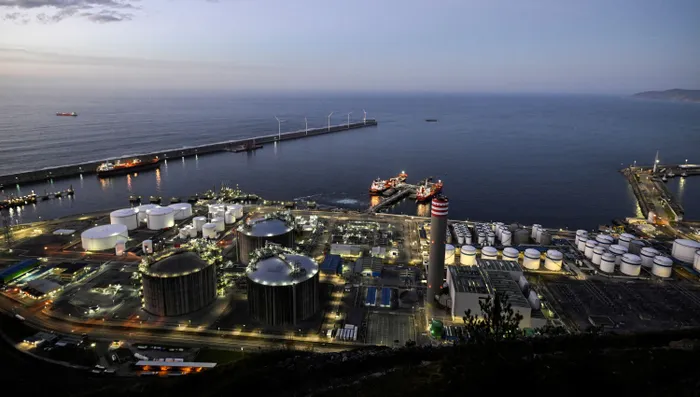
Renewed military action between the United States and Iran pushed oil prices sharply higher, weighed on global equities and placed investors back into risk off mode.
Image: Ander Gillenea / AFP
Renewed military tensions between the United States and Iran unsettled global financial markets on Wednesday, sending oil prices sharply higher, weighing on equities and reigniting concerns over supply disruptions through the Strait of Hormuz.
According to Anchor Capital's market commentary, the conflict premium has returned rapidly after the United States launched strikes against dozens of Iranian targets in response to attacks on ships in the Strait of Hormuz.
Brent crude climbed from $71 a barrel to more than $76 a barrel in just two trading sessions as fears over global energy supplies resurfaced.
The renewed escalation reversed weeks of declining oil prices that had followed optimism around a peace agreement announced only three weeks ago.
The JSE was not immune to the shift in investor sentiment, with the All Share Index falling 0.8% to close at 110 325.50. Platinum miners, gold miners, banks and telecommunications shares all came under pressure as investors reduced exposure to risk assets.
Technology giants Naspers and Prosus were among the few bright spots, gaining 5.2% and 4.2% respectively.
Global equity markets also reflected growing caution.
In the United States, the S&P 500 slipped 0.4%, the Nasdaq declined 1.2% and the Dow Jones Industrial Average lost 0.2%. Semiconductor companies led the declines, with Intel dropping 9.7%, AMD falling 6.5% and Micron Technology losing 4.7% as concerns around artificial intelligence valuations continued alongside geopolitical uncertainty.
Asian markets were mixed on Wednesday morning as investors assessed the latest developments. Japan's Nikkei 225 declined 0.7%, while South Korea's Kospi fell 1%. Hong Kong's Hang Seng, however, advanced 2%.
Energy companies benefited from the sharp increase in oil prices. In the United States, Devon Energy gained 5.1%, Diamondback Energy rose 3.9% and Chevron climbed 3.5%.
Anchor Capital noted that Brent crude had risen 3% on Tuesday before climbing a further 2.6% during early Wednesday trade.
"The US military has launched strikes against dozens of Iranian targets in response to tanker attacks," the firm noted.
Gold initially fell 1.6% as investors waited for the release of the US Federal Open Market Committee minutes but later recovered some losses as demand for safe haven assets returned.
The rand weakened against the US dollar during Tuesday's trading as geopolitical tensions intensified, although early Wednesday trade showed the local currency recovering modestly. At 05:30 SAST, the rand traded at R16.26 against the dollar, R18.56 against the euro and R21.72 against the pound.
Bond markets also reflected the cautious mood, with South Africa's 10 year government bond yield edging higher to 8.34%.
Elsewhere, Germany provided a positive economic surprise after industrial production increased by 0.9% month on month in May, marking a second consecutive month of growth. In the United Kingdom, the Lloyds house price index rose 0.2% in June, the first monthly increase in four months.
Corporate developments also remained in focus.
One of the most significant announcements for South Africa was Abu Dhabi National Oil Company's agreement to acquire Shell's fuel supply business in South Africa, giving the UAE state energy company a larger footprint in Africa's biggest economy.
Anchor Capital described the transaction as "part of a broader Gulf state push into African energy markets."
In Europe, banking regulators also intensified scrutiny of artificial intelligence, warning that advanced AI models could pose systemic risks to the financial sector. Banks have reportedly been given four months to strengthen their defences against AI driven cyber threats.
Meanwhile, Airbus announced a joint venture with MTU Aero Engines to develop hydrogen aircraft propulsion technology, marking another step towards the aviation industry's decarbonisation efforts.
Investors are now expected to monitor developments in the Middle East closely, with oil prices, inflation expectations and central bank policy likely to remain highly sensitive to further geopolitical developments.
Follow Business Report on Facebook, X and on LinkedIn for the latest Business and tech news.