

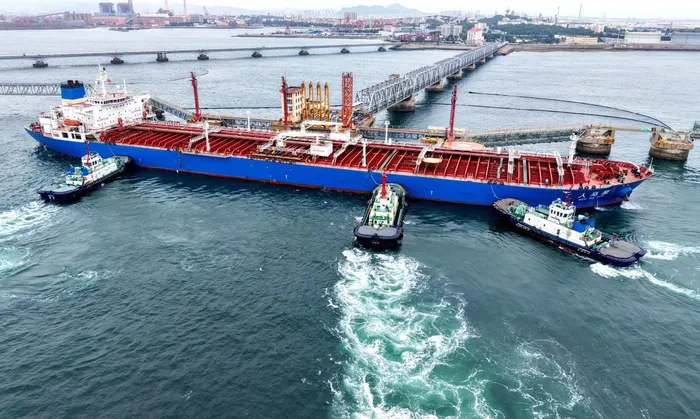
Global markets rallied and oil prices fell sharply after the US and Iran agreed to a framework aimed at reopening the Strait of Hormuz, but analysts warn the road to normalisation could take months.
Image: AFP
Global financial markets surged this week after the United States and Iran announced a breakthrough peace agreement that is expected to pave the way for the reopening of the strategically important Strait of Hormuz, a vital shipping route through which roughly a fifth of the world's oil supply normally passes.
The prospect of easing tensions in the Middle East triggered a sharp rally across global equity markets while sending crude oil prices lower as investors unwound some of the geopolitical risk premium that had been built into energy markets over the past three months.
Neil Wilson, investor strategist at Saxo UK, said the agreement had significantly improved investor sentiment.
"Let the oil flow," Wilson said, referencing US President Donald Trump's comments following the announcement.
"The deal is seeing investors take some geopolitical risk premia off the table."
Wilson noted that European stock markets rallied strongly, with reopening trades leading gains as investors anticipated improved economic conditions and lower energy costs.
"We are seeing equity markets in relief rally mode. Nonetheless, the mood is decidedly risk on," he said.
Brent crude dropped around 5%, while US benchmark West Texas Intermediate fell below $80 a barrel, reaching its lowest level since the conflict began in March.
However, despite the positive market reaction, analysts caution that restoring normal oil flows will take time.
Paul Gooden, head of natural resources at Ninety One, said the reopening of the Strait of Hormuz would help ease pressure on global energy markets but warned that the disruption has left lasting damage.
"A re-opening of the Strait of Hormuz will ease the squeeze on global oil markets, especially as tankers and seafarers who have been unable to leave the Strait for more than three months head for the exit," Gooden said.
"However, it will take several months to fully normalise flows, and we estimate that global oil inventories have shrunk by more than one billion barrels since the start of the conflict."
He added that oil markets may continue to feel the effects of the crisis for years as governments seek to rebuild depleted strategic reserves.
"Oil markets will therefore likely suffer a hangover for several years as governments seek to rebuild inventories and insulate themselves from further geopolitical shocks."
Wilson echoed similar concerns, warning that investors may be underestimating the complexity of rebuilding relations between Washington and Tehran.
"The realisation will dawn on markets that unwinding the Gordian knot of US Iran relations will take time. Energy prices will decline slowly rather than suddenly," he said.
The peace agreement has also shifted attention back to central banks and the inflation outlook.
Lower oil prices are expected to reduce some inflationary pressure globally, which could support financial markets and lower bond yields.
Investors interpreted the agreement as reducing risks to inflation and economic growth, contributing to gains across equity markets in Europe, Asia and the United States.
Wilson believes policymakers are unlikely to rush into cutting interest rates.
"Inflation remains elevated at the same time as optimism rises for the global economy, which means it is not a good time for the Federal Reserve to cut."
Gooden said investors will closely monitor shipping activity through the Strait of Hormuz in the coming weeks.
"We will be keeping a close eye on the pace of tankers re entering the Strait in coming weeks, as opposed to exiting, as this will provide a clue as to how quickly flows can normalise."
While markets have welcomed the breakthrough, analysts agree that the coming months will be crucial in determining whether the agreement marks the beginning of lasting stability or merely a temporary pause in tensions.
For now, investors are embracing optimism, but the global economy remains heavily dependent on how quickly one of the world's most important energy corridors returns to normal.
Bianca Botes, managing director at Citadel Global, highlighted the resounding shift to a “risk-on” mood across markets, signalling optimism in the wake of this historic accord.
"Additionally, the ongoing negotiations between the US and Iran take centre stage as anticipation builds for the signing of the final deal this coming Friday," Botes said.
"However, the complexities of these discussions carry inherent risks, particularly regarding the potential for renewed military actions should an accord fail."