

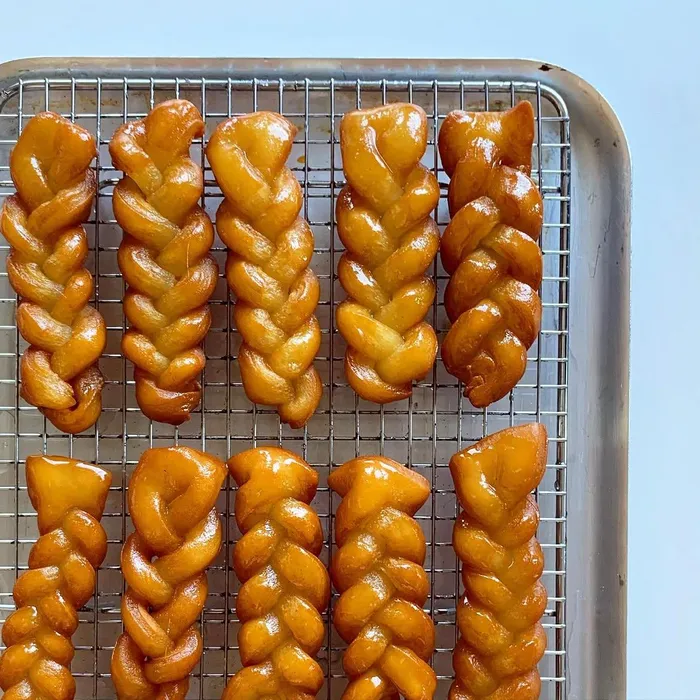
Crisp on the outside, sticky with syrup and soft in the middle, they're worth every bit of effort.
Image: Instagram / warrenmendes
Few South African treats are as satisfying as a freshly made koeksister. Crisp on the outside, sticky with syrup and soft in the middle, they're worth every bit of effort.
But while homemade is always best, koeksisters have a reputation for being one of the trickier bakes to master.
The plaits can unravel, the syrup doesn't always soak in and getting that perfect crisp shell takes a little know-how.
The good news is that most problems come down to a handful of common mistakes.
Avoid them, and you'll be rewarded with beautifully golden, syrup-soaked koeksisters that taste every bit as good as the ones you've grown up eating.
If you've ever bitten into a koeksister that's beautifully sticky on the outside but dry in the middle, chances are the syrup wasn't cold enough.
One of the secrets behind traditional homemade koeksisters is the dramatic contrast between piping hot pastries and ice-cold syrup.
That temperature difference helps draw the syrup deep into the pastry while keeping the outside deliciously crisp.
To give yourself the best chance of success, make the syrup several hours before you start frying.
Many experienced home bakers even place the syrup bowl inside a larger bowl filled with ice to keep it as cold as possible throughout the cooking process.
It's also worth giving each koeksister enough time to soak. A quick dip may coat the outside, but it won't allow the syrup to reach the centre.
Plaiting is often the part that puts people off making homemade koeksisters, but it becomes much easier with a little practice.
The biggest mistake is pulling the braid too tightly. The dough needs room to expand as it fries. At the same time, plaiting too loosely can cause the strips to separate in the oil.
Try to cut your strips as evenly as possible, braid them gently and pinch the ends firmly before frying. Even if your first few aren't picture-perfect, they'll still taste just as good.
Nothing ruins a homemade koeksister faster than a greasy finish.
The biggest culprit is oil that's too cool. Instead of crisping the outside, the dough absorbs the oil, leaving the finished koeksisters heavy and oily.
Overcrowding the pot has the same effect because every new piece of dough lowers the oil temperature.
Frying in smaller batches may take a little longer, but it produces a much better result. If you have a kitchen thermometer, aim to keep the oil between 170°C and 175°C.
Golden brown doesn't always mean fully cooked.
If the oil is too hot, the outside browns quickly while the inside remains undercooked.
Rolling the dough too thick can also cause problems because the centre simply doesn't have enough time to cook before the outside is done.
Keeping your dough an even thickness and maintaining a steady oil temperature will help ensure every koeksister cooks evenly from the outside in.
It can be tempting to keep adding flour if the dough feels sticky, but that often creates a heavier, tougher koeksister.
The dough should feel soft and slightly tacky rather than dry.
Handle it gently, flour your work surface instead of the dough itself where possible, and avoid overworking it. Too much kneading develops the gluten and can affect the final texture.
Giving the dough time to rest before rolling it out also makes it easier to work with and helps create a lighter result.
If your homemade koeksisters don't all look identical, don't be discouraged.
Even experienced bakers will tell you that every batch has a little personality.
Focus on cutting evenly sized strips, keeping your plaits consistent and frying them in small batches. Before long, you'll find your rhythm, and the shaping will become second nature.
Remember, it's the flavour and texture that matter most.
Before you tie on your apron, keep these simple tips in mind:
Homemade koeksisters may take a little patience, but they're one of those recipes that become easier every time you make them.
Once you've mastered the balance between soft dough, neatly plaited strips, hot oil and icy syrup, you'll understand why generations of South Africans continue to swear that nothing beats a homemade koeksister.