

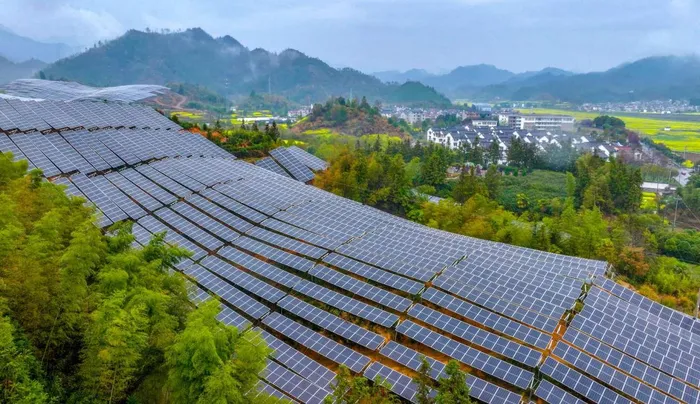
A 40 MW solar-plus-camellia oleifera project in Songjing village, Hangzhou, east China's Zhejiang province. A report shows that Africa's renewable energy workforce currently accounts for just 2% of the global total, despite the continent holding 60% of the world's best solar resources.
Image: Yang Bo
A recently released report has unveiled a promising outlook for South Africa's green economy, forecasting the creation of up to 4.3 million jobs by 2050. However, it also raises alarm bells regarding the potential for these positions to be predominantly low-paid and out of reach for many, particularly women. The findings, part of a study titled Unlocking Africa’s Green Transition: Opportunities Towards a Green and Inclusive Workforce, were launched by financial sector development agency FSD Africa in collaboration with Shell Foundation and Shortlist.
The report indicates that as the green economy begins to take shape, South Africa is projected to generate 1.3 million green jobs by 2030, before escalating to 4.3 million by 2050. Unlike most African nations where job growth is primarily spurred by decentralised and service-led industries, South Africa's trajectories are rooted in utility-scale infrastructure. The report identifies key sectors such as energy, waste recycling, and agriculture — particularly cold-chain solutions — as pivotal for job creation.
Despite these promising figures, serious issues around job quality and inclusivity loom large. More than 93% of current green workers earn less than $5 000 (R81 000) annually, largely due to the prevalence of entry-level, labour-intensive roles in areas such as construction and waste collection. Alarmingly, two-thirds of these workers earn below the lowest income band, indicating limited avenues for economic advancement. Women's participation in green jobs also remains stagnant, accounting for just 25% of the workforce.
“South Africa’s green transition is on a strong footing, but without deliberate policy interventions, it risks enlarging low-income employment rather than creating genuine economic mobility and excluding women from much of the workforce,” warns Kevin Munjal, Director of Development Impact at FSD Africa.
The report outlines several systemic barriers that South Africa must confront to maximise its advanced green policy frameworks. With all of the projected green jobs for 2030 concentrated in the energy and waste sectors, diversifying into agriculture and nature is crucial to mitigate risks associated with overconcentration. Furthermore, structural barriers inhibiting women's participation, such as inadequate workplace facilities and transport concerns, must be rectified to fully leverage the domestic labour force.
Currently, many jobs are temporary, concentrated in construction phases. However, by 2050, more permanent roles related to technologies like battery storage and smart grids are expected to predominate. If South Africa is to fill these skilled positions with local talent, there is an urgent need to enhance the domestic workforce's capabilities.
The report hones in on critical priorities for South Africa to prevent setbacks in its Just Transition efforts and fully realise inclusive, high-quality employment opportunities. Essential actions include:
On a broader scale, South Africa stands as a key player in an anticipated continent-wide green jobs boom, with projections suggesting that 3.8 million to 7.9 million jobs could be created in Africa by 2030, escalating to between 65.9 and 84.5 million by 2050. These opportunities will hinge on strategic policy decisions and the prioritisation of workforce development, particularly given that Africa’s renewable energy workforce currently accounts for only 2% of the global total, despite holding 60% of the world’s best solar resources.
Richard Gomes, Chief Programme Officer at Shell Foundation, says, “Africa’s green transition represents one of the most significant economic opportunities of our generation. However, this vision can only be realised if the green economy is designed to work for lower-income and informal workers who power our society — particularly women.”
In response to these revelations, FSD Africa is launching the Green Jobs Innovation Hub. This initiative aims to mobilise financial resources and partnerships to scale workforce development across the continent, ensuring that job training and education keeps pace with investments in green infrastructure.
IOS