

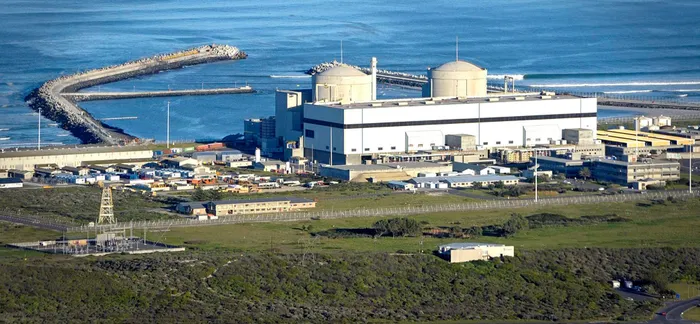
Eskom's Koeberg nuclear power plant in the Western Cape.
Image: Supplied
Rosatom, the state-owned nuclear power company of Russia, has begun construction of the world’s first export Small Modular Nuclear Power Plant in Uzbekistan, which gives South Africa the opportunity to study the practical aspects of constructing small modular reactors.
A ceremony marking the start of construction of the first power unit of an integrated nuclear power plant (NPP) took place at the site in Farish District of Uzbekistan’s Jizzakh Region last week, a statement from Rosatom said Thursday.
The pouring of the first concrete into the foundation of the future unit, within the integrated nuclear power plant project, also marked the transition of the facility into a status of 'under construction' in accordance with the IAEA (International Atomic Energy Agency) standards.
South Africa was once a world leader in the development of small, pebble-bed modular nuclear reactors, but this ended during President Jacob Zuma’s administration due to perceived funding constraints. However, since then, Centurion-based Stratek Holdings is currently at the stage where it is ready to build an improved version of the earlier PBMR that was pioneered by South Africa in the early 2000s.
And ASP Isotopes, the Nasdaq and JSE-listed technology company, also plans to supply the HALEU (High-Assay Low-Enriched Uranium) nuclear fuel to global markets which is required to power small modular reactors, including pebble bed design.
“We are only at the beginning of the project’s implementation, yet its significance is evident. Once commissioned, the NPP will be capable of supplying up to 14% of (Uzbekistan’s) electricity demand. This will boost industrial, technological, and economic development.
Moreover, the atomic city project proposed to Uzbekistan will create an entirely new community – it will be a science city showcasing advanced nuclear and related technologies,” said Russia’s first deputy director-general for nuclear energy at Rosatom, Andrey Petrov, in a statement.
Just a few days earlier, on the sidelines of the St. Petersburg International Economic Forum, participants discussed the prospects for nuclear energy development, including SMR projects and personnel training for newcomer countries.
South Africa operates the only nuclear plant in Africa, the Koeberg plant on the West Coast, while the El-Dabaa nuclear power plant is under construction in Egypt. The project, employing more than 30,000 people, will cost $28.75bn, of which Russia, which is also building the plant, will finance 85% as a state loan, while Egypt will provide the remaining 15% in the form of installments.
South Africa and Russia also maintain a longstanding partnership in the nuclear field. In 2024, Rosatom and South Africa’s energy company Eskom signed an action plan for 2024–2026, covering personnel training and joint educational initiatives.
To strengthen this cooperation, a memorandum was concluded this year with the state-owned Nuclear Energy Corporation of South Africa, aimed at skills development and knowledge exchange in nuclear and related technologies.
BUSINESS REPORT