

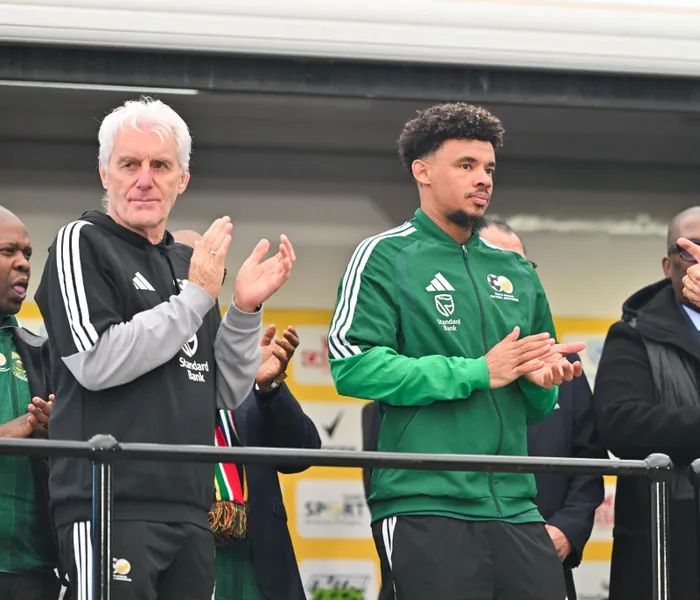
BAFANA Bafana coach Hugo Broos and captain Ronwen Williams during the FIFA World Cup 2026 South Africa Homecoming at OR Tambo International Airport in Johannesburg on Thursday.
Image: BackpagePix
There was a moment, early in Bafana Bafana’s World Cup journey, when the scale of the occasion nearly swallowed them whole.
Hugo Broos admits it now with rare honesty — the opening night against Mexico was not lost purely on tactics, but on everything that came with the theatre of football’s biggest stage.
“We were ready for the game, but then you go with the bus to the stadium, you see all the crowd, you see what happens in the stadium, 80,000 crazy Mexicans, the opening ceremony. It’s not a game, a usual game, it’s something very special,” Broos explained.
For a side still learning how to function under the weight of World Cup pressure, the environment itself became an opponent before a ball was even kicked.
The noise, the occasion, the scale — all of it combined into a psychological wave that Bafana struggled to fully withstand.
What followed on the pitch was a performance that exposed a clear split in their game.
Structurally, they were not completely broken without the ball, but in possession they struggled to cope with the intensity and decision-making demands of the moment.
“And I think that the players were a little bit overwhelmed by that event, because we didn’t do it so bad defensively, but the moment we had the ball it was a disaster, that first game,” he added.
That contrast became the defining issue of Bafana’s early tournament identity — organisation without fluency, discipline without confidence. They could survive phases of pressure, but they could not yet impose themselves on matches.
At World Cup level, that imbalance is often fatal.
But what separates survival from collapse is not the setback itself — it is the response.
Two days after the defeat, Broos called a meeting that would quietly reshape the trajectory of the entire campaign.
There was no panic, no sweeping tactical overhaul, but instead a direct and honest breakdown of what went wrong and what could be salvaged.
“And two days after we had a meeting with the players and we told them what was wrong and what was good, and forget the wrong things but learn from it, but go for the good things.”
That reset was critical. It simplified the message. It removed fear from decision-making. And it gave players permission to play without the weight of the opening-night collapse hanging over them.
Against Czechia, the difference was already visible. Bafana were more composed, more structured in possession, and more willing to play forward rather than sideways. The defensive base remained intact, but now there was intent.
Then came South Korea — the defining performance.
There, Bafana finally brought both sides of their game together: defensive discipline and attacking bravery.
They absorbed pressure when necessary, but more importantly, they transitioned with purpose and belief, producing the result that secured a historic passage into the knockout stages.
“And we did it. We played a better game against Czechia, we played a very good game against South Korea.”
The evolution, Broos insists, was not accidental. It was accelerated learning under extreme conditions — a team forced to adapt quickly or fall behind.
“That is what I always say, when you are on that level, you learn a lot and you learn quick. And that happens with us, I think, also now this World Cup,” Broos reflected.
That final line captures the essence of Bafana’s journey.
From being overwhelmed by 80,000 voices in Mexico City to standing tall in Monterrey with belief and clarity, the transformation has been both tactical and psychological.
What began as an opening-night struggle has become a case study in adaptation — how quickly a team can evolve when the margin for error disappears.
And in tournament football, that kind of growth is often the difference between an early exit… and a place in history.