

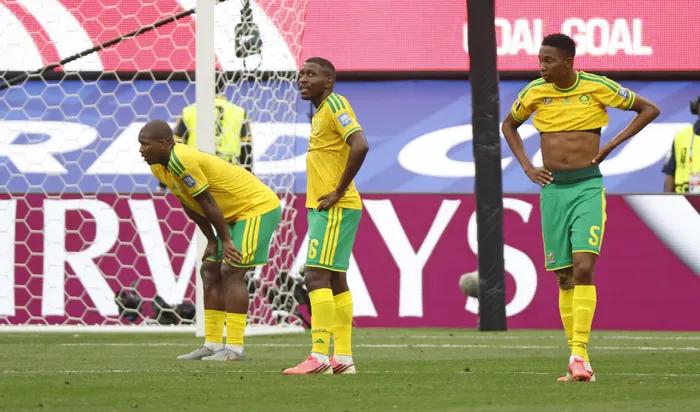
Bafana Bafana’s historic Fifa World Cup 2026 run came to an end after a phenomenal tactical battle with Canada on Sunday night. Photo: Backpagepix
Image: Backpagepix
Bafana Bafana’s historic Fifa World Cup run ended in narrow but decisive fashion as Canada struck deep into stoppage time to seal a 1-0 victory in a tightly contested knockout encounter in Los Angeles.
On the surface, it looked like a single moment of heartbreak. In reality, it was the outcome of a tactical battle that slowly tilted away from Hugo Broos’ side across 90 minutes on Sunday night. Broos set Bafana up in a compact 4-3-3, with the intention of repeating the disciplined mid-block structure that had served them well earlier in the tournament.
The idea was simple: absorb Canada’s early intensity, deny central access, and spring forward through the pace of Thapelo Maseko, Oswin Appollis and Relebohile Mofokeng.
Canada, however, made the game uncomfortable from the outset. Jesse Marsch’s side pressed aggressively in a 4-2-4 out of possession, pushing their fullbacks high and forcing Bafana’s centre-backs into rushed decision-making.
The absence of clean first-phase progression quickly became a problem, with Ime Okon and Mbekezeli Mbokazi frequently forced into longer, less controlled passes.
That disruption achieved Canada’s first objective: turning Bafana’s build-up into a survival exercise rather than a platform for attack. Teboho Mokoena’s return was meant to provide composure in midfield, but Canada’s double pivot suffocated central space.
With Sphephelo Sithole sitting deeper, Mokoena was forced into uncomfortable receiving positions, often facing pressure immediately after collecting possession. As a result, Bafana struggled to establish rhythm between the lines.
Relebohile Mofokeng’s early substitution told a deeper story. Canada deliberately overloaded his zone, denying him the half-spaces where he thrives. Without his ability to turn and progress play, Bafana lost their most important transitional connector.
This had a knock-on effect on Thapelo Maseko. Isolated high and wide, he rarely received the ball in stride.
Canada’s centre-backs, comfortable in defending facing forward, aggressively stepped into duels and prevented him from running in behind. What had been a key weapon against South Korea was effectively neutralised.
Out of possession, Bafana were largely disciplined in their mid-block. The back four held shape well, with Khuliso Mudau and Aubrey Modiba managing wide zones efficiently.
The Okon–Mbokazi partnership continued to defend the box strongly, dealing with aerial pressure and second balls with resilience. But the issue was territorial.
Canada slowly pinned Bafana deeper as the game progressed. Their rotations in wide areas forced constant defensive shifts, and without an effective outlet, Broos’ side struggled to climb the pitch.
Evidence Makgopa’s isolation was particularly telling — he won aerial duels but had no support arriving in the second phase.
The final stages exposed fatigue. With Bafana unable to retain possession, Canada increased wave after wave of pressure, eventually finding the decisive moment in stoppage time as defensive concentration dipped.
Ultimately, this was not a collapse, but a containment failure. Bafana were tactically organised without the ball, but their inability to progress play and relieve pressure became the decisive factor.
Canada controlled territory, dictated rhythm, and waited for the moment the structure finally cracked. And in knockout football, that single crack is often enough.