

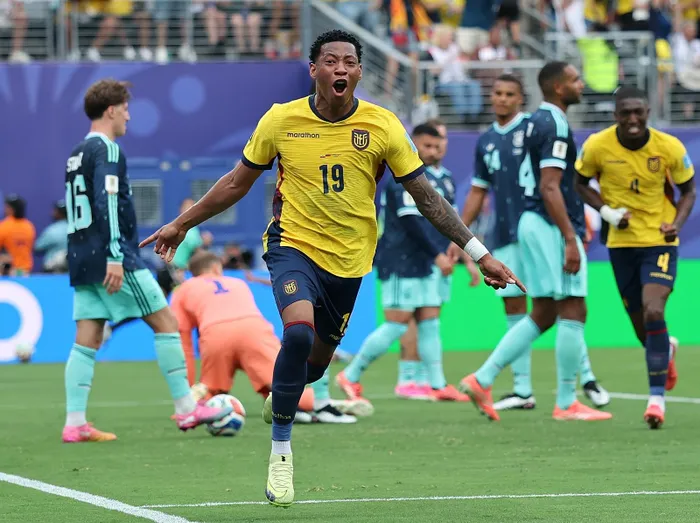
Plata of Ecuador celebrates scoring during their Fifa World Cup Group E match against Germany.
Image: Xinhua via IANS
The expanded World Cup format all but guaranteed a record-breaking total number of goals with more teams in the mix, but nobody quite predicted the sheer efficiency of the onslaught.
The tournament is averaging close to three goals per match, placing it among the highest-scoring World Cups in modern history.
Even with only half the groups completed, this is already shaping into a relentless showcase of attacking football, late drama, and shifting momentum.
If the early rounds were meant to settle nerves, they have done the opposite, feeling less like a structured group phase and more like a continuous wave of attacking intent.
The latest round of matches only reinforced that pattern.
Elsewhere, the matches offered a mix of tactical discipline and pure, chaotic entertainment. Japan and Sweden played out a 1-1 draw in a match that balanced structure with moments of attacking quality; both sides did enough to remain competitive but lacked the final edge to take full control.
Meanwhile, Paraguay and Australia followed with a more cautious 0-0 draw—a tactical stalemate defined by organization rather than risk-taking, as both sides prioritized structure in a tightly contested group.
The United States and Turkey, however, delivered one of the most entertaining matches of the round as the Europeans notched up their first win if the competition on their way out in a chaotic encounter filled with momentum swings, late pressure, and end-to-end transitions. It served as a perfect reflection of the tournament’s wider identity.
Across the partial group-stage picture, the most striking trend remains the same: goals are coming at a historic rate. Analysts point to three distinct factors driving the high scorelines:
What has emerged is a group stage that refuses to settle—still incomplete, but already defined by chaos, intensity, and attacking ambition. And with only half the groups played, the sense remains that the most unpredictable moments are still to come.