

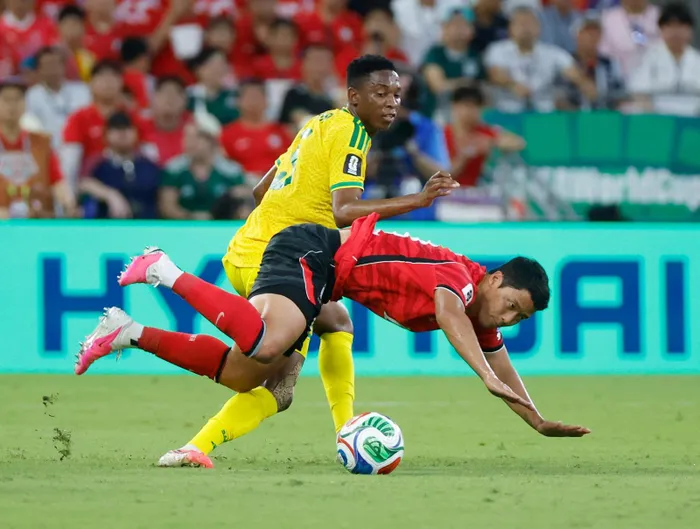
Bafana Bafana midfielder destroyer Thalente Mbatha thunders into a South Korean player during their World Cup clash.
Image: Backpagepix
Bafana Bafana’s historic 1-0 victory over South Korea was shaped less by possession dominance and far more by structure, patience, and devastating efficiency in transition.
Hugo Broos’s side operated in a fluid 4-3-3 system, but crucially, they defended in a compact mid-block that completely frustrated South Korea’s 3-5-2 before springing into life when space opened up. It was a tactical masterclass built on control without the ball — and explosive speed with it.
Here is the tactical breakdown of how the historic triumph was achieved.
Bafana’s defensive shape was one of the defining tactical features of the match. Rather than pressing high for long spells, they held a disciplined mid-block, squeezing space between the lines and forcing South Korea into predictable, sideways circulation in front of them. The back four stayed tightly connected to the midfield engine room, whilst the front three screened passing lanes rather than aimlessly chasing the ball.
This rigid structure ensured South Korea struggled to find clean entries into the final third, despite possessing a numerical superiority in midfield through their 3-5-2 system. The result was a controlled defensive performance that limited central penetration and forced the opposition wide.
Against South Korea’s wing-back system, the widest areas became the most vital zones on the pitch. With the Korean wing-backs pushing aggressively high, huge pockets of space opened behind them whenever possession was turned over. Bafana were alert to this vulnerability from the first whistle.
The moment they regained the ball, the first thought was strictly vertical — not sideways recycling. Those wide channels became launchpads for quick transitions, especially when South Korea were caught mid-transition and still reorganising. This was where the match began to tilt heavily in South Africa's favour.
Bafana’s primary attacking threat arrived when Relebohile Mofokeng and Thapelo Maseko were unleashed in transition. Mofokeng’s ability to receive between the lines and immediately turn forward created constant instability in South Korea’s midfield structure. Maseko, meanwhile, was the chief runner into space behind the defensive line — even if his finishing was initially erratic.
Several of Bafana’s best openings came from quick combinations where Mofokeng released him early into channels before the back three could reset. The pressing sequence that led to one of Maseko’s first-half chances perfectly summed up the blueprint: win possession, find Mofokeng, break the line, and release Maseko.
Whilst South Korea enjoyed sustained phases of possession, their biggest weakness was their rest defence. With their wing-backs pinned high and central midfielders committed forward, they were often completely exposed when possession turned over.
Bafana exploited this repeatedly by playing the first pass forward immediately rather than building slowly from the back. Even when they did not create clear-cut chances, they consistently forced the South Korean defenders to sprint backwards toward their own goal, disrupting their shape and draining their physical reserves. This structural imbalance became more costly as the match stretched in the second half.
The winning goal in the 63rd minute was no accident — it was the system in perfect harmony. A clean regain within a compact defensive block, a rapid forward move into space, and a decisive wide delivery from substitute Tshepang Moremi led to Maseko arriving on cue to finish inside the penalty box.
By that point, South Korea’s structure had already been stretched to breaking point. When the definitive moment arrived, Bafana were positioned exactly where the tactical blueprint demanded.