

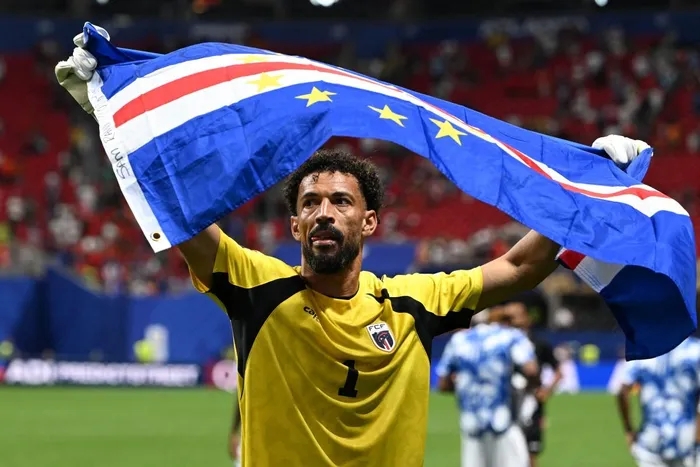
Cape Verde's goalkeeper Vozinha celebrates with his national flag at the end of their 2026 Fifa World Cup match against Spain.
Image: AFP
COMMENT
A week has already flown by at this historic Fifa World Cup 2026.
Here at home, the fever-pitch excitement leading into Bafana Bafana’s opening clash against Mexico was rapidly punctured by a sobering 2-0 defeat. It felt like a balloon popping, leaving an eerie silence in its wake.
However, as the initial sting of disappointment fades, it has quickly been overshadowed by a genuinely exhilarating week of global football.
There has been no shortage of loud, persistent criticism regarding the World Cup’s expansion to 48 teams — the largest in the quadrennial tournament's history. The prevailing fear among traditionalists was that parachuting 16 lower-ranked nations into the mix would inevitably lead to unbalanced, lopsided group-stage snoozefests.
Uefa President Aleksander Čeferin has been the loudest voice in the room, recently branding some of the expanded matchups as "uninteresting." His prime exhibit? Germany walloping Curaçao — the smallest nation by both population and area to qualify — 7-1 in their Houston opener.
I tend to disagree with this pessimistic outlook. Let us not forget that Germany notoriously dismantled a star-studded Brazil by a similarly humiliating margin in their very own Estádio Mineirão not so long ago. Blowouts are a feature of tournament football, not an exclusive byproduct of expansion.
Opening the tournament's doors wider serves a much greater purpose. The expansion allows debutants like Jordan and Uzbekistan to experience the pinnacle of the sport, which will undoubtedly catalyze the growth of football infrastructure and funding back in their home countries.
Because third-place teams can now advance to the knockout stages, we are witnessing a brilliant tactical shift. Teams are abandoning negative, defensive strategies in favor of a much more aggressive, attacking brand of football. Every point and every goal matters.
Without expansion, we wouldn't have the sensation of the first round: Cape Verde’s 40-year-old, previously unknown goalkeeper, Vozinha. After a heroic performance to deny tournament favourites Spain, he has amassed a staggering four million more Instagram followers. This kind of magic simply does not happen if the World Cup remains a closed-off playground exclusively for Europe and South America’s elite.
The presence of 10 African countries at this tournament is already proving significant, building on the foundation Morocco laid in Qatar when they reached the semi-finals. The continent is proving it belongs among the contenders:
The Moroccons reminded the world of their pedigree with a gritty 1-1 draw against Brazil, while Cape Verde: Pulled off a historic draw against Spain, powered by Vozinha's heroics.
Egypt secured a monumental result by holding a heavily favoured Belgium; and Ivory Coast, long considered one of Africa’s premier teams, but historically cursed by the 'Group of Death', they finally fulfilled their undoubted potential by securing a 1-0 victory over Ecuador — bringing the South Americans' impressive 19-game unbeaten streak to a screeching halt.
The traditionalists have also not been left out with the "GOAT" Lionel Messi scoring a hat-trick to become the leading goalscorer in World Cup history.
Of course, it would be naive to say this tournament is without its flaws. There are glaring bugbears that Fifa still needs to answer for.
The most concerning is the political red tape, highlighted by Somali referee Omar Artan being detained by US immigration officials and deported, denying him entry to officiate. Add in the exorbitant, exclusionary ticket prices and the disruptive 20-minute water cooling breaks.
But despite its flaws, and no matter how much it is occasionally sullied by bureaucracy, this remains the beautiful game. As this opening week has proven, football will always find a way to remind us exactly why it captures the hearts of the masses.