

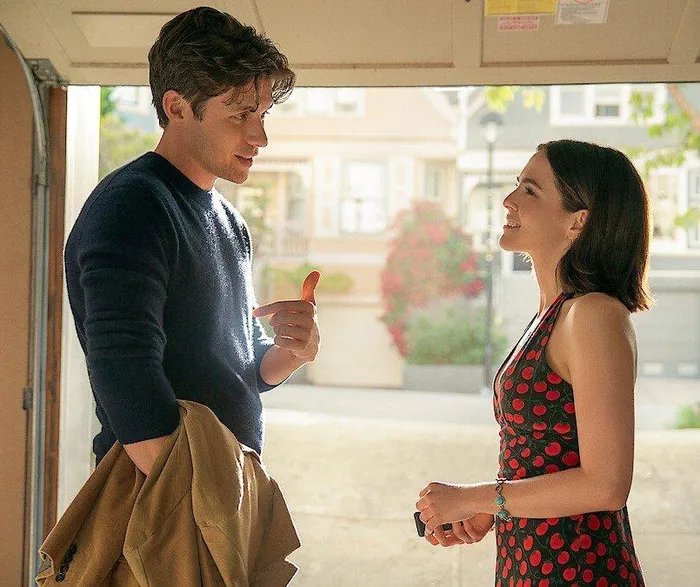
'Voicemails for Isabelle' is an emotional romance centred on grief and unexpected human connection.
Image: X/@KetchupBinge
Okay, why did I think "Voicemails for Isabelle" was going to be a romcom? No seriously.
I pressed play, expecting something light. Something cute. Something that would give me a few laughs, a few swoon-worthy moments and then send me on my way.
Instead, I spent the better part of two hours crying at least once every 10 minutes and questioning why nobody prepared me for the emotional rollercoaster I had just willingly climbed aboard.
That's not to say the film isn't funny. It is. There are genuinely charming moments scattered throughout and enough humour to stop the story from becoming unbearably heavy. But what completely caught me off guard was just how much heart this film has.
Written and directed by Leah McKendrick, the film follows Jill, played by Zoey Deutch, who copes with the devastating loss of her sister Isabelle by leaving voicemails on her phone.
However, the number now belongs to Wes, played by Nick Robinson, a stranger who slowly becomes invested in the woman behind the messages. It is a premise that could have easily felt gimmicky, but somehow turns into a surprisingly moving story about grief, healing and finding connection when you least expect it.
The film feels less like a romantic comedy and more like a love letter to grief, healing and the people we carry with us long after they're gone.
The story follows Jill as she leaves voicemails for her late sister Isabelle, continuing a conversation that death interrupted. It sounds simple enough on paper, but the way the film unfolds had me hooked from the start.
Every voicemail feels intimate. Every message feels like something that was never meant for anyone else's ears. As a viewer, you almost feel guilty listening in, and yet you can't look away.
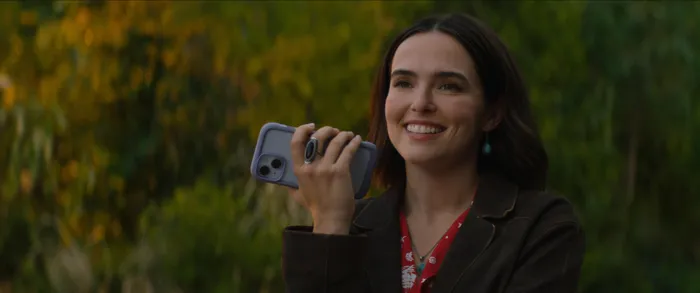
Zoey Deutch as Jill in 'Voicemails for Isabelle'.
Image: Courtesy of Netflix
What surprised me most was how invested I became in Isabelle despite barely knowing her. The film somehow manages to make her presence feel enormous even when she's not physically there. By the end, I felt like I had lost someone, too.
And then there's the romance.
Love stories still exist.
I don't know what else to tell you.
The chemistry between the leads is absolutely insane. Not the forced kind where you're constantly being told two people belong together. The believable kind. The kind that sneaks up on you until suddenly you're smiling at your screen like a fool.
What I appreciated most was that the romance never overshadowed the emotional core of the story. It wasn't there to "fix" anyone. It simply existed alongside the grief, the healing and the messiness of life.
That balance is incredibly difficult to get right, and yet the film pulls it off beautifully.
The performances are another reason this story works so well. Every emotional beat landed for me. Every awkward moment felt natural. Every tear felt earned.
There wasn't a single point where I felt manipulated into feeling something. The emotions arrived naturally and then hit me like a truck.
Also, can we please discuss the soundtrack? Impeccable.
There are films where the music simply fills space, and then there are films where every song feels carefully chosen to stab you directly in the heart. This is one of those films.
More than once, I found myself sitting through a scene thinking, "Whoever picked this song deserves a raise."
What I loved most about "Voicemails for Isabelle" is that it reminded me that romance doesn't always have to be grand gestures and perfect endings. Sometimes it's about connection. Sometimes it's about finding someone who understands the parts of you that are still hurting.
I walked into this film expecting a sweet romcom. I walked out feeling emotionally wrecked, weirdly hopeful and deeply grateful that stories like this still get made.
One of the clearest lessons is how people don’t “finish” grieving on a timeline. The story leans into the idea that loss doesn’t disappear just because life moves forward. It reshapes itself.
In Jill’s case, those voicemails become a kind of survival mechanism, showing how people sometimes keep speaking to those they’ve lost because silence feels worse than imagination.
There’s something quietly honest in that - the idea that healing isn’t about letting go completely, but learning how to carry the person differently.
♦ Rating: **** a standout film with exceptional qualities.