

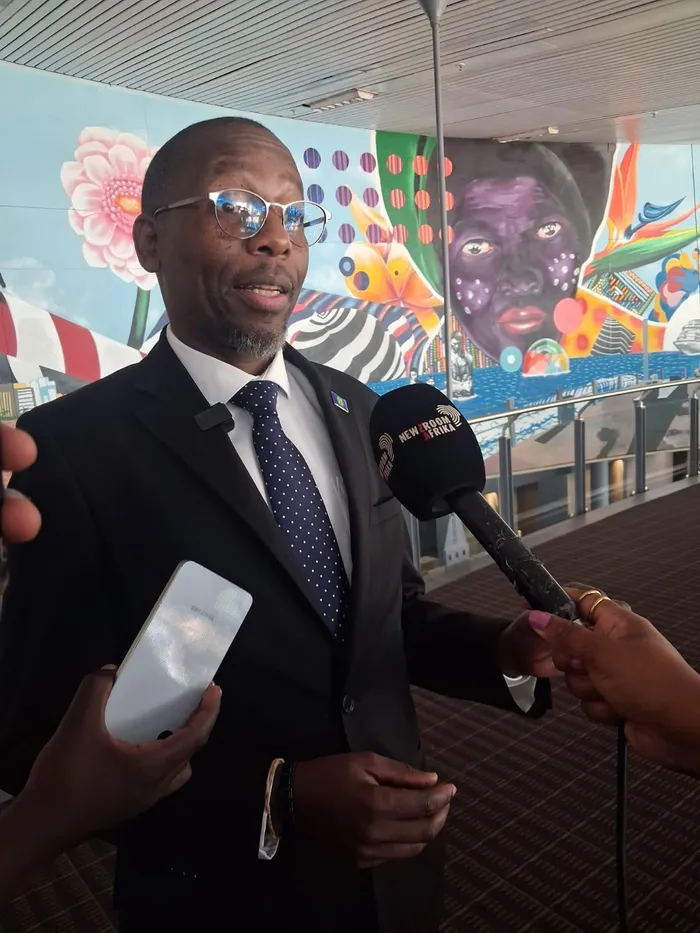
The 9th annual Southern African Development Community (SADC) Industrialisation Week was closed on Thursday with a declaration and seven observations read by Khulekani Mathe, chairperson of the SADC Business Council and CEO of Business Unity South Africa (BUSA).
Image: Yogashen Pillay/Independent Newspapers
The Southern African Development Community (SADC) has renewed calls for accelerated regional industrialisation, deeper integration of value chains and stronger partnerships to boost competitiveness, create jobs and drive inclusive economic growth across the region.
Delivering the closing declaration at the SADC Industrialisation Week on Thursday, chairperson of the SADC Business Council, Khulekani Mathe, said the week-long event reaffirmed the region's shared commitment to industrialisation as a catalyst for economic transformation.
Mathe, who's also the CEO of Business Unity South Africa, emphasised the country's commitment to regional industrialisation as a driver of inclusive economic growth, job creation and economic transformation.
Mathe said participants engaged in high-level policy dialogues, technical sessions, business forums covering sectors including agro-processing, manufacturing, pharmaceuticals, automotive industry, digital transformation and Artificial Intelligence.
“Observations include that Southern Africa possesses abundant natural resources, a growing entrepreneurship base and significant market opportunities,” he said.
“However, industrialisation continues to be constrained by fragmented regional value chains, inadequate infrastructure, limited industrial financing, technological gaps, supply chain disruptions and increasing global competition.”
Mathe said developing integrated regional value chains remains essential to increase value addition and promote beneficiation of natural resources and enhance competitiveness of the SADC industries.
“Digital transformation, green transition, artificial intelligence and other emerging technologies are rapidly shaping global production systems and international trade, underscoring the urgency of investing in digital and green infrastructure, innovation systems, research and development, technology transfer and relevant skills,” he said.
Mathe added that agriculture remains a strategic pillar for industrialisation, strengthening agri-industry value chains, modernising food systems and expanding the agro-processing industry are needed to improve food security, increase exports and create employment opportunities for women and young people.
Mathe noted that the region's endowment of critical minerals presents a unique opportunity to reposition Southern Africa within global industrial supply chains.
“The region must move beyond the export of raw materials by promoting local processing and manufacturing that generate greater value , industrial capacity and employment.”
Mathe said that MSME (micro, small, and medium enterprises) remain the backbone of the regional economy.
“Their access to finance , technology , markets and standards , business development services and digital platforms must be improved to enable more effective participation in regional and global value chains.”
Mathe added that sustainable development cannot be achieved by governments alone.
“Strong partnerships between governments, private sector, development finance institutions, academia, research institutions and development partners remain essential for mobilising investment, supporting innovation and accelerating implementation of regional industrial priorities.”
Mathe concluded that the declaration is to accelerate the implementation of the SADC Industrial strategy roadmap through co-ordinated regional and national actions.
“It is also to strengthen industrial value chains to increase production, value addition , Intra SADC trade and industrial competitiveness.”
BUSINESS REPORT