


New analysis reveals how skilled emigration, regional labour migration and urbanisation are transforming South Africa's economy and creating new opportunities for business.
Image: Meta AI
South Africa's migration patterns are transforming the country's economy in ways that businesses can no longer afford to ignore, with new research pointing to three simultaneous trends that are reshaping labour markets, consumer demand and investment decisions.
According to consumer analytics company Eighty20, South Africa is experiencing a combination of regional labour inflows, continued emigration of skilled professionals and large scale internal migration toward economic hubs.
Together, these shifts are influencing everything from talent retention to retail expansion and long term business strategy.
The findings come as migration remains firmly in the national spotlight following President Cyril Ramaphosa's recent address acknowledging shortcomings in immigration management while condemning xenophobia, vigilantism and attempts by private groups to police foreign nationals. At the same time, anti immigration movement March and March has intensified pressure through nationwide protest plans targeting undocumented migrants.
Against this backdrop, Eighty20 believes the data offers a more balanced understanding of how migration is shaping the economy.
"South Africa is being reshaped by multiple migration forces that all have an impact on business decisions," Andrew Fulton, Director at Eighty20, said.
"Whether it be skilled professionals leaving, regional labour arriving, or millions moving toward economic opportunity at the urban edge. The businesses that read those signals correctly will find themselves where the markets and talent actually are."
One of the biggest challenges in understanding migration is the lack of reliable official data.
The Department of Home Affairs has not published immigration statistics since 2015, while emigration estimates compiled by Statistics South Africa rely on modelling rather than actual departure records.
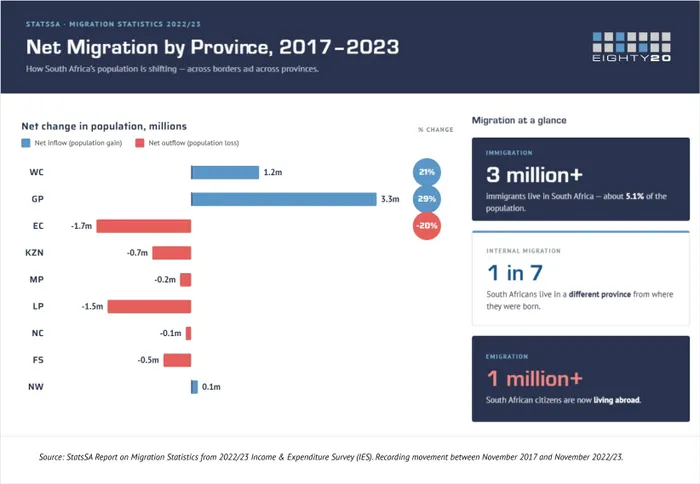
As migration debates intensify, new data highlights the business implications of talent loss, consumer market shifts and rapid urban growth.
Image: Supplied.
Eighty20 noted that undocumented migration is inherently difficult to measure because many foreign nationals avoid formal surveys.
Despite these limitations, the available data paints a clear picture of South Africa's changing population.
The 2022 Census recorded 2.4 million immigrants, while the 2022 and 2023 Income and Expenditure Survey estimated the figure at more than three million people, representing 5.1% of the country's population.
Nearly two thirds of immigrants originate from countries within the Southern African Development Community. Zimbabwe accounts for almost half of the foreign born population recorded in Census 2022, followed by Mozambique, Lesotho, Malawi and the United Kingdom.
Most immigrants are male, of working age and concentrated in Gauteng and the Western Cape.
While immigration often dominates political debate, Eighty20 argued that the outward migration of skilled South Africans carries even greater economic consequences.
United Nations International Migrant Stock data updated to mid 2024 estimates that just over one million South African citizens now live abroad, compared with fewer than 300 000 in 1990.
Australia, the United Kingdom, the United States, New Zealand and Germany remain the leading destinations.
The concern, however, is less about the number of people leaving than who is leaving.
According to the research, the country's highest earning taxpayers make an outsized contribution to government revenue, meaning even relatively small losses of skilled professionals can have significant fiscal and economic consequences.
Healthcare remains one of the clearest examples. OECD data shows that more than 23 400 South African healthcare professionals are working in the United Kingdom, Australia, New Zealand and the United States, leaving many public sector vacancies unfilled.
The desire to emigrate also remains widespread among higher income households.
BrandMapp research found that around 27% of South Africans earning more than R10 000 a month consider emigration likely or highly likely, a figure that has remained largely unchanged since 2021.
At the same time, millions of South Africans are relocating within the country in search of employment and better opportunities.
Statistics South Africa estimates that 9.1 million people, roughly one in every seven South Africans, now live in a province different from the one in which they were born.
The migration pattern consistently points toward the country's major economic centres.
Gauteng accounts for 38% of registered taxpayers and contributes 47% of personal income tax despite housing only one quarter of the population. Between 2021 and 2026, the province is projected to gain 1.4 million net new migrants, while the Western Cape is expected to attract nearly half a million.
Additional research from Wise Move, which analysed almost 6 000 interprovincial household relocations, found that although moves from the Western Cape to Gauteng rose sharply, the Western Cape remained the country's strongest net recipient of migrants during 2025, with Cape Town continuing to attract residents seeking lifestyle benefits.
Urbanisation is also accelerating.
South Africa's urban population expanded from about 34.3 million people in 2013 to 40.2 million in 2023. Much of that growth has occurred not within city centres but on the outskirts of metropolitan areas, including townships, backyard settlements and peri urban communities.
For businesses, Eighty20 believes these demographic shifts carry three major implications.
The first is competition for skilled workers, requiring employers to strengthen retention strategies, benchmark salaries internationally and invest more heavily in graduate development.
The second is the emergence of new consumer markets.
As population growth concentrates in peri urban communities, retailers and service providers may need to rethink expansion strategies to better serve these fast growing areas.
Highlighting this opportunity, the Head of Marketing for one of South Africa's fastest growing clothing retailers said, "The biggest retail growth opportunities lie in township and peri urban markets, where proximity, value, and relevance matter most. It allows us to connect with more customers, support local economic ecosystems, and become a trusted part of the communities we serve."
Finally, Eighty20 warned that xenophobic violence presents growing operational and reputational risks for businesses through supply chain disruption, damage to employer brands and reduced investor confidence.
The company argued that much of the political tension surrounding migration reflects deeper domestic challenges, including unemployment, housing shortages and poor service delivery, rather than migration itself.
As South Africa's demographic landscape continues to evolve, businesses that understand where talent is moving, where consumers are settling and how migration is reshaping local economies are likely to be better positioned for long term growth.
Follow Business Report on Facebook, X and on LinkedIn for the latest Business and tech news.