

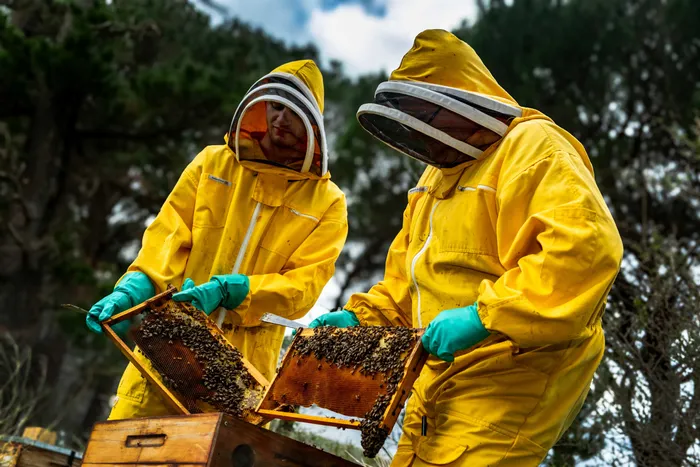
The role of honeybees pollinating the country's fruit crops was highlighted by the Department of Agriculture at the annual Bee conference on Tuesday in the North West.
Image: File Supplied
The role of honeybees pollinating the country's fruit crops was highlighted by the Department of Agriculture at the annual Bee conference on Tuesday in the North West. The conference was hosted by the South African Bee Industry Organisation (SABIO).
Mooketsa Ramasodi, Director-General at the Department of Agriculture, said that the significance of honeybees within South Africa's agricultural landscape cannot be overstated.
“Honeybees pollinate an estimated 80% of the country's fruit crops and other economically important plants and vegetation. For many fruit growers, pollination services provided by managed honeybee colonies can increase yields dramatically, often doubling production.”
Ramasodi added that this reality places beekeeping at the heart of agricultural productivity, food security, and rural economic development.
“Despite their immense contribution, honeybees remain one of the most underappreciated species in our agricultural ecosystem. Yet they are indispensable to the sustainability of our food systems and agricultural value chains.”
Ramasodi said that beekeeping is perhaps one of the few agricultural activities that delivers overwhelmingly positive environmental benefits while simultaneously generating economic opportunities. “However, globally and locally, honeybee populations face mounting challenges.”
Ramasodi said the Department is committed to ensuring that the South African beekeeping industry remains resilient, competitive, and sustainable. “A well-crafted policy and strategic framework will strengthen the entire value chain, from pollination services and honey production to research, market development, and environmental conservation," he said.
Such interventions would contribute directly to enhanced food security, sustainable agricultural production, economic growth, rural development and job creation opportunities.
Ramasodi said that there is a need to establish a coherent and integrated legislative framework governing all aspects of beekeeping, including:
Ramasodi added that to address existing challenges and ensure the long-term sustainability of the sector, the Department will intensify its efforts to build capacity and provide training at both national and provincial levels, including among extension officers who serve as a vital interface between government and producers.
“The conservation of bee forage resources remains a matter of critical importance. The ongoing loss of forage, coupled with theft and vandalism affecting beekeeping operations, continues to undermine the sector's growth and sustainability,” added Ramasodi.
Ramasodi said the beekeeping sector is not a peripheral component of agriculture - it is one of its foundational pillars.
“The future of our food systems, biodiversity, agricultural productivity, and environmental sustainability is inextricably linked to the health and survival of honeybees. The Department of Agriculture stands ready to provide leadership, support, and partnership in building a resilient and thriving beekeeping sector for generations to come.”
Inge Austin, a Board Member at SABIO, said that there are around 4000 registered beekeepers, but most are hobbyist or small-scale beekeepers.
“From the perspective of the SABIO, pollination is not just an environmental side-note - it is vital, foundational infrastructure for national food security and the global competitiveness of South Africa's agricultural export economy.”
Austin said over 50 crops in South Africa rely on insect pollination. “Managed pollinators are essential for the production and export quality of high-value crops like apples, avocados, pears, and macadamias. Proper pollination results in higher-quality fruit, better pack-out rates, and reliable export consignments.”
Austin said that managed honeybee colonies act as a productive asset that drives revenue across multiple sectors.
“Successful pollination supports jobs in packhouses, the cold chain, logistics, and ports. Pollination services and beekeeping are recognized as highly accessible entry points into the agricultural sector, creating opportunities for rural transformation, women, and young entrepreneurs.”
Dawie Maree, head of FNB agriculture marketing and information, said that the bee industry is definitely not the biggest industry in agriculture, but a very important one. “The industry is more important than expected because the biggest contribution comes from crop pollination services, and that is difficult to measure. Guesstimates estimate the broader bee industry turnover to be in the region of R20 billion per year.”
Maree added that high-value industries, such as citrus, blueberries, macadamias, avocados, deciduous fruit, and vegetable seed production, rely on bees for pollination. “Without bees, these industries will not be able to survive or compete on their current levels.”
Visit:www.businessreport.co.za