

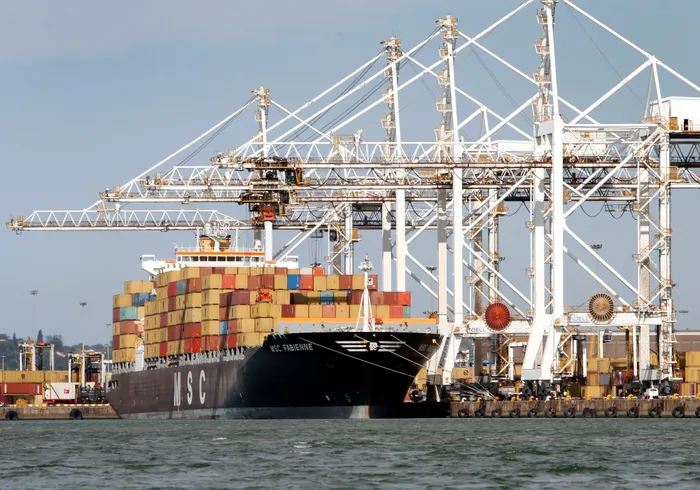
A new report by the Bureau for Economic Research (BER) indicated that structural reforms are bearing fruit after South Africa recorded a 6th consecutive quarter of positive Gross Domestic Product (GDP) growth.
Image: Shelley Kjonstad/Independent Media
South Africa’s structural reform programme is beginning to show measurable economic benefits, with the country recording a sixth consecutive quarter of GDP growth, but weak implementation capacity continues to slow progress in several critical areas, according to the Bureau for Economic Research (BER).
Real GDP expanded by 0.5% in the first quarter of 2026, extending the longest run of quarterly growth since 2017/18.
BER economist Rose Murunzi said the result suggests that reforms in electricity, digital public infrastructure and parts of the logistics sector are starting to feed through into economic activity, although the recovery remains gradual and uneven.
“South Africa’s growth recovery continues to make gradual but uneven progress. Growth of 0.5% was recorded in 2026Q1, the sixth straight quarter of expansion,” Murunzi said.
“While important gains have been recorded in electricity reform, digital public infrastructure and elements of logistics modernisation, several reform areas remain constrained by weak institutional capacity, poor coordination, infrastructure deterioration and slow implementation at municipal and administrative levels.”
She added that private sector participation helps with reform.
“A recurring pattern is that reform momentum tends to pick up when implementation frameworks are commercially structured, operationally measurable, and supported by institutional partnerships.”
Murunzi said that reforms that depend heavily on municipal capacity, intergovernmental coordination, or large-scale public-sector execution continue to progress more slowly.
“Electricity reforms continue to support improved generation performance and rising private investment in renewable energy, while digital public infrastructure reforms have accelerated through the expansion of Smart ID partnerships and digital service platforms,” said Murunzi.
Murunzi added that logistics reforms have also advanced through several port concession processes and the gradual rollout of open-access freight rail reforms.
“Importantly, the overall trajectory of reform remains positive relative to recent years. Business confidence, although weaker in the second quarter of 2026 amid rising global uncertainty, remains above recent lows.”
Murunzi said that South Africa’s economic recovery continues to be slow.
“Real GDP grew by 0.5% in 2026Q1. It was the sixth straight quarter of expansion, the longest expansion since 2017/18. While the headline is encouraging, the composition of growth is less so.”
Murunzi added that domestic demand contracted for the first time since 2024Q1, with negative investment growth.
“Gross domestic expenditure contracted by 0.3% q-o-q, indicating that the stronger GDP outcome was largely due to net exports.”
Murunzi said that South Africa’s logistics reform agenda continues to show gradual progress, supported by rising private-sector participation across key port and freight rail infrastructure.
“Concessions involving the Durban Gateway Terminal, the Cape Town Liquid Bulk Terminal, and the Durban Fresh Produce Terminal, as well as open-access freight rail reforms, signal a broader shift towards crowding private capital and operational expertise.”
Murunzi added that the broader rollout of open-access freight rail reform has progressed more slowly than initially anticipated.
“While third-party rail access has begun to move into implementation, important elements of the framework, including refinements to the Network Statement and concession structures, remain under development.”
Murunzi said that logistics inefficiencies, particularly at the Port of Cape Town, are increasingly emerging as a major constraint on the competitiveness and expansion of South Africa’s export-oriented agricultural sector.
“Discussions with the South African Table Grape Industry (SATI) highlighted how port delays during the 2025/26 export season forced exporters to redirect volumes through Eastern Cape ports at higher transport costs. The share of table grape exports shipped through Cape Town declined from 91% in the previous season to 76%, while volumes routed through Eastern Cape ports increased from 6% to 21%.”
Murunzi added that the latest Blue, Green and No Drop Progress Assessment Reports (PAT) suggest that while oversight and reporting systems have improved, municipal water and wastewater performance remains under significant pressure.
“Blue Drop results indicate that the deterioration in drinking water quality observed between 2013 and 2023 has broadly stabilised, although overall risk levels remain elevated. Provincial performance has remained uneven, with the Northern Cape recording the highest average risk levels while the Western Cape has continued to perform relatively well.”
Murunzi said that the Green Drop findings point to further deterioration in wastewater management, with the share of systems classified as critical increasing from 39% in 2022 to 47% in 2025.
Murunzi concluded that the most recent positive GDP numbers reinforce that structural reform is slowly feeding through into economic growth, despite a significant weakening of the global environment.
“The pressure now moves from policy formulation to implementation. One of the key lessons from the reform programme is that strong private sector involvement can accelerate progress.”
BUSINESS REPORT