

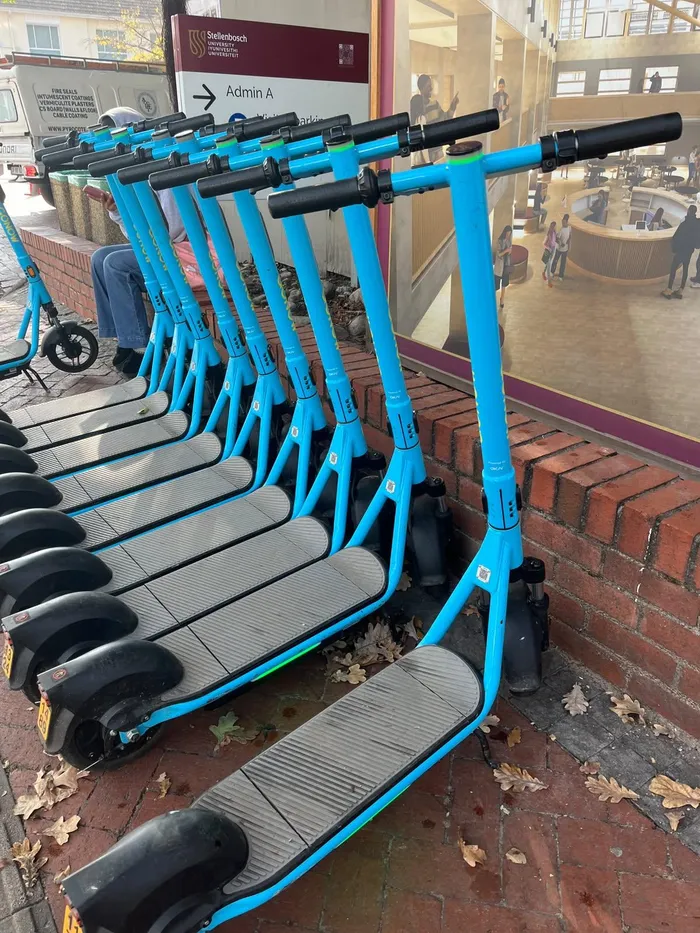
Are we ready for a future filled with humanoid robots and autonomous vehicles? As Stellenbosch grapples with the challenges of eScooters, we explore the broader implications of innovation governance in our rapidly changing world.
Image: supplied/ Kieran Van der Schyff
In the not-too-distant future, our daily lives will likely involve walking alongside humanoid robots and navigating streets filled with autonomous vehicles.
The question we must confront is whether our societal framework is ready for such a shift. The evidence suggests it is not.
History has shown us that innovation—that restless, relentless force—almost always moves faster than the slow, deliberate pace of legislation. We see this tension playing out vividly today in Stellenbosch, where the local municipality’s struggle with e-scooters serves as a microcosm for a much broader challenge.
To understand this impasse, we must first look back. Years ago, the late Mayor Conrad Sidego articulated a vision that was as audacious as it was clear: he sought to establish Stellenbosch as "Africa's innovation capital."
This was not empty rhetoric. It was a catalyst for a series of partnerships and initiatives designed to turn the historic university town into a living laboratory where new ideas could be stress-tested and refined.
That vision—and the spirit of experimental dynamism it embodied—came to mind when considering the recent dispute between the service provider GoNow and the Stellenbosch Municipality.
At its core, the debate is about far more than just scooters. It touches upon a fundamental, recurring theme in the history of technological progress: How do societies reconcile the disruptive nature of innovation with the necessary management of its inherent risks?
Stellenbosch offers a perfect case study. It possesses a distinct "innovation edge"—a blend of academic rigor from its world-class university, a flourishing tech ecosystem, and an entrepreneurial culture. Yet, success, as it often does, has brought complications.
The town's appeal has created a paradox; its streets, originally designed for a quieter era, are now congested with traffic and lack sufficient parking. Mobility, the lifeblood of any modern city, has become a grinding challenge.
Against this backdrop, the introduction of e-scooters was not merely a novelty; it was an experiment in urban problem-solving.
They offered a pragmatic, efficient alternative for movement. Thus, the impulse to shut down such services seems to run directly against the very ethos of innovation that Stellenbosch has championed.
However, we must also acknowledge the other side of the ledger. Municipal leaders are tasked with the crucial responsibility of public safety.
Throughout history, from the introduction of the bicycle to the automobile and the ride-sharing platform, cities have been forced to iterate and evolve their rules, infrastructure, and social norms to accommodate new realities.
Innovation truly succeeds not when regulation is discarded, but when it evolves in tandem with the technology it governs.
The way forward is not to choose between innovation and safety. It is to devise a synthesis of both.
This conflict reveals a grander opportunity. If congestion and parking scarcity are the primary friction points, perhaps Stellenbosch should contemplate a more radical transformation—a town centre where the pedestrian, not the car, takes precedence.
Many of the world's most liveable cities have discovered that reducing vehicle density often catalyzes, rather than hinders, accessibility and economic vitality.
In the near term, practical compromise is the most effective tool. We can envision speed caps that prioritize pedestrian safety, age restrictions that ensure maturity, and dedicated infrastructure that prevents the cluttering of public spaces. These are not radical departures; they are the standard adjustments that vibrant cities and towns adopt as they learn to harmonize new forms of mobility with existing urban fabric.
Ultimately, the debate over GoNow is not about the hardware of a scooter. It is a question of character: Does Stellenbosch remain committed to the vision it once embraced? True innovation is rarely a comfortable process. It demands a tolerance for experimentation, a willingness to adapt, and a focus on solving problems rather than suppressing the technologies that expose them.
The real test for Stellenbosch is whether it can continue to be a town that welcomes the future while developing the wisdom to govern it.
This is a challenge that every city will soon face. We cannot wish technology away. We must instead build the systems that allow us to live, work, and thrive alongside it. The innovations of today are but a prologue to what is coming; the sooner we learn to adapt, the greater the prosperity we shall reap.
Wesley Diphoko is a Technology Analyst and the Editor-In-Chief of FastCompany (SA) magazine.

Wesley Diphoko is a Technology Analyst and Editor-in-Chief of Fast Company (South Africa) magazine.
Image: Supplied
Follow Business Report on Facebook, X and on LinkedIn for the latest Business and tech news.