

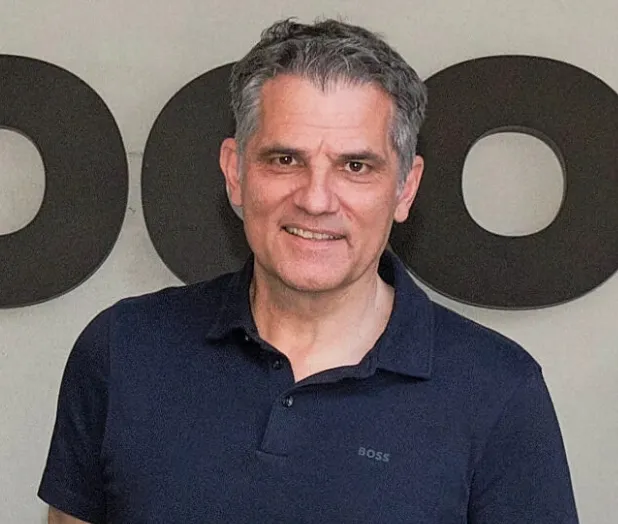
Yoco CEO: Carsten Höltkemeyer Getting to know the new Yoco CEO
Image: Yoco
This week marks a significant moment for South Africa's fintech champion, Yoco.
The company that helped democratize digital payments for hundreds of thousands of small businesses across South Africa has officially handed the reins to Carsten Höltkemeyer.
The transition follows a period of reflection and recalibration. Towards the end of 2025, founding CEO Katlego Maphai stepped down after helping build one of Africa's most admired technology companies.
In the interim, co-founders Lungisa Matshoba and Bradley Wattrus assumed leadership responsibilities, preserving continuity while the board searched for the person who would lead Yoco into its next phase.
The question facing Yoco today is not whether it can continue growing. The question is what kind of company Yoco wants to become.
To understand why Höltkemeyer's appointment matters, one must first understand the ideas that have shaped his career.
Throughout the history of technology, there have been builders who create products and there have been architects who build systems. Höltkemeyer belongs firmly in the latter category.
His career has taken him through investment banking, retail finance, card payments, and financial infrastructure. He spent a decade leading Barclaycard Germany before taking senior leadership positions at Nets Group and Concardis.
However, his tenure at Solaris may prove most relevant to Yoco's future.
Solaris emerged during a period when the very nature of banking was being questioned. For centuries, banks had existed as institutions.
They occupied buildings, maintained branches, and cultivated direct relationships with customers. But the rise of the internet challenged a fundamental assumption: what if banking no longer needed to be a place?
Under Höltkemeyer's leadership, Solaris embraced a radically different vision. Rather than competing with banks, it sought to become the invisible infrastructure beneath them.
The company became one of Europe's pioneers of Banking-as-a-Service, or BaaS.
In essence, Solaris transformed banking from a destination into a utility.
Financial products could now be embedded directly into technology platforms, retailers, marketplaces, and digital services. Customers might never know Solaris existed, yet its infrastructure would power the transactions occurring behind the scenes.
That idea helped turn Solaris into one of Europe's most valuable fintech companies.
More importantly, it revealed something about Höltkemeyer himself. He is attracted to systems-level transformation.
He is drawn to businesses that sit beneath the surface, quietly enabling entire ecosystems.
That matters because Yoco may now be approaching its own inflection point.
For much of its existence, Yoco has been known as the company that brought card payments to South Africa's small businesses. It helped thousands of merchants accept digital payments and participate more fully in the modern economy.
It solved a problem that many incumbents had ignored.
But successful technology companies rarely remain defined by their first act.
The arrival of Höltkemeyer suggests that Yoco may be preparing for a larger role in Africa's digital economy.
Yoco already possesses merchant relationships, payment infrastructure, trusted distribution channels, and an increasingly sophisticated technology platform. The question is whether those assets can be transformed into something bigger.
The answer may already be emerging.
Last week Yoco announced the acquisition of Dyner, a young company that has quietly built an AI-native operating system for restaurants. At first glance, it may appear to be a straightforward acquisition. In reality, it offers an intriguing glimpse into how Yoco's leadership is thinking about the future.
Dyner's founders, Thalentha Ngobeni and Chris du Plessis, followed an unconventional path into entrepreneurship.
Both trained as actuaries and built careers within Discovery, working in environments shaped by data, systems thinking, and operational excellence. Yet instead of applying those skills exclusively to large corporations, they turned their attention to independent business owners.
What followed was less a software project than an ethnographic study of entrepreneurship.
They spent countless hours inside restaurants.
They sat with owners during dinner rushes. They observed kitchen operations.
They fielded late-night calls about supplier invoices, gross profit margins, inventory management, and staffing pressures. They immersed themselves in the everyday realities of businesses that customers rarely see.
From that experience emerged a platform designed to make restaurants more intelligent. Dyner provided owners with deeper visibility into their operations and the ability to make faster, better-informed decisions.
Many of those businesses were already Yoco customers.
That overlap was more than coincidence. It revealed a shared mission.
For years, Yoco has focused on helping entrepreneurs get paid. Dyner focuses on helping them run better businesses.
Together they point toward a future in which Yoco becomes more than a payments company. It becomes an operating system for commerce itself.
The acquisition may therefore be remembered not as an isolated transaction but as the opening move in a broader strategy.
History offers many examples of companies reinventing themselves through acquisitions. Microsoft expanded beyond operating systems.
Amazon moved beyond books. Apple evolved beyond personal computers. In each case, acquisitions became a mechanism for accelerating strategic transformation.
Whether Yoco follows a similar path remains to be seen. But the Dyner deal feels less like an endpoint and more like a beginning.
It would not be surprising if additional acquisitions follow.
Yet there is another reality that cannot be ignored.
Africa is not Europe.
The continent's entrepreneurial landscape is shaped by different economic conditions, different regulatory environments, different infrastructure constraints, and different consumer behaviours. Strategies that succeeded in Berlin, London, or Frankfurt do not automatically translate to Johannesburg, Lagos, Nairobi, or Cape Town.
The challenge facing Höltkemeyer is therefore not merely operational. It is cultural.
His success will depend less on importing European fintech playbooks and more on partnering closely with the local leaders, entrepreneurs, and teams who built Yoco's success in the first place.
The company's greatest asset is not its technology. It is its understanding of the realities faced by African small businesses.
If Höltkemeyer can combine his experience in building financial infrastructure with Yoco's deep local knowledge, the company could enter a new era—one in which it evolves from a payments provider into one of the foundational technology platforms underpinning Africa's digital economy.
That is the opportunity before him.
Whether he can seize it will become one of the most important fintech stories on the continent in the years ahead.
Wesley Diphoko is a Technology Analyst and the Editor-In-Chief of FastCompany (SA) magazine.

Wesley Diphoko is a Technology Analyst and Editor-in-Chief of Fast Company (South Africa) magazine.
Image: Supplied
Follow Business Report on Facebook, X and on LinkedIn for the latest Business and tech news.