

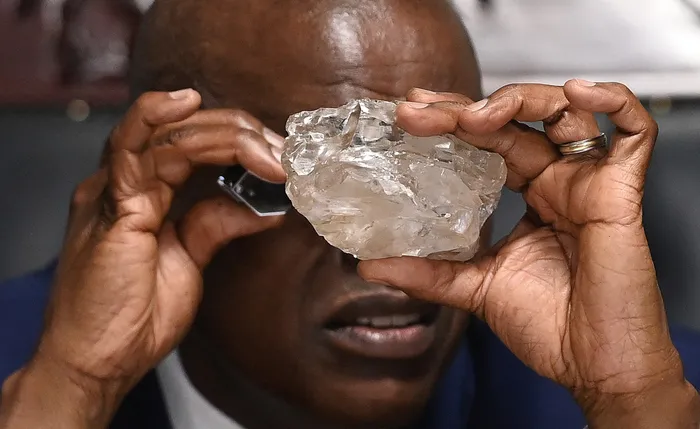
Unearthing the secrets of the Earth’s depths, researchers reveal the hidden origins of the world’s most extraordinary diamonds, creating potential pathways to discover more treasures beneath our feet.
Image: Monirul Bhuiyan / AFP
In a groundbreaking study, researchers from the University of Cape Town (UCT) have unveiled new insights into the enigmatic origins of the world's rarest and most coveted diamonds, known as Cullinan-like, large, inclusion-poor, pure, irregular, resorbed diamonds (CLIPPIRs).
This compelling research, conducted by the Kimberlite Research Group (KRG) in the Department of Geological Sciences, has been published in the esteemed journal Nature Communications.
The formation conditions for these exceptional gemstones have long puzzled geologists.
The study identified that kimberlites – volcanic rocks that sometimes host diamonds – carrying CLIPPIR diamonds sample unique, iron-rich domains located over 150 kilometres beneath the Earth’s surface.
This revelation stems from analysing the chemistry of olivine, a mineral found in these kimberlites, which has provided a crucial window into the deep mantle.
Collaboration with scientists from the Carnegie Institution for Science in Washington, D.C., and the China University of Geoscience in Beijing has further enriched this research.
Together, they discovered that these deep-seated, iron-rich environments exhibit distinct isotopic signatures indicative of hydrothermally altered oceanic crust. This crust, which had been subducted into the Earth’s depths, becomes part of the continent’s base through processes of buoyant mantle upwelling.
According to Associate Professor Geoffrey Howarth, lead author of the study, the interaction between rising kimberlitic melts and these iron-rich domains generates the significant olivine and garnet megacrysts that characterise kimberlites bearing CLIPPIR diamonds.
These precious diamonds crystallise within this unusual substrate under extreme pressures exceeding 11 GigaPascals (GPa), situated in the mantle transition zone.
But the significance of this discovery extends beyond deciphering the origins of diamonds.
The findings point to the widespread existence of isotopically anomalous iron-rich domains as a crucial source of geochemical diversity in volcanic rocks erupted on a global scale.
"These extraordinary diamonds – some of the largest and most valuable gems on Earth – have long been a mystery," Howarth explained.
"Our study shows that they grew in an unusual iron-rich environment deep beneath the continents, formed from ancient oceanic crust that was dragged down by subduction and then accreted at the base of the lithosphere. By reading the chemical fingerprints preserved in the mineral olivine brought up by kimberlite eruptions, we can now trace where these exceptional diamonds come from and how to find more of them.”
Follow Business Report on Facebook, X and on LinkedIn for the latest Business and tech news.