

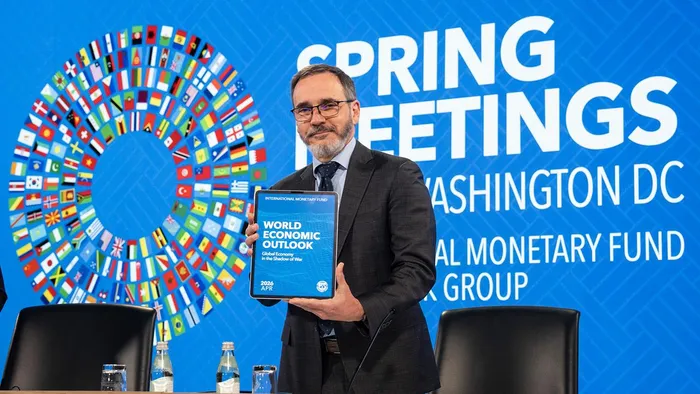
IMF chief economist Pierre-Olivier Gourinchas said they were seeing broad downgrade of growth and an uptick in inflation in a number of countries in the region.
Image: Supplied
The International Monetary Fund (IMF) has sharply downgraded South Africa’s economic growth forecasts for 2026 and 2027, warning that escalating conflict in the Middle East and resulting energy shocks are weighing on global and regional prospects.
In its April edition of the World Economic Outlook, the IMF revised South Africa’s growth projection for 2026 down to 1.0%, down from the 1.4% forecast in January. The outlook for 2027 was also lowered to 1.3%, compared with the previous estimate of 1.5%.
The downward revisions reflect mounting global uncertainty following the outbreak of war in the Middle East in late February, which has disrupted energy markets, driven up oil prices, and heightened inflationary pressures worldwide.
The war is a blow for South Africa's economy, which is forecast by the National Treasury and the SA Reserve Bank to move somewhat higher, approaching 2% over the medium term.
While the IMF in January expected the sub-Saharan Africa region as a whole to accelerate to 4.6% growth in 2026 and 2027, it downgraded the region's growth forecast by a cumulative 0.4 percentage point. The Fund now forecasts growth of 4.3% and 4.4% in the two years, respectively.
At the same time, inflation in the region is expected to rise significantly, with median inflation projected to increase from 3.4% in 2025 to 5% in 2026.
IMF chief economist Pierre-Olivier Gourinchas said they were seeing broad downgrade of growth and an uptick in inflation in a number of countries in the region.
"So the impact is very much along the lines of what we see more broadly, which is for a lot of countries, especially the ones that are energy importers. But they're also energy exporters in the region, and so there is some differentiation in terms of the impact," Gourinchas said.
IMF division chief for the research department, Deniz Igan, highlighted that the sub-Saharan Africa region had entered 2025 on relatively strong footing, supported by resilient global growth, firm non-oil commodity prices, and favourable financial conditions.
However, she said the war has reversed many of these gains.
"Now, with the war, we have reduced global growth and softened prices for non-oil commodities. And also worse in terms of trade for oil importers. And that's an important aspect for variation within the region as well. And on top of that, the region is also facing significant challenges from headwinds from declining foreign aid, which on bilateral aid cuts range from 16% to 28% in 2025," Igan said.
"At the same time, median inflation in sub-Saharan Africa is projected to go up from 3.4% in 2025 to 5% in 2026. And that's only reflecting the high oil and fertilizer prices, fuel shortages potentially, and rising borrowing costs. And fertilizer prices, in particular, are a concern for the region because of its dependence on agricultural products as well and existing level of food insecurity."
At a global level, the IMF now expects economic growth to reach 3.1% in 2026, down from 3.3% previously projected. The Fund noted that what had been a relatively resilient global recovery has been derailed by the conflict, with risks now firmly tilted to the downside.
Gourinchas said the war has significantly altered the global economic trajectory.
“The global economy was on a steady growth trajectory — around 3.3% in recent years — and we were looking to upgrade our projections. The war has stopped that momentum and we now project growth of 3.1% this year, with inflation rising to 4.4%, a sharp departure from the previous trend,” he said.
Gourinchas warned that the economic fallout would be uneven across countries, with emerging markets and commodity-importing economies among the hardest hit.
He explained that the shock is being transmitted through higher energy and food prices, persistent inflation pressures, and tightening financial conditions driven by weakened confidence.
“The impact will depend on the duration and scale of the conflict,” he added. “It will be highly uneven across countries, hitting commodity-importing low-income countries and emerging markets hardest.”
Gourinchas noted that the IMF is closely monitoring developments and coordinating with global institutions to assess emerging needs.
Looking ahead, the IMF stressed that policymakers face a delicate balancing act. Central banks must remain vigilant in tackling inflation while avoiding overly aggressive tightening that could stifle growth.
Fiscal policy, meanwhile, should remain targeted and prudent, focusing on supporting vulnerable populations without undermining macroeconomic stability.
BUSINESS REPORT