

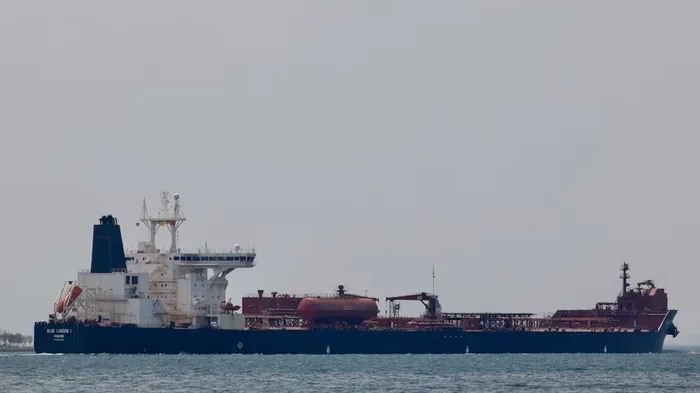
Before the outbreak of hostilities, roughly 20 million barrels per day (mb/d) of crude oil and petroleum products passed through the narrow waterway linking the Persian Gulf with global markets.
Image: File
Global oil markets are facing an unprecedented supply disruption, with millions of barrels of crude and refined fuels suddenly cut off from international markets following the outbreak of war in the Middle East, according to the latest report from the International Energy Agency (IEA).
In its Oil Market Report for March 2026 released on Thursday, the Paris-based energy watchdog said the conflict has triggered the largest supply shock in the history of the global oil market, primarily due to the near-collapse of tanker traffic through the vital Strait of Hormuz.
Before the outbreak of hostilities, roughly 20 million barrels per day (mb/d) of crude oil and petroleum products passed through the narrow waterway linking the Persian Gulf with global markets. But since the conflict escalated, flows have plunged to a trickle, leaving producers with limited options to move oil and forcing widespread production cuts.
The crisis began after joint air strikes by the United States and Israel on Iran on 28 February, triggering a regional conflict that has damaged energy infrastructure and disrupted shipping routes across the Gulf. With tanker movements largely halted and storage tanks rapidly filling up, Gulf oil producers have been forced to sharply reduce production.
The IEA estimates that at least 10 mb/d of oil output has been shut in, including around 8 mb/d of crude oil and a further 2 mb/d of condensates and natural gas liquids. It said the largest cuts are occurring in major exporting nations including Saudi Arabia, Iraq, Kuwait, Qatar and the United Arab Emirates.
As a result, global oil supply is expected to plunge by roughly 8 mb/d in March, the agency said.
Some of the losses are being partly offset by higher output from non-OPEC+ producers such as Kazakhstan and Russia, which have increased production after earlier disruptions this year.
Despite the immediate supply shock, the IEA still expects global oil supply to increase by around 1.1 mb/d on average during 2026, driven entirely by non-OPEC+ producers.
The disruption is not limited to crude oil production. The report said attacks on energy facilities and blocked export routes have forced refineries and gas processing plants across the Gulf to suspend operations.
More than 3 mb/d of refining capacity has already been shut down due to security risks and the inability to export products, while over 4 mb/d of refining capacity is considered at risk if the disruption persists.
In 2025, Gulf producers exported around 3.3 mb/d of refined petroleum products and 1.5 mb/d of liquefied petroleum gas (LPG). With exports now largely halted and storage tanks filling rapidly, refineries are being forced to cut processing runs or close completely.
The IEA warned that diesel and jet fuel markets are particularly vulnerable if the loss of Middle Eastern supply continues, as spare refining capacity elsewhere is limited. The sudden supply shock has triggered sharp price volatility in global energy markets.
Benchmark Brent crude prices surged close to $120 per barrel in the days following the outbreak of hostilities. Prices have since eased somewhat but were still trading around $92 per barrel, roughly $20 higher than a month earlier, reflecting ongoing uncertainty about the duration of the conflict.
The IEA noted that oil prices have “gyrated wildly” as markets respond to shifting news about military developments and shipping disruptions. The conflict is also affecting oil demand.
Widespread flight cancellations across the Middle East have reduced global jet fuel consumption, while disruptions to LPG and naphtha supplies are forcing petrochemical producers to scale back operations.
As a result, the IEA has lowered its forecast for global oil demand growth. Oil consumption is now expected to increase by 640,000 barrels per day in 2026, down 210,000 barrels per day from the agency’s previous projection.
Demand in March and April alone is expected to fall by about 1 mb/d compared with earlier forecasts.
In response to the crisis, member countries of the IEA agreed on Wednesday to release 400 million barrels of oil from emergency reserves to help stabilise global markets.
Global oil inventories currently stand at about 8.2 billion barrels, the highest level since early 2021. Around half of these stocks are held in member countries of the Organisation for Economic Co-operation and Development, including about 1.25 billion barrels held by governments for emergency use.a
The coordinated stock release is intended to provide a temporary buffer against the supply shock. However, the IEA warned that emergency reserves are only a short-term solution.
BUSINESS REPORT