

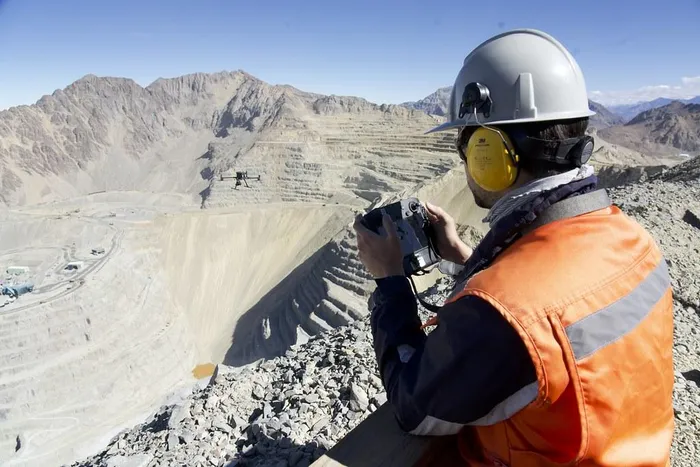
Anglo American, through its 50.1%-owned subsidiary, Anglo American Sur S.A. (AAS), and Codelco announced on Wednesday they had completed an agreement to implement a joint mine plan for their respective Los Bronces and Andina copper mines in Chile.
Image: Supplied
Anglo American and Codelco have completed the Los Bronces - Andina agreement, paving the way for 2.7 million tons of additional copper production - environmental permits are still outstanding.
Anglo American, through its 50.1%-owned subsidiary, Anglo American Sur S.A. (AAS), and Codelco announced on Wednesday they had completed an agreement to implement a joint mine plan for their respective Los Bronces and Andina copper mines in Chile. The country is the world’s top producer of copper, accounting for about 24% of global output.
Anglo American said implementation of the joint mine plan remains conditional on securing the relevant environmental permits, along with other customary conditions for final implementation, which is currently expected by 2030.
A month ago, uncertainty arose regarding one of the world’s biggest copper operations when the Chilean environmental court annulled a permit for a desalination plant on the $3.2 billion expansion of the Collahuasi copper mine, citing concerns over impacts on indigenous communities and the marine environment. Collahuasi is jointly owned by Anglo American and Glencore.
“The next important milestone for Los Bronces - Andina is the timely receipt of the permits, which will allow us to begin delivering the additional volume and value that we are targeting, for the benefit of all our stakeholders and for Chile,” said Anglo American’s CEO Duncan Wanblad on Wednesday in a statement.
"By integrating the Los Bronces and Andina mine plans, we are unlocking one of the most significant copper adjacency opportunities in the world. Our agreement with Codelco demonstrates what is possible when we work in partnership to unlock compelling industrial synergies—delivering significant value and more copper tons for both companies and for Chile,” said Wanblad.
The project has also received the required competition and regulatory approvals, along with the fulfilment of conditions precedent to the deal. The agreement was initially signed and announced by Anglo American and Codelco in September last year.
The joint mine plan is expected to unlock 2.7 million tons of additional copper over a 21-year period, delivering an average of 120,000 tons a year of additional low-cost copper production, to be shared equally, with minimal capital investment.
This was anticipated to create at least $5 billion pre-tax in shared additional value.
"Adjacencies such as these are rare, and they highlight the role that responsible, partnership-led development can play—in this case supporting Chile's ambition to lift national copper production to 6 million tons per year by 2030," said Wanblad.
Codelco chairman Bernardo Fontaine said that the agreement was a more efficient and responsible way to develop one of the world's leading copper districts.
“It allows us to make better use of existing infrastructure, capture greater benefits for Chile, and move forward with a long-term vision based on operational excellence, sustainability, and the responsible use of resources,” he said.
He added that the Andina–Los Bronces Joint Mine Plan reflected the principles that guide Codelco: safety; maximising returns to the State while ensuring operations remain profitable without increasing debt; putting the house in order with firm leadership and transparency; and strengthening sustainability.
In terms of the agreement Anglo American and Codelco will maintain the flexibility to develop their own standalone projects, including the advancement of their respective underground resources, during the term of the joint mine plan.
The companies have also established principles to guide the implementation of the joint mine plan, including sustainability principles that safeguard both social programs and adherence to existing environmental commitments.
The Baker Institute for Public Policy noted that, based on the social responsibility reports and annual reports of companies mining in Chile, persistent issues include water scarcity in the Atacama Desert, cultural heritage protection, environmental degradation, and concerns over long-term impacts on salt flats, distribution of economic benefits especially for remote communities, and legal disputes and appeals through environmental tribunals.
This made robust engagement and transparent governance essential for long-term project viability, the institute said.
BUSINESS REPORT