

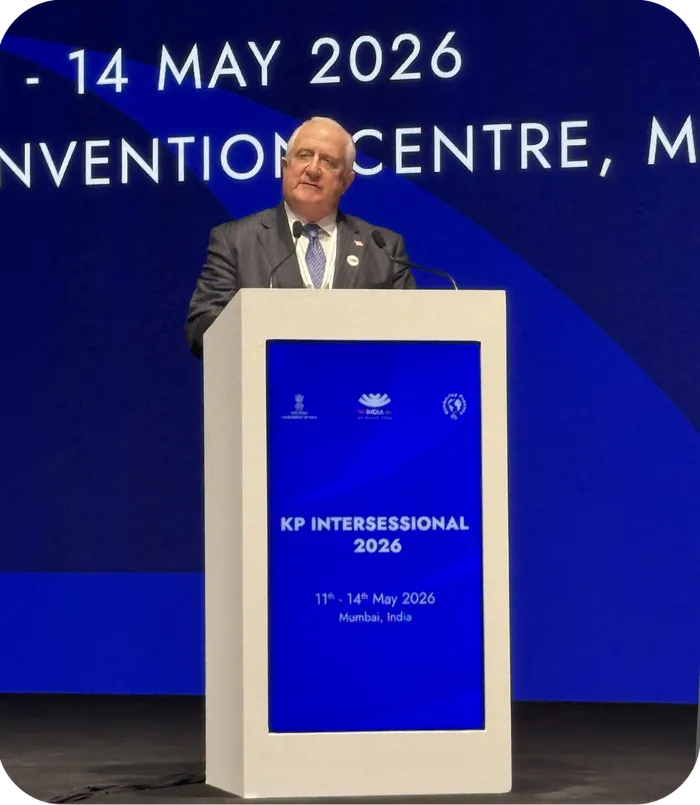
WDC President Ronnie VanderLinden addressing the Opening Session of the Kimberley Process Intersessional Meeting in Mumbai, India, on Monday.
Image: Supplied
The global diamond industry must unite behind a single message promoting natural diamonds and urgently modernise the definition of “conflict diamonds” if it hopes to maintain consumer confidence in a rapidly changing market, Ronnie VanderLinden said on Monday.
Addressing the opening of the 2026 Kimberley Process intersessional meeting in Mumbai, India, the World Diamond Council president warned that the natural diamond sector was under mounting pressure from shifting consumer sentiment and the rise of lab-grown diamonds.
The global diamond industry has been struggling, with major producers affected by falling prices of the precious stones. Companies such as Anglo American are are proceeding to dispose of their diamond operations such as De Beers, leaving producing countries such as Botswana scrambling for a way forward.
“We are here for one reason. To be the champion for the natural diamond trade,” VanderLinden told delegates attending the Kimberley Process meeting.
“To build confidence in that trade with one voice. And to help sell natural diamonds to people who love them – who are proud of where the natural diamonds they buy come from.”
The Kimberley Process was established in 2003 to prevent the trade in conflict diamonds, commonly referred to as “blood diamonds”, which have historically funded rebel movements and armed conflicts in parts of Africa.
VanderLinden said the industry now faced a more complicated environment, where consumers increasingly demanded transparency, traceability and proof of social impact from the products they purchase.
“Demand for natural diamonds is under pressure. People are hearing too many different messages. And lab-grown, synthetic diamonds have changed the conversation,” he said.
He stressed that the industry needed to focus less on internal processes and more on convincing consumers of the enduring value of natural diamonds.
“We can talk about governance. We can talk about process. But if we are not supporting the trade and helping to sell natural diamonds, we are missing the point,” VanderLinden said.
According to VanderLinden, restoring consumer confidence requires the industry to clearly demonstrate the origin and broader economic contribution of natural diamonds.
“We have to show where they come from. We have to show how they move through the pipeline. And we have to show what they do. The jobs they create. The communities they support. The countries they help build,” he said.
A major theme of the speech was the need to reform the Kimberley Process definition of conflict diamonds, which critics argue no longer reflects modern geopolitical realities or contemporary forms of violence linked to mineral extraction.
The World Diamond Council, industry representatives and some civil society groups have for several years pushed for the definition to be broadened beyond diamonds linked solely to rebel movements fighting legitimate governments.
VanderLinden said significant progress had been made during the most recent three-year review and reform process, but member states ultimately failed to finalise changes to the definition.
“We must not wait for the next review and reform window,” he said. “We must pick up where we left off in November and get back to work on changing the definition of a conflict diamond now.”
He added that the world and the diamond industry had evolved considerably since the Kimberley Process was first established.
“The world has changed. The industry has changed. Our definition needs to reflect that. We all know it,” VanderLinden said.
At the same time, he cautioned that reform efforts should not undermine the commercial viability of the natural diamond trade.
“We need to do it in a way that supports the trade. Not a way that distracts from it,” he said.
VanderLinden also called for stronger institutional support for the Kimberley Process itself, including a more robust funding model for its secretariat to ensure it can effectively carry out its work.
“The Kimberley Process needs a Secretariat that is supported. That means a clear and robust funding model,” he said.
He also urged governments, industry and civil society organisations involved in the Kimberley Process to work together in defence of the natural diamond market.
“The Kimberley Process is government, industry and civil society. We are three. But we must act as one,” VanderLinden said.
BUSINESS REPORT