

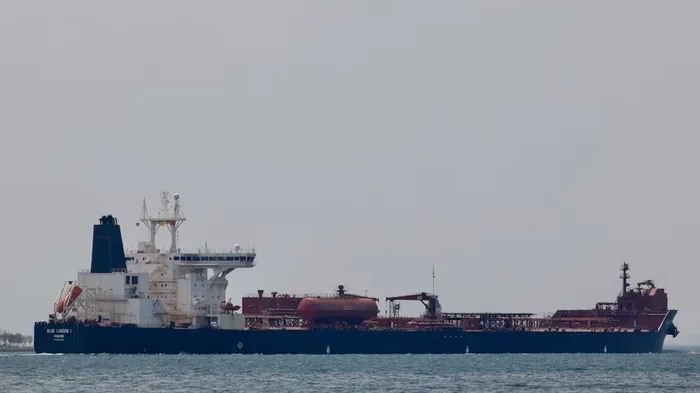
Although global oil markets currently have some buffers, Moody's said a sustained interruption to maritime traffic would likely drive a significant rise in energy prices, increasing operating costs for industries that depend heavily on fuel and electricity.
Image: File
A prolonged disruption to Middle Eastern energy flows could ripple through multiple global industries, raising financing risks for companies and putting pressure on sectors ranging from aviation and logistics to manufacturing, according to a new report by Moody’s.
The ratings agency on Thursday said the credit impact of the escalating conflict involving Iran will largely depend on how long shipping through the strategically vital Strait of Hormuz remains disrupted and whether energy supplies can be maintained through alternative routes.
Although global oil markets currently have some buffers, Moody's said a sustained interruption to maritime traffic would likely drive a significant rise in energy prices, increasing operating costs for industries that depend heavily on fuel and electricity.
Moody’s noted that the most immediate risks would emerge in energy-intensive sectors across Europe and Asia, particularly companies with limited ability to pass higher costs on to customers or those facing near-term refinancing needs.
"Our baseline scenario is that the conflict is relatively short-lived, likely a matter of weeks, and that navigation through the Strait of Hormuz will then resume at scale. This scenario is unlikely to result in meaningful credit impact on the issuers we rate," reads the report.
"But any lengthy disruption to the Strait of Hormuz would drive a sustained rise in oil prices, deepen global risk aversion and likely generate wider credit-spread pressure across high-yield markets."
Among the industries most exposed to operational disruption are aviation, tourism and logistics, where restrictions on Middle Eastern airspace and heightened security concerns could reduce travel demand and disrupt international supply chains.
Major aviation hubs in the Gulf, including Dubai, Doha and Manama, are particularly vulnerable because their global connectivity depends on open airspace and stable regional conditions.
If conflict escalates further or retaliatory strikes target commercial infrastructure, Moody's said confidence in these travel hubs could weaken significantly. That would affect airlines, airport operators and tourism businesses that rely heavily on transit passengers and international visitors.
Shipping and logistics operators also face potential disruption as insurers withdraw coverage from high-risk maritime routes, particularly around the Strait of Hormuz — one of the world’s most important energy corridors.
The report noted that maritime traffic in the strait has already slowed sharply as shipping companies reassess risk exposure, creating uncertainty for global energy supply chains and trade flows.
Energy-related infrastructure and port operators in the region could face operational and financial strain if maritime flows remain constrained for an extended period.
Ports that depend entirely on access through the Strait of Hormuz are especially exposed.
Moody’s said an extended closure would be credit-negative for UAE-based port operators such as DP World and Abu Dhabi Ports Company PJSC because trade volumes would decline if shipping routes are disrupted.
However, the ratings agency added that geographic diversification across international terminals could soften the blow by allowing operators to rely more heavily on assets outside the Gulf.
Infrastructure projects linked to pipelines, liquefied natural gas terminals and energy transport networks could also face operational challenges if the conflict intensifies, Moody's said.
Many large infrastructure projects are structured under project-finance frameworks that include force majeure protections. The report said these provisions can help shield investors and lenders from short-term cash-flow shocks, even in cases where physical infrastructure is damaged or temporarily shut down.
While the first round of economic effects is likely to hit trade-exposed industries, Moody’s said the financial sector could experience second-round impacts if the conflict drags on.
Moody's said banks would be indirectly affected by weaker economic activity, reduced investor confidence and potential liquidity pressures in markets sensitive to geopolitical developments.
Financial systems that rely heavily on foreign deposits or international capital flows could be particularly vulnerable if geopolitical tensions trigger capital outflows or a broader repricing of risk.
Insurance companies, meanwhile, are unlikely to face significant underwriting losses because war risk is typically excluded from standard policies.
However, Moody's said they could still experience market-related losses if regional asset prices decline, particularly in real estate or equity markets exposed to tourism and energy exports.
Not all industries would be negatively affected. Moody’s noted that defence contractors and energy producers with diversified export routes could benefit from the geopolitical turmoil.
Higher oil prices would strengthen revenues for many energy exporters, while increased military spending could boost demand for defence equipment and services.
BUSINESS REPORT