

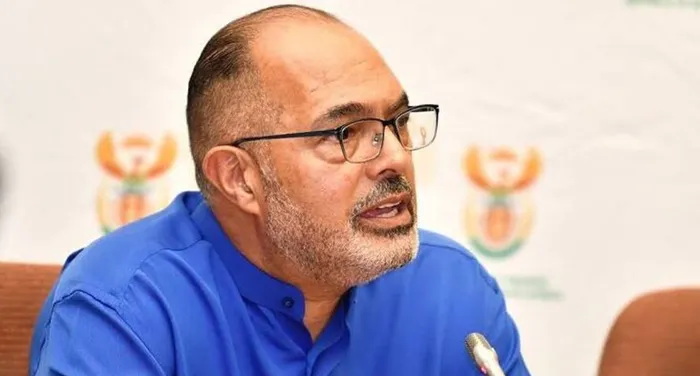
Addressing a joint meeting of the Standing and Select Finance and Appropriations Committees on Friday, SARS Commissioner Edward Kieswetter responded by acknowledging broad agreement on the need for a far more coordinated national effort.
Image: File
The South African Revenue Service (SARS) has laid out an ambitious, system-wide plan to tackle the country’s ballooning illicit economy after ActionSA MP Alan Beesley warned in Parliament that the revenue authority remains underfunded and unable to fully confront organised criminal networks.
Beesley on Friday argued that illicit trade had become “a cancer” on the economy, warning that South Africa was moving from “stage one to stage two” of a crisis that could soon spiral beyond control.
He called for an urgent, integrated response and proposed a discussion between the Finance Minister, National Treasury and SARS to address funding constraints. According to Beesley, strengthening SARS could be done without worsening pressure on the fiscus.
Addressing a joint meeting of the Standing and Select Finance and Appropriations Committees on Friday, SARS Commissioner Edward Kieswetter responded by acknowledging broad agreement on the need for a far more coordinated national effort.
He revealed that the illicit economy has grown significantly over the past two decades, faster than the formal economy, expanding from around 5% of GDP to between 12% and 15% today.
In rand terms, Kieswetter estimated the size of the illicit economy at between R800 billion and R1.2 trillion. He said the tax revenue forfeited as a result is believed to be between R200bn and R300bn annually.
“There is a strong business case to do better,” he told MPs.
While SARS has recorded notable successes over the past five years in dismantling elements of complex syndicated crime, Kieswetter said fragmented mandates across departments have undermined overall progress.
“Each department is pursuing its narrow mandate, often with perverse incentives,” he said, noting the absence of a national dashboard to measure whether the country is making real progress against organised crime and illicit trade.
At the heart of SARS’s proposal is the establishment of a National Illicit Economic Disruption Programme, to be led by President Cyril Ramaphosa.
Kieswetter argued that only a President-led initiative would have the authority to hold multiple ministers accountable and ensure proper coordination across government departments.
The second pillar involves strengthening inter-agency collaboration through the creation of a dedicated command centre and collaboration platform. Kieswetter distinguished this from the existing Fusion Centre, which he suggested exists largely in theory rather than practice.
A third intervention would focus on targeting high-risk value chains, both at the border and within the domestic economy. SARS proposes beginning with tobacco, fuel and alcohol, sectors long identified as major revenue leakages.
The tobacco sector illustrates the scale of the challenge. Industry estimates indicate that roughly three out of four cigarettes sold in South Africa are illicit. With legitimate manufacturers required to pay at least R26.22 in excise tax per pack, they struggle to compete with smuggled cigarettes retailing for as little as R10 to R20. Annual tax losses in tobacco alone are estimated at between R18bn and R28bn.
Illicit alcohol is also surging, accounting for nearly 20% of total consumption and costing the fiscus at least R16bn in lost revenue annually. Beyond lost taxes, unregulated products pose serious public health risks.
To prevent enforcement efforts from being bogged down in lengthy legal battles, SARS is proposing the creation of dedicated prosecution teams and specialised courts to fast-track illicit economy cases. Currently, seizures often become entangled in protracted litigation, creating uncertainty and undermining deterrence.
The fifth intervention centres on scaling up investment in technology, data science and artificial intelligence. Kieswetter said SARS’s own modernisation efforts demonstrate how data-driven approaches can significantly enhance enforcement capacity. The plan is to extend these capabilities across the broader security and justice cluster.
Crucially, SARS is also proposing a shift in how capital budgets are allocated. Instead of dispersing funds across departments for isolated projects, resources would be assigned to clearly defined systemic fixes.
“So we're proposing that in the future, money is allocated to a project, for example, fix the border line between South Africa and Mozambique, including the port. Then when we walk away in three years time, we know that we've actually fixed something substantially, but also demonstrated the proof-of-concept of what a smart modern border would look like in the future,” Kieswetter said.
“But it's going to require a fundamentally different approach to how we organize ourselves and a fundamentally different approach to how resources are allocated.”
Government has increasingly framed the fight against organised crime as central to economic recovery. Minister in the Presidency Khumbudzo Ntshavheni on Thursday emphasised that dismantling criminal networks is essential to restoring investor confidence and protecting jobs.
BUSINESS REPORT