

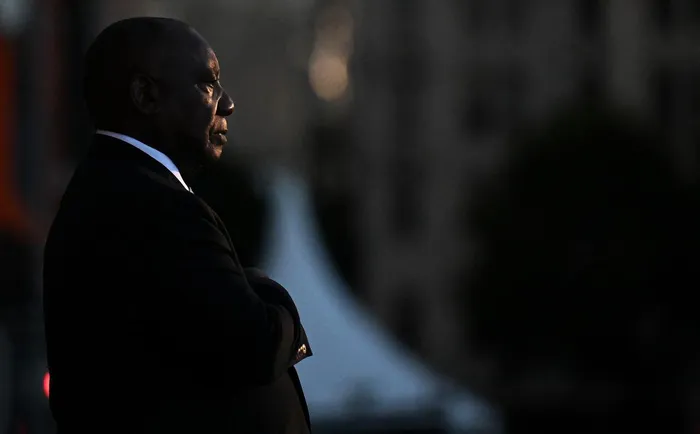
President Cyril Ramaphosa delivered the 2026 State of the Nation Address (SONA) on Thursday night in Parliament.
Image: Phando Jikelo / Parliament of SA
President Cyril Ramaphosa has announced sweeping reforms to South Africa’s energy and logistics sectors, including the establishment of an independent state-owned transmission company, new private investment in the national grid and plans to introduce high-speed rail corridors.
Delivering the 2026 State of the Nation Address (SONA) on Thursday night in Parliament, Ramaphosa said government is determined to create a competitive electricity market and reduce the country’s reliance on a single energy supplier.
“We are now establishing a level playing field for competition so that we are never again exposed to the risk of relying on a single supplier to meet our energy needs,” he said. "By 2030, more than 40% of our energy supply will come from cheap, clean, renewable energy sources."
Central to this reform is the restructuring of Eskom, whose unbundling into three units has faced multiple delays, and the creation of a fully independent state-owned transmission entity.
The new entity will own and control transmission assets and operate the electricity market, separating it from generation and distribution functions.
To fast-track the process, Ramaphosa has established a dedicated task team under the National Energy Crisis Committee, which was established to deal with the load shedding crisis.
Ramaphosa said that the team, comprising the Ministers of Electricity and Energy, Finance, the Presidency and others, will develop clear proposals and timelines for the phased implementation of the restructuring.
“This task team will report to me within three months,” Ramaphosa said.
In addition, Ramaphosa said the government will launch the first round of independent transmission projects this year to attract private investment into expanding the national grid. He said there has already been “tremendous interest” from investors in transmission infrastructure.
"We will work in each province to address transformer overloading, illegal connections and equipment failure with the objective of eradicating load reduction by next year. We are committed to the path that we have embarked upon to modernize our energy system," Ramaphosa said.
Turning to logistics, Ramaphosa noted improvements in rail and port performance, alongside reforms allowing private rail operators to access the national network on a concessionary basis. This is aimed to enable competition among rail companies and help shift freight volumes from road to rail.
Later this year, Ramaphosa said, major public-private partnerships will be initiated in port terminals and rail corridors under concession models that preserve state ownership while mobilising private capital and expertise.
"Last month, we concluded a partnership with an international port operator to manage the Durban Pier 2 Container Terminal, the largest in our country. This partnership will result in new investment in equipment and infrastructure at the port and will bring it back to world-class standards," he said.
Ramaphosa also confirmed ongoing preparations for high-speed rail in South Africa, a long-standing commitment, with initial proposed routes linking Johannesburg to Musina and eThekwini to Johannesburg.
“In my book, it should no longer take five to six hours to travel from eThekwini to Johannesburg,” he said, arguing that modern rail systems globally have dramatically reduced travel times.
Ramaphosa said nearly 30 companies responded to last year’s Request for Information on high-speed rail corridors, however, government is now preparing to issue a formal Request for Proposals.
"We are preparing to send out a Request for Proposals, which will introduce a new era of long-distance rail travel in South Africa at a faster pace. We are determined to compete in a rapidly changing global economy," he said.
Beyond infrastructure, Ramaphosa outlined an industrial and trade strategy aimed at strengthening competitive sectors, protecting jobs and expanding exports in a volatile global economy.
He said government is working to revive the ferrochrome industry and protect jobs in steel, automotive and other manufacturing sectors, while also focusing on future growth areas such as agriculture, mining, services and the green economy.
Ramaphosa's speech was heavy on interventions in dealing with the water supply crisis currently gripping the country's largest metros, as well as measures to eradicate the Foot-and-Mouth Disease outbreak that is crippling the agricultural industry.
"We have committed more than R156 billion in public funding for water and sanitation infrastructure alone over the next three years," he said.
"Where municipalities fail, we will strengthen the ability of national government to intervene more quickly and to direct corrective measures in the interests of serving our people better."
BUSINESS REPORT