

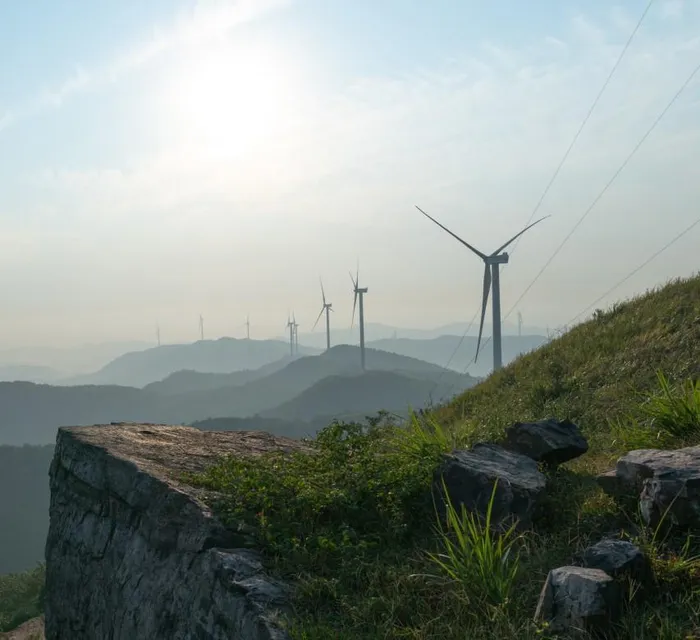
The green economy refers to commercial solutions with a clear environmental purpose or solutions that are a direct response to environmental challenges. This covers both mitigation and adaptation and resilience, from advanced clean technologies to nascent agri-tech solutions.
Image: Supplied
A new report released by the World Economic Forum (WEF) in collaboration with Boston Consulting Group (BCG) shows that businesses across multiple sectors are reaping the benefits of the rapidly expanding green economy, now the world’s second-fastest growing market after technology.
The report titled "Already a Multi-Trillion-Dollar Market: A CEO Guide to Growth in the Green Economy", reveals that the global green economy has already reached an annual value of $5 trillion and is projected to exceed $7trln before 2035.
In this report, the green economy refers to commercial solutions with a clear environmental purpose or solutions that are a direct response to environmental challenges. This covers both mitigation and adaptation and resilience, from advanced clean technologies to nascent agri-tech solutions.
Despite global economic uncertainty and uneven policy environments, investment in green technologies continues to soar.
According to the report, the green economy has become a major driver of growth, offering businesses competitive advantages ranging from faster revenue expansion to improved investor confidence.
“Two years ago, in the World Economic Forum’s Winning in Green Markets, we argued that pioneering in green markets is a bet that would pay off and that large-scale green markets would become a reality proving the business case,” said Pim Valdre, head of climate and nature economy at the WEF.
“Despite the current headwinds for global climate action, this report shows that the green economy is not a distant opportunity but already a major growth engine of this decade.”
The findings show that companies generating significant green revenues often outperform traditional business lines. On average, green revenue growth is double that of conventional operations.
These companies also benefit from lower capital costs, while those deriving more than half their revenue from green markets enjoy valuation premiums of 12% to 15%, underscoring investor confidence in their long-term resilience.
A major driver of this momentum has been the dramatic decline in the cost of clean technologies. Since 2010, solar photovoltaic prices and lithium battery costs have fallen by approximately 90%, while offshore wind costs have dropped 50%.
The report estimates that 55% of global emissions reductions needed for decarbonization can already be achieved using cost-competitive solutions. Another 20% can be tackled with only minor premium costs, while 5% depend on behavioural changes.
However, the remaining 20% of deep decarbonization technologies still face steep cost barriers and will require strong policy and industry support.
China continues to dominate clean-energy investment and deployment, reshaping global supply chains in the process. The report highlights that China invested $659 billion in clean energy in 2024 alone, and is expected to account for more than 60% of new global renewable capacity through 2030. It also leads globally in patents related to solar power, electric vehicles and battery technologies.
The report includes 14 case studies from companies within the WEF’s Alliance of CEO Climate Leaders, outlining strategies that have allowed businesses to gain competitive edges in green markets. A CEO playbook further identifies key accelerators for growth, including scaling emerging technologies, influencing regulatory environments and unlocking innovative financing.
Patrick Herhold, managing director and Senior Partner at BCG, said the growth trajectory should motivate firms to act decisively.
“Three things are striking: the resilience of the green economy, with investments in green technologies jumping from record to record against a change in public headlines and sentiments; China's leadership in manufacturing, innovation and deployment of green technologies; and the opportunity for companies operating in green markets to outperform and earn a premium in capital markets,” he said.
“With projections to become a $7trln market, there will be many more opportunities for companies that act boldly today.”
BUSINESS REPORT