

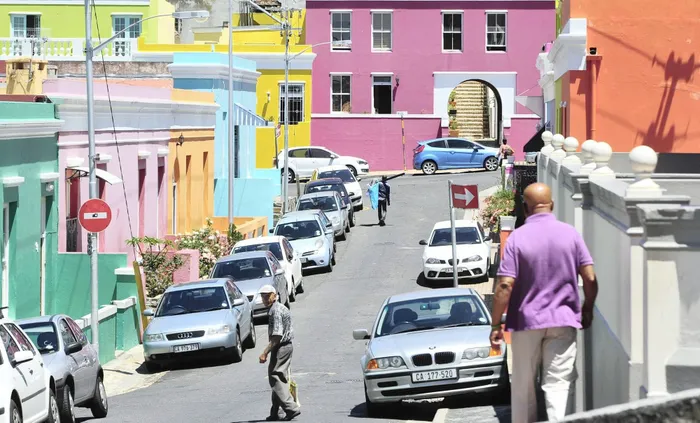
Bo-Kaap residents accuse BKYM of siding with property developer Blok on contested building project. Picture: Henk Kruger/African News Agency (ANA) Expanding finance options for lower- and middle-income buyers, reducing the deposit barrier and supporting developments in areas where young households can realistically live close to work, transport and services would resolve this youth property ownership challenge.
Image: Henk Kruger
Homeownership by young people in South Africa is some distance away from ideal levels.
The decline from around 40% youth participation in 2014 to 30% in 2025 shows that the market is moving away from younger ownership rather than towards it, says Hayley Ivins-Downes, the Managing Executive of Real Estate at Lightstone Property.
To move closer to the ideal state, she says the country would need better-located affordable supply, broader finance innovation, improved income growth, lower transaction friction, and stronger support for first-time buyers.
“The focus should be on practical access rather than aspiration alone,” Ivins-Downes told "Independent Media Property".
As the country marks 50 years of the 1976 Youth Uprising, Lightstone Property says South Africa’s youth property ownership is currently under pressure, with young people entering the market later and representing a smaller share of residential property buyers than they did a decade ago.
The information, valuations and market intelligence on properties in South Africa says the current picture is that affordability, access to finance, income pressure and lifestyle shifts are delaying their entry into the market.
It says that their data shows that buyers aged 18 to 35 declined from 40% of natural-person buyers in 2014 to 30% in 2025, while the absolute number of buyers in this group fell from about 72,000 to 47,000 over the same period.
A Lightstone workbook shows a similar trend for non-subsidised transactions: buyers aged 35 and younger accounted for 44.5% of non-subsidised purchases in 2005, 39.7% in 2015 and 30.5% in 2025.
Youth property demand exists, but the ability to convert that demand into ownership is constrained.
The managing executive says what stands out most is that the low youth property ownership levels in SA is both a volume story and an access story. Ivins-Downes says says Lightstone’s 2024 analysis showed that young buyers aged 20 to 35 still accounted for 30% of residential property purchases and that 69% of youth buyers were first-time buyers.
She says this indicates that youth demand exists, but the ability to convert that demand into ownership is constrained.
“Another important highlight is the shift in the profile of young ownership. There is a growing divide in which formal mortgage finance continues to serve middle-to upper-income buyers, while the largest and more affordable segment remains underfunded.”
According to Lightstone Property improving access to affordable entry-level stock, expanding finance options for lower- and middle-income buyers, reducing the deposit barrier and supporting developments in areas where young households can realistically live close to work, transport and services would resolve this youth property ownership challenge.
The provider says there is also a need to make the buying journey easier for first-time buyers.
It says many young people may be able to afford a monthly repayment but struggle with deposits, transfer costs, credit history requirements or uncertainty about the process.
“Solutions could include more targeted first-time buyer education, clearer pathways to subsidy-linked or blended finance, and stronger collaboration between developers, banks, government and data providers.”
If this is not addressed, Ivins-Downes says South Africa risks creating a larger permanent renter class, with more young households unable to build housing wealth.
She says this would affect intergenerational wealth creation, reduce social mobility and weaken the future base of the residential property market.
“Over time, fewer first-time buyers also means fewer move-up buyers later, which can reduce transaction volumes and limit market depth.”
In March, around 1 000 young people from Soweto gathered at Property Point’s Real Estate Incubator Programme roadshow to learn how to find jobs and opportunities in South Africa’s real estate sector.
The event held at Safe Hub in Jabulani was designed to help young people enter the property industry by connecting them with information, support, and application opportunities.
At a time when millions of young South Africans remain excluded from formal economic opportunity, the strong turnout underscored both the demand for practical pathways into work and the growing interest among young people in entering the property sector.
According to the Quarterly Labour Force Survey (QLFS) by Statistics South Africa (StatsSA),South Africa’s working-age population stood at 42.2 million individuals aged 15-64 in the first quarter of 2026, up by 121 000 compared to the last quarter of 2025.
The statistical agency says this represents the backbone of South Africa’s economy, yet its true potential is concentrated in a notably young demographic. It said that of the 42.2 million individuals in the working-age population, 21.0 million (i.e. 49.7%) were aged 15-34 years.
“Despite their large share of the population, youth labour market outcomes remain unfavourable. In Q1:2026, 5.6 million young people aged 15-34 were employed, while 4.7 million were unemployed and the remaining 10.6 million were outside the labour force.”
While the national unemployment rate stood at 32.7% in Q1:2026, the burden was disproportionately carried by the youth, with those aged 15-24 facing the highest unemployment rate at 60.9%, followed by those aged 25-34 at 40.6%, said Stats SA.
“Too many young people still see the property sector as something that is out of reach,” said
Shawn Theunissen, Founder of Property Point then. “The response in Soweto showed just how much appetite there is for real opportunity when access is brought closer to the community. What we saw was energy, ambition and a clear willingness from young people to step forward and explore a future in the industry.”
The Real Estate Incubator Programme is focused on helping young South Africans overcome common barriers to entry into the property sector by connecting them to skills development, mentorship, industry exposure and practical support.
Independent Media Property