

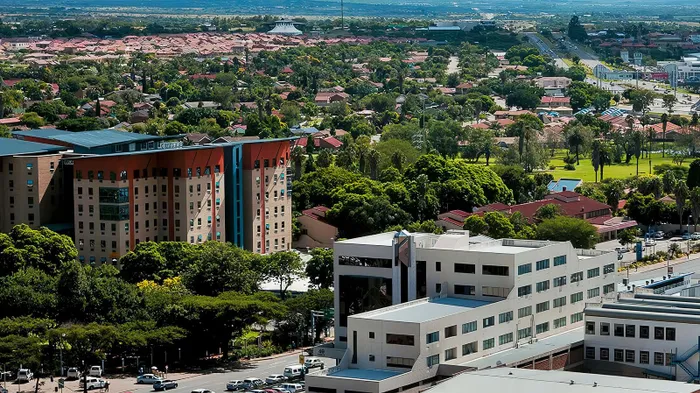
Limpopo's capital city, Polokwane.
Image: Wikimedia Commons
If residential property were treated like a unit trust, some homeowners would have enjoyed returns that many investors would envy over the past year.
New data from Statistics South Africa's Residential Property Price Index shows national house prices rose 7.8% in the year to January 2026, but the gains were far from evenly distributed.
If homes were ranked like unit trusts, some of the country's best-performing investments over the past year would have been found in Limpopo, Mpumalanga and the Northern Cape rather than the traditional property hotspots.
The biggest winner was not Cape Town, Johannesburg or Pretoria. It was Limpopo.
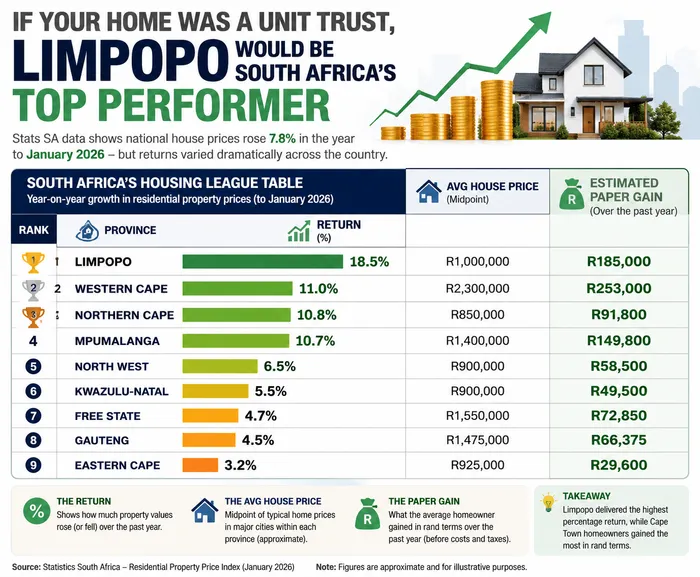
House prices in the province surged 18.5% over the year, making it South Africa's best-performing residential property market. This, however, does assume that your house price actually gained at that pace.
The picture changes when actual property values are considered.
While Limpopo delivered the strongest provincial growth rate, the Western Cape remained the biggest driver of South Africa's overall residential property market. According to Statistics South Africa, the province recorded annual house-price inflation of 11%.
An average Cape Town home is worth substantially more than a typical property elsewhere in the country. Using an indicative average value of R2.3 million, a Western Cape homeowner would have added about R253,000 in paper wealth over the year.
By comparison, a typical R1 million property in Polokwane would have gained around R185,000 despite generating the country's best percentage return.
In investment terms, Limpopo delivered the highest return, while Cape Town generated the biggest rand gains.
House price inflation at a glance.
Image: ChatGPT
The Statistics South Africa data also reveals a group of markets quietly outperforming South Africa's major metros.
Northern Cape property values climbed 10.8%, while Mpumalanga recorded growth of 10.7%. Those gains comfortably outpaced Gauteng's 4.5% growth rate and were more than double the increase recorded in the Eastern Cape.
For years, the property conversation has been dominated by Cape Town and semigration. The latest numbers suggest some of the strongest returns are increasingly being found in places that attract far less attention from investors.
At the other end of the table, Eastern Cape homeowners saw average values rise by just 3.2%, while Gauteng recorded 4.5% growth and the Free State 4.7%. That means a homeowner in Limpopo enjoyed a return more than four times greater than one in the Eastern Cape.
The data also points to a widening divide between different segments of the housing market. Properties being sold for the first time recorded annual growth of just 2.0%, while resold properties increased by 7.6%. That suggests existing homeowners benefited far more from the market's recovery than buyers entering the market for the first time.
Freehold homes continued to outperform sectional-title properties. Freehold properties recorded annual growth of 9.9% in January 2026, compared with 5.5% for sectional-title properties such as apartments and townhouses. The gap suggests buyers remain willing to pay a premium for larger properties despite ongoing affordability pressures.
IOL BUSINESS